What AI’s promise of perfect satisfaction misses about desire
By Travis Alexander
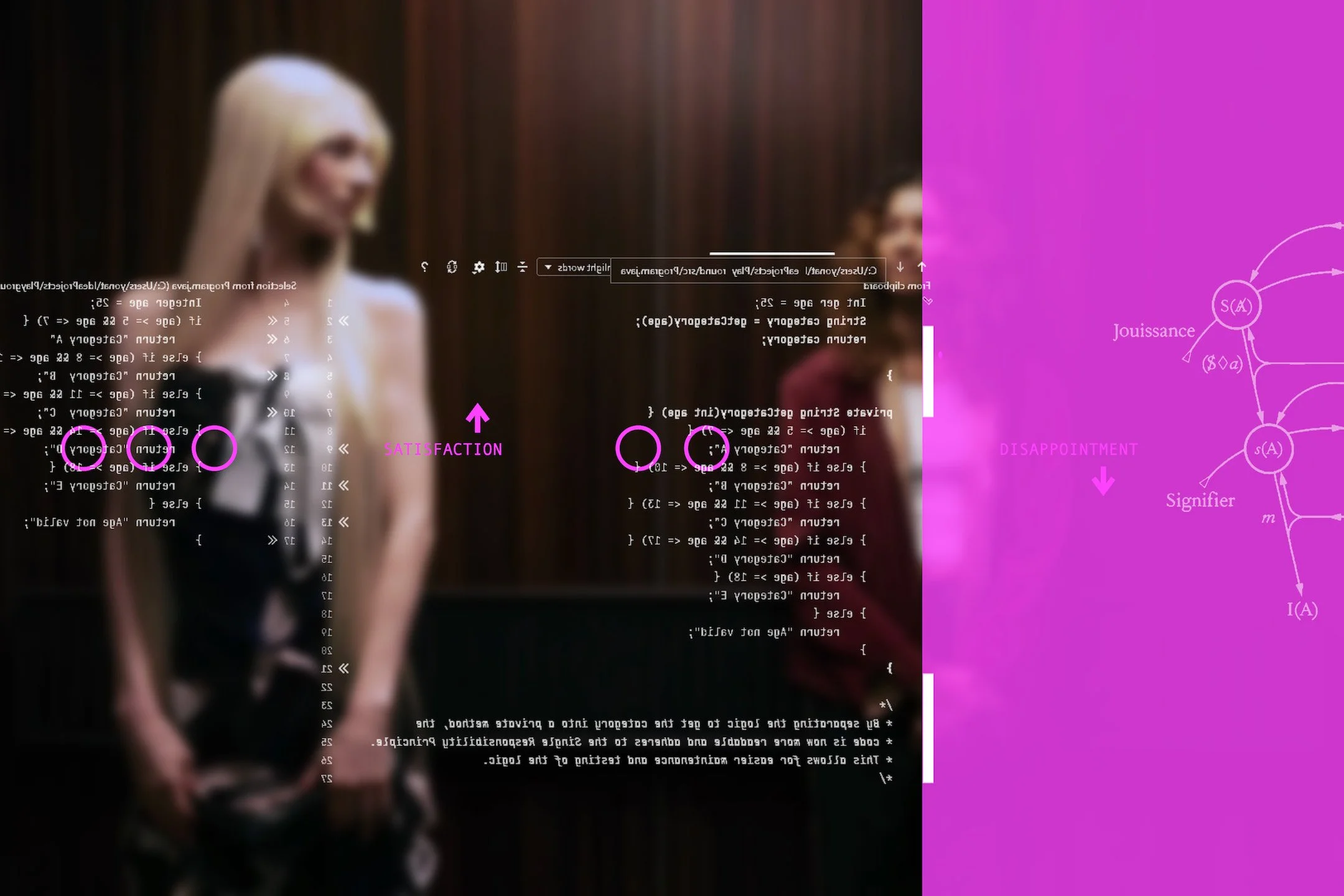
Collage by Austin Hughes
In a 2023 episode of the health and science podcast The Huberman Lab, billionaire investor Marc Andreessen waxed on about the AI future in uncharacteristically emotional tones. He predicted that the near term will deliver an AI companion who is “never gonna judge you. It’s never gonna be resentful. It’s never going to be upset that you didn’t listen to it. It’s never going to go on vacation.” In a word: “It’s going to be there for you.” What stands out in Andreessen’s account is the fantasy underlying the eulogy to convenience: the fantasy, that is, of perfect responsiveness and frictionless attunement.
Indeed, the broader ambition behind so-called “agentic” AI is a system capable of anticipating and fulfilling intentions before they are even consciously articulated. As Francis Hellyer, the CEO of the app tickadoo puts it, “The future of personalized experiences won’t be about providing endless choices but intelligently anticipating users’ needs before they consciously realize them.” Sam Altman has made a similar point, prophesying a “reasoning model” with a “trillion tokens of context,” one that would retain every conversation, every book, every email, every accumulated trace of a life.
The aspiration, in both Hellyer’s and Altman’s visions, then, isn’t recommendation. It’s anticipation: a machine that knows what we want before we want it.
One objection to this horizon is familiar to those following debates about tech: machines that are so tailored to us will give us worse things, frictionless companions rather than demanding human beings. In Filterworld (2024), Kyle Chayka claims that, in its promotion of the most frictionless forms of experience, algorithmic “culture” erodes personal taste by relieving it of the burden of any labor. Taste, on this kind of account, is a learned power of discrimination. What algorithms leave in the place is mere preference. The music historian Ted Gioia has made a very similar critique.
Suppose that we agree: We don’t want to be fed AI slop that is designed to go down easy. But let’s also suppose, for the plot, that the machines get really good. Suppose that instead of offering us some flattened median of our preferences, they give us their keenest expression—the hard, the weird, the intense: all the extremities Gioia, for instance, fears (already) lost under the algorithm’s reign of slop. Imagine, for example, being fed an exhilarating experimental music recording that you didn’t already want because you couldn’t have imagined it. What, if we grant all of that, would we still have lost?
The machine that anticipates perfectly can’t deliver a world that isn’t ours to manage. What’s worth preserving, I will argue, isn’t friction itself—at least as some kind of ascetic virtue or means to something else—but cultural non-sovereignty, the brutal and dry condition of living in a world that wasn’t arranged for us.
**
Consider the third season of HBO’s Euphoria (spoilers follow), which arrived after a four-year hiatus in April 2026. Four years is more than enough time to transform something from a (mere) show into an object of longing and theory. A source of questions: Who will return? Will the actors have outgrown their roles? For some, the resulting season’s heavy turn to plots based in sex work—Cassie’s OnlyFans, Jules being kept—was soulless and exploitative. For others, the same turn was simply meandering and decadent: of a piece with Rue’s $43 million drug debt and Nate’s death-by-rattlesnake. Yet the object and occasion for these fractures was shared and public. And pretty much everyone agreed Zendaya was great. What we were all wanting for the season, in that four-year hiatus, was shaped by our imaginations of what everyone else was out there wanting. Though divergent, these fan arcs were forced into relation by the show itself: the one thing none of us controlled. HBO, in this case, was certainly trying to please an imagined viewer, but it wasn’t thinking, specifically, of me. The network was trying to please an aggregate, and therefore no one specifically.
I am doing something more specific than bemoaning the loss of shared experience, the “bowling alone” thesis expressed by Brad Berens of the Center for the Digital Future: “Who can you talk with about a hyper-personalized narrative that you watch alone? We are a social species.” He has a point: With this technology, we will lose phatic communion, the shared object of attention, the common occasion that makes small talk possible and community real. But shared culture does more than merely bring us together around shared objects. It shapes what we even want(ed) in the first place, and it does this by routing our wanting through other people’s.
It takes a theory of desire to understand why. Not desire, here, in the sense of appetite, taste, or preference—any of which could be satisfied by better objects, the right objects. Desire here describes an irreducible condition of subjectivity itself, premised not on discovering the right object, but, indeed, on the impossibility of ever discovering it.
“The problem with these technological fantasies, then, is not that the cycle of desire would end but that it would be privatized.”
**
In Seminar VII (1959–1960), the French analyst Jacques Lacan develops his most sustained account of desire as being oriented not towards a specific object but toward the condition of desiring, toward the ongoingness of unfulfillment. His great example of this state is courtly love—a cultural form whose virtue lies not in its ethical consideration of the other, but in its ability to indefinitely prolong desire. For Lacan, getting what we want would be a shattering catastrophe, and so we continually settle on surrogate objects of desire—each promising something it can’t actually deliver. What Lacan calls objet petit a, the “object-cause of desire” developed further in 1964’s Seminar XI, is not itself one of these objects, but is instead what makes them desirable in the first place. The objects can be chained infinitely, indefinitely, without ever exhausting the desire that attaches to them.
But how are we drawn to objects at all? Desire for Lacan moves through a social space—if to be sure a shadowy one, given Lacan’s running skepticism toward the idea of any real communion between subjects. Desire, as Lacan writes enigmatically in “The Subversion of the Subject and the Dialectic of Desire” (1960), is always and necessarily the desire of the Other. Not the desire for the Other: the Other’s (imagined) desire. What I want is what I imagine the Other wants. It is the hypothetical enjoyment of that Other—the figure of plenitude against whom I measure myself—that tells me what might make me complete and what I, therefore, should want.
Culture is where this process achieves visibility. And shared cultural disenchantments are its clearest instance. Culture’s gift to us—its real gift—has always been how much it sucks, or, more accurately, how it stages this whole cycle of wanting: anticipation, partial satisfaction, more anticipation, harder disappointment. It’s these failures that allow our desire to linger.
To be clear, satisfaction is essential: Without it, there’s no incentive to restart the cycle. But it’s in disappointment that the intractable inadequacy of our chosen objects becomes perceptible, and thus when desire drifts, migrates, reattaches. Disappointment, then, is the moment when the object’s failure to terminate desire becomes visible. Thus are satisfaction and disappointment two nodes of the same circuit. But the latter is the node that keeps it in motion.
This account of desire is the foundation of Lacan’s ethics, as the Slovenian philosopher Alenka Zupančič argues in Ethics of the Real (2000): The ethical question is whether the conditions under which desire remains possible stay open. The problem with Altman’s “trillion token” personalization, then, is less its giving us the wrong objects than its ideal of presatisfaction—its dream of nullifying the interval in which the inadequacy of the object becomes visible. A dissatisfaction that cannot register is one we aren’t allowed to interpret. Thus the special horror of Hellyer’s machine “intelligently anticipating users’ needs before they consciously realize them.”
Of course, even this technology may not finally satisfy desire. Upon Hellyer’s machine giving us what we want, desire’s goalposts might migrate, new gaps might emerge, paths around the paradoxical obstacle of fulfillment might appear. Realizing this, a savvy, Lacanian developer may even intentionally design a machine to satiate and frustrate us selectively. This machine might well be buildable. This machine could be designed to tell me No. But what it could not do—at least not without ceasing to function as an agent of personalization—is to be truly indifferent to what its No does—or doesn’t do—for me. It would produce a tailored No, just as its yes is a tailored Yes.
The problem with these technological fantasies, then, is not that the cycle of desire would end but that it would be privatized. The social circulation of lack begins to break down. I continue wanting. You continue wanting. Yet the objects around which our wanting organizes itself become increasingly idiosyncratic, increasingly insulated from one another. What disappears isn’t desire itself but the public staging of desire’s inevitable failures. What is lost with such public staging is the ability to live in a world that is not arranged for me.
The value of other people’s desires, in this account, is that I can’t administer them. Other people want the wrong things, want bad things, misunderstand what I love, are bored even while I invest and engage, love what disappoints me, and refuse to supply the responses I require from them. Their interiority—their desires—arrive to me as brute facts I have to negotiate around rather than experiences calibrated to sustain me. These are the facts, as the saying goes, that don’t care about my feelings.
So: The problem posed by agentic AI was never merely that personalization deprives us of common objects. What it does threaten is the common conditions under which objects can succeed and fail before us. Your object and my object are now calibrated separately, destined to disappoint each of us in our own tragically insular ways. What disappears is the experience of having our desires organize and take shape around objects—and be exposed to other desires: an experience none of us can rein in, reroute, or lock down.
None of this means personalization ought to be resisted in full, still less that disappointment should be cultivated for its own sake. It means there’s good reason to preserve cultural spaces where our encounters aren’t—or at least aren’t wholly—organized around our preferences. Common objects we didn’t commission or prompt. Audiences we didn’t select or cultivate. Judgments we can’t either mute or append a “community note” to. Other people whose desires stay inconveniently (but wonderfully) autonomous. What’s worth keeping, then, is cultural non-sovereignty itself. And non-sovereignty isn’t a feeling that can be provisioned to us. It’s either a fact about the world or it’s nothing at all.
This is what the personalized world rhapsodized by Andreessen and Altman would take from us. A personalized system might be capable of reproducing the feeling of that alterity. It could contradict me, even, perhaps, perform a misunderstanding of my meaning. But these frustrations would be features of an environment organized around my experience. And therefore, it would be no (real) alterity at all. This, finally, would be yet another layer of solicitude. Even if we were programmed not to notice this problem from within the artificial experience, we understand the problem now, when we contemplate stepping in, and we have reasons to prefer a world that is truly shared.
**
The danger in Andreessen and Altman’s fantasies isn’t simply that machines will become too pleasurable or accommodating, leading us into an Idiocracy-style sloptoia. The danger, if we take these tech leaders literally, is of an immersive interface that renders mass culture itself redundant: the set of works—records, books, podcasts, films, TV series—that large cross-sections of people encounter, if not together exactly, then roughly in parallel, day to day and week to week: a schedule of sameness that finds us. Any culture worth saving needs things that specifically aren’t “there for you”: art that irritates you, groups that exasperate you, enthusiasms you can’t understand, fashions you adopt too late.
We don’t have to romanticize disappointment to realize there is value in a world confronting us that hasn’t yet been completely reorganized as a service each of us subscribes to separately. The pleasure of the letdown, then, may finally be the pleasure, however oblique, of discovering that something other than ourselves is still there.
Travis Alexander is an Assistant Professor of English at Old Dominion University. He is the author of The Birth of Viropolitics, forthcoming from The University of Minnesota Press. His essays have also appeared (or are forthcoming) in The Point, Compact, Liberties, Aeon, The Los Angeles Review of Books, and elsewhere.
Published November 2026