On frames, boundaries, and what they hold
By Mendel Horowitz
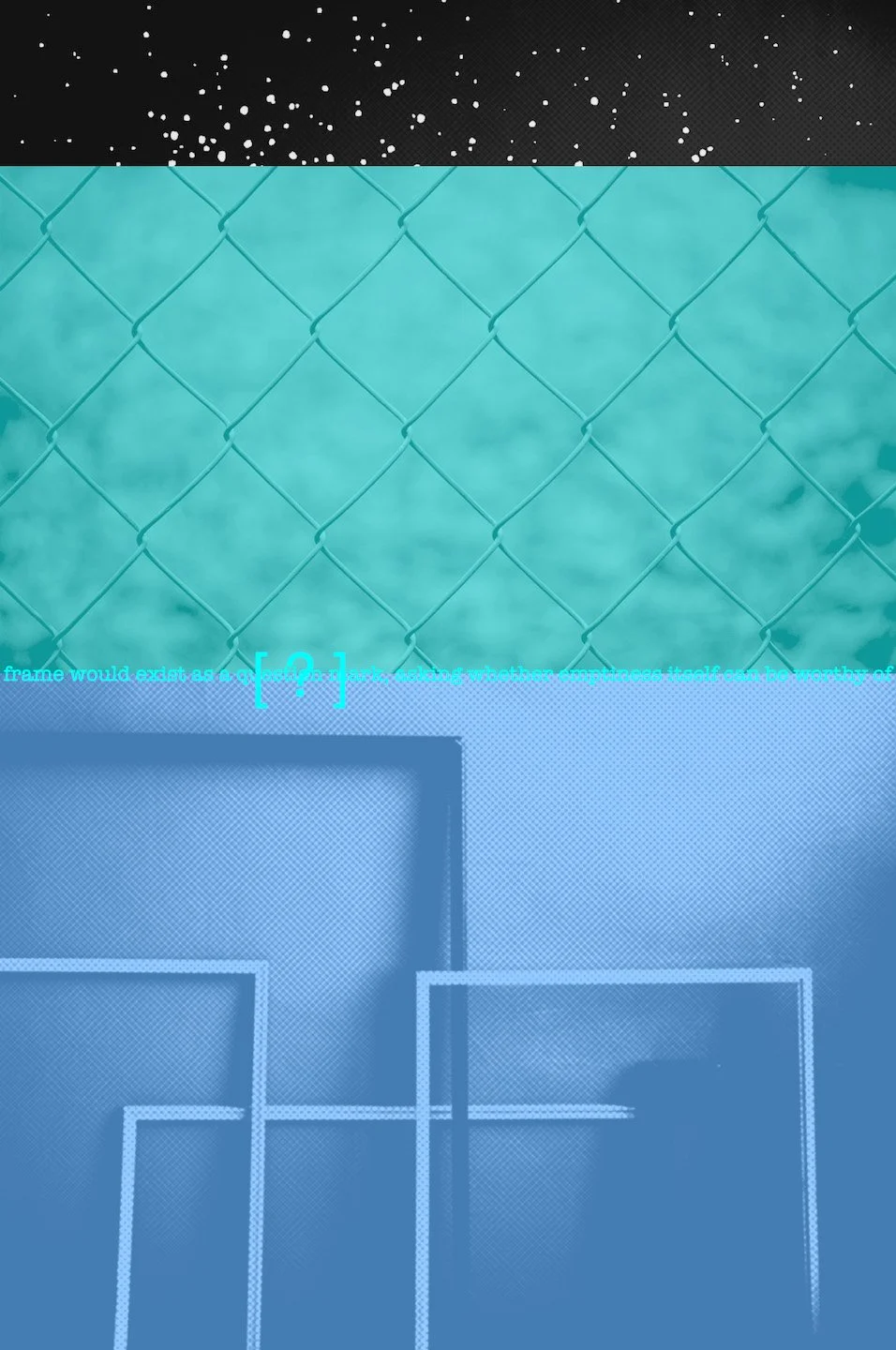
Illustration by Austin Hughes
I purchased the frames in an antique shop in Monticello, New York, around the summer of 2000, while working a job that had nothing to do with antiques. I was about 30 then, a teacher in Jerusalem hired between school years to haul children’s luggage to summer camp, and the heavy lifting suited me.
In contrast to the buttoned-down confines of a classroom, it was pleasurable to sweat through T-shirts, sip unfussy coffee, eat candy bars for meals because there was little time for anything else, and navigate a route I improvised before Waze or Google Maps in the largest U-Haul that did not require a commercial license. The labor was raw, and the gratification was immediately felt.
Somewhere along Monticello’s Broadway, I noticed a going-out-of-business sign in a store window and clumsily parked the truck by riding the high curb and coming down hard against the pavement. Inside the cluttered space, I bought a dozen wooden picture frames for no more than 20 dollars each, not choosing them so much as claiming each from where it hung, guided by an odd sense of familiarity, the way your hand finds a favorite book on a crowded shelf.
At the time, I did not own anything to fill them. I was drawn, instead, to their weight and geometry. The frames were heavier than I expected, dense walnut and oak with tight mitered corners. They varied in size, all of them rectangles built to anchor to a wall rather than sit on a desk, some large enough for an oil landscape and others proportioned for formal portraits. All bore the marks of age, and a few still held their cloth mats and the faint luster of worn gilding.
I transported the frames in the empty rental at the end of a long weekend, binding them to the side rails with luggage straps and hoping they would survive the journey intact. A few of the frames even made the transatlantic passage at summer’s end and now hang in my family home in Jerusalem. Instead of portraits or landscapes, my wife and children grew accustomed to seeing quotations from volumes on our shelves enclosed beneath glass, text treated with the reverence usually reserved for art. It may not have been their original purpose, but I let the frames decide what deserved attention. Most of those objects, though, have remained in my parents’ New York basement, wrapped in old blankets on a shelf beside the boiler, without fulfilling the purpose for which they were made.
**
The objects returned to mind recently in supervision, as I sat in an office crowded with framed images on nearly every wall and surface. I am a psychotherapist now, no longer a teacher, and that Thursday I was free-associating about fences, another kind of frame. My supervisor’s home office overlooks a park, which was surrounded by a temporary chain-link fence. I wondered aloud whether the fence was meant to keep people in or out, knowing immediately that the question was not really about that enclosure.
I mentioned, too, another wooden frame which I salvaged from a dumpster near our home years after that summer abroad and which now hung from a single corner so that it dangled like a diamond. In Monticello and again on my own street in Jerusalem, I had been salvaging containers that someone else was finished with, rescuing structures that retained their integrity even after their contents had been stripped away.
I found myself wondering about more than what I saw, about what an enclosure might hold and what it might keep out. I wondered, too, about my consulting room. The frame I build for my patients has its own design elements, a room that stays exactly as it was, held steady week after week, so that someone can risk being seen inside it.
That frame from the dumpster and those shelved in my parents’ basement were worth keeping even without anything filling them. In the consulting room, too, the boundary comes first, marking off a quiet space so that whatever is brought inside can take shape and be seen.
A frame declares that whatever lies inside deserves focus, protection, or respect. In biblical Hebrew, the word for frame is misgeret, which shares its root with the verb meaning “to enclose.” The term appears in the instructions for the Tabernacle, where it designates a wooden frame surrounding the table. Around it was placed a golden molding, as if framing the frame itself.
More than an object that inertly surrounds an image, a frame actively directs our gaze before we even realize it has been directed, like a wall that does more than contain, or a door that does more than open. An empty frame complicates this architecture by retaining the function of display while leaving its center bare, asking whether the container itself can hold our interest.
The therapeutic frame is more than an abstraction. It has a texture: a simple Ikea rug I align with the floor tiles before each session, the glow of an overhead light set to its warmest tone, and a flimsy wooden door that closes with the same flat smack each time. Like any well-designed space, the room is tested before it is trusted. When someone arrives late, knocks inaudibly, forgets to pay, mentions an event occurring elsewhere, or asks about my life outside these walls, I understand that they are assessing what the room is built to hold, much as I had considered the two sides of that fence. Is this frame sturdy? Can it take that kind of pressure without giving way?
Sometimes I imagine what that empty frame would become if I moved it from our home to the wall of my consulting room, above the chairs arranged at their careful angles. In a space where every detail is already scanned for meaning, an object is never only an object. Hanging there, the frame would exist as a question mark, asking whether emptiness itself can be worthy of attention, an invitation to whatever might arrive. In practice, it might prove too distracting, demanding focus precisely because it is unresolved. To picture it there is to recognize how heavily we depend on our environments to speak for us, and what a single, ambiguous object can ask of the people inside a room.
I have wondered since that Thursday about my fondness for frames as objects, not for what they are meant to hold. It may explain my being drawn to a therapy built on fixed elements, and it may be why I sought out a supervisor who takes the frame as seriously as I do, who saw nothing strange about my noticing a chain-link fence. I carry these questions the way I once carried those antique objects, without fully knowing what I meant to do with them.
The frames are still in the basement quietly waiting. The one from the dumpster still dangles against our wall, tilted and bare.
Somewhere further back than Monticello, further back than that summer of duffel bags and candy bars, there was another fence too, from my childhood. It was an imperfect enclosure, always prone to collapse, marking the edge of our small concrete yard while never fully containing it. The truth is that I resented that fence. Its neglect bothered me when I saw it from my second-floor bedroom window, its warped boards and leaning posts that my parents never managed to repair, whether out of thrift or for some other reason I never understood.
Mendel Horowitz, MSc, CGP, is a Jerusalem-based psychotherapist in private practice who serves on the editorial staff and Public Outreach Committee of the AGPA. His writing explores the space between memory and experience, seeking what lingers beneath the immediate encounter.
Published November 2026