A Zeitgeist of the Bizarre
The literary magazine slush pile as cultural unconscious
By Fawn Ward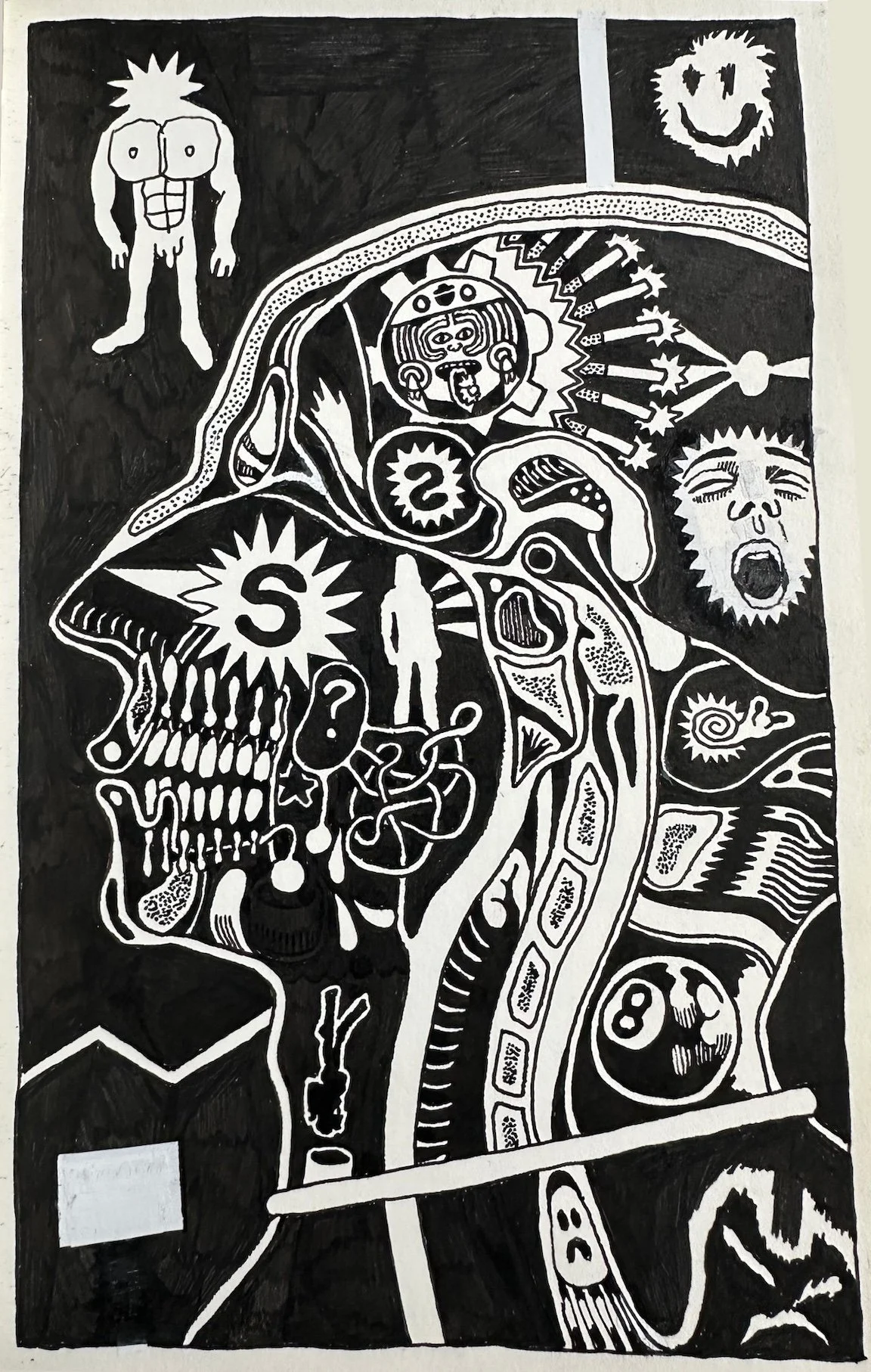
Illustration by Virgil Ratner
A man collects his decaying nose and ears and stores them in the fridge, hoping his date won’t find them. A new mother plants her placenta and sprouts a tree that feeds on it. A woman grows wings and flies away from the suburbs. These are the kinds of stories I encounter as an editor at Weird Lit Magazine, which was founded in 2024 with the goal of publishing short fiction outside the norm. The journal aims to be a platform for the boundless, publishing off-kilter work that doesn’t care about commercial genre, literary gatekeeping, or social sensitivities. It’s not always polite, and it pushes boundaries—sometimes gently, with a quiet burn, or forcefully, with unexpected roughness that truly isn’t for everyone. As an editor, I read thousands of submitted stories hoping for the “right” ones: pieces that connect strongly to a singular or societal unconscious, have something striking to say, and obviously, are weird.
As we publish quarterly, our submissions tend to be a reflection of the moment, a true zeitgeist of the bizarre, a shrinking of the space between the day to day and the strange, formulated into absurdist, haunting, magical, or speculative fiction. We find a lot of recurring themes in the slush pile—that stack of work submitted for a chance at publication. In fact, the entire vantage of the literary slush pile is of a beautiful repository of human desire and anxiety, one that can help us approach that deeper understanding of the self at a given moment in time. It offers a unique perspective on creative expression outside the bounds of societal norms and outside the stage of official publication.
Missing Pieces
A top recurring theme in the slush pile is one of disturbed physicality, where body parts fall off or otherwise leave a person. Some stories move formulaically through individual features that disappear, while others are more visceral or graphic, with entire organs escaping on their own, sometimes violently. Unsurprisingly, from a psychoanalytic perspective, we’ve seen a lot of detaching penis stories. Once, a penis had a delightful adventure on its own, descending a staircase like a Slinky. In another, political leaders anxiously waited for their privates to grow up and fly away. These stories are not terribly hard to analyze: The penis that detaches fantasizes about a sexual life drastically separate from the owner’s, one that might not bear the weight of responsibility of actions as while attached. Other organs that disappear reflect a dread of aging and our poor ability to resolve our changing appearance in the mirror with our conceived identity. Body horror is a big element in these pieces, though some are clearly crafted to be humorous or deadpan, nonchalantly describing what should be a traumatizing scene with little to no emotion. Unlike with some of the transmutation fright of classic body horror, these narrators remain themselves, just with missing pieces. Perhaps that’s the most horrifying idea for most of us, beyond the metaphor: a life of missing pieces that we must continue to endure.
Mirror, Mirror
If stories of detached organs and wandering body parts reveal an anxiety about the integrity of the body, stories about mirrors extend this anxiety to the self as such. In these pieces, a mirrored subject moves on its own, independent of the self looking on. Most of these stories are similar to each other: A protagonist wakes up, looks in the bathroom mirror, and sees a reflection that doesn’t follow. In some, this mirror-self walks out of frame. In most, they just move separately. Although this theme could easily go the direction of Through the Looking-Glass, and What Alice Found There (1871) and into the fantastical or psychedelic, it’s almost always more darkly written in our submissions. There is always an undertone of dread.
Unfortunately, there isn’t much depth in this theme, at least in the stories we’ve seen. The authors generally focus all their energies on that disturbing conceit of a fractured, out-of-sync identity beyond control of the protagonist, leaving not much else for plot. It’s this lack of follow-through that interests me most. Why can’t anyone find more to say? It is clearly not a simple theme, and it’s understandably a challenging one to write. A single protagonist is hard enough to depict with integrity, much less one that’s cut in two. Maybe the sheer horror of a split identity is enough to freeze further unpacking. Or perhaps we have a deeper resistance to empathizing with such a scenario, to maintain a rooted connection to a singular self. This theme remains somewhat uncharted, which ultimately adds to its intrigue.
“The entire vantage of the literary slush pile is of a beautiful repository of human desire and anxiety.”
Clones and the Anxiety of Replacement
Mirror stories ask what happens when the self splits in two. Clone stories ask what happens when the self is replaced by a stand-in. Clones certainly aren’t a novel concept, making appearances in a lot of notable literature exploring dystopian worlds, from Huxley’s ever-impactful Brave New World (1932) to one of my favorites, Where Late the Sweet Birds Sang (1977) by Kate Wilhelm, and Never Let Me Go (2006) by Kazuo Ishiguro. Each of these works uses the concept of clones to further or explore deep-seated concerns about the direction of the human race.
In one slush pile piece I read recently, all dating happened via clones, voyeuristically viewed through their eyes from the safety of home, with all interactions recorded and replayed, including sexual acts. This type of clone speaks to our obsession with convenience, along with a desire—like in the detached penis stories—for sex and intimacy without social requirements. The antisocial setup of this scenario feels like a truly post-COVID narrative: social and emotional distancing through tech-induced isolation, all in the name of ease. Clones appear more often in Weird Lit submissions recently, likely because of a growing concern surrounding the persistent daily presence of technology. As a culture, we’ve too quickly caught up to our own speculative fiction, becoming more desensitized to and yet increasingly worried about what happens next in the world. AI, or the threat of it, is replacing human jobs—and with those, many people’s perceived value. When most of our worth in a capitalist system is woven into our ability to make money, these fears underlie nearly everything. Many clone stories highlight a new type of dystopia, one where a disappearing humanity isn’t novel or even feared.
Most clone-focused pieces with male narrators spend a good amount of literary real estate unfolding the horror of watching their clone find success dating their ideal mate, a kind of social theft. This friction typically fades into numbness, with the narrator accepting that he won’t measure up to his replacement and then walking away from any investment in the story, displaying the futility of our culturally credited male self-worth. When a replacement performs better in attracting a sexual partner, what’s left for the men in these stories? The answer: very little. Conversely, female narrators in clone stories we’ve read are not nearly as detached. They take matters into their own hands, often violently, wielding deadly weapons with the intent to extinguish their clone replacements. This is a departure from most female protagonist-led pieces and feels especially distinct measured against the male-narrated versions of this theme. I can feel the repressed rage in these scenarios, regardless of outcome, molding a strong movement away from the norms of female social roles. This is where real action seems to begin for these female characters, after having had their identity diluted, their physical form replicated; necessitating a desperate, final kind of power.
Conspicuous Absences
The meta-analysis of thousands of weird story submissions is compelling, but I spend an equal amount of time considering the themes we don’t see. Psychoanalysis teaches us to pay attention to both presence and absence. The slush pile is full of recurring themes of anxiety and fantasy, but the conspicuous absences there may say even more than those that repeat again and again. Where are the stories of uteruses out on joyrides of their own? When will we receive a story narrated by the man inside the mirror, or the clone? Perhaps these absences indicate we already understand these themes, that we are at peace with them, unconsciously; and that we don’t need to work their elements out in narrative prose. Or maybe they’re merely waiting for the right symbolic form. These emerging questions from the slush pile are what propel us onward, always seeking the next new strange story to read.
Fawn Ward is a senior editor at Weird Lit Magazine (weirdlitmag.com). She also edits books, writes, and manages editorial projects at a boutique marketing agency in Portland, Oregon. Find her at fawnward.com or substack.com/@fawnward.
Published August 2026