The Patient Looks Back
Three years painting portraits of my therapist
By Joyce Polance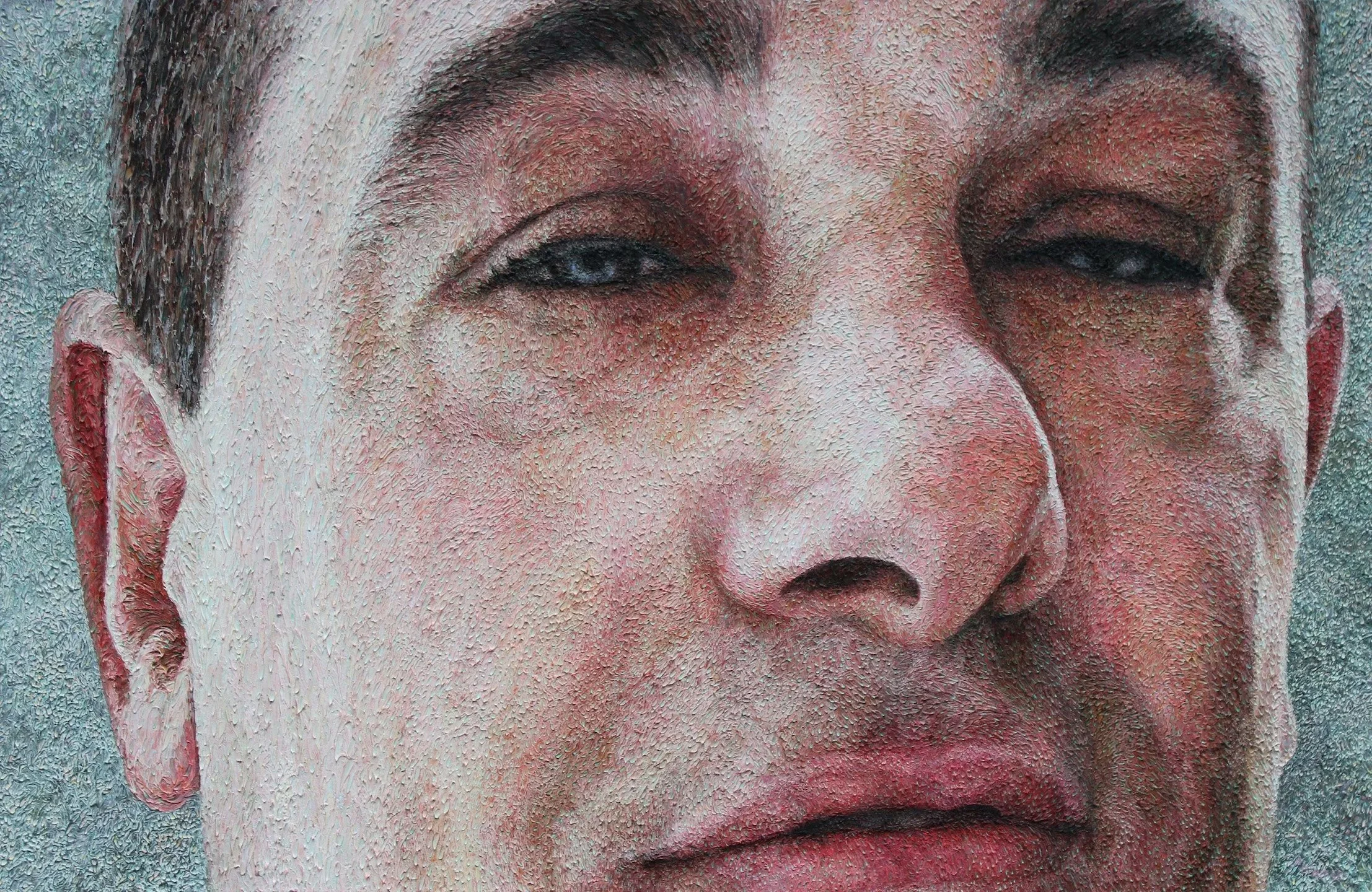
Tropical Print (2026), oil on canvas, 72 x 48 in., by Joyce Polance. Courtesy the artist.
Beneath my hands, my therapist’s face takes shape. I’ve built it from nothing with my fingers. I mix multiple flesh tints and pick them up together, pressing them into a wet underpainting with my fingers, removing some of the top layer with my fingernails to reveal shades of green that lie beneath. I’ll add even more color when it dries. We were working together for less than a year when I asked to paint him. I was afraid to ask, but he said it seemed an inevitable part of our process.
I’ve been painting him in oils for three years now, touching the face I’ve never actually touched, his features becoming more familiar to me than my own. What does it mean to have this unusual intimacy with someone who is in so many ways a stranger?
I’d had lots of therapy and thought I was done, but during a severe bout of Covid, I decided to seek some temporary support. Unexpectedly, our process became transformative for me; attachment and transference happened. I saw I had deeper unresolved issues around self-acceptance. He said we were going to rewire my amygdala, and I could feel it beginning to occur.
This man saw through everything: my perfectionist, performative, overthinking, anxious mind. Everything about my evolving brain back then seemed intertwined with him; he echoed my own story to me. Yet he didn’t give himself away. Since childhood, I’d studied people’s faces for signs of safety, trying to read what they might need of me. How closely was I allowed to look? If I reversed the gaze, would it affect our connection?
When we spoke over Zoom, I would break up his face into areas of color in my mind. I’m visual; I do that with everyone, but it had never before contained the wish to capture something elusive that I nonetheless wanted to hold tightly.
On the computer screen, I could only see him from the shoulders up. I became fixated on small shifts in imagery: the shirt he wore, his smooth or unshaven jawline, the way his hair was combed that day. It was a shock when we finally met for an in-person session. (I live two hours away, and we still mostly meet on Zoom.) Physically, he seemed so different from what I’d imagined—he was younger, shorter, more muscular. He wore sneakers. He sat, relaxed, notebook in hand, on an office chair, an ankle crossed over a knee, instead of upright at a computer desk, the way he’d appeared on Zoom. I knew that face better than almost any other, but he was a stranger in the room. It was also unsettling when I went back to Zoom and he seemed a different person again, more remote. It made me want to find a way to define the parts of him I hadn’t seen before, to get a complete picture of him for myself.
**
I intended to paint him once: a three-foot square. I wasn’t concerned then with achieving accurate likeness—my work over the past few years had been about pressure and distortion, and I assumed I’d go in that direction. Mostly, I wanted to depict his warmth and kindness. Even as I write this sentence, I can see the contradiction in combining those elements; it’s probably why the painting gave me so much trouble. I struggled with it for months, adding and removing layers of paint until it finally resolved. Yet I’d never thrown myself so passionately into my art, worked so many hours with such determination. It was coming from a different place than my anxious, expressionistic work. It was my favorite thing I’d ever painted.
I sent him a JPEG of the image. When he praised it, I offered to give him the painting. I liked the idea of his taking me home with him. I wished to feel important to him, just as he was to me. I also wanted to repay him for his generosity. No gifts, he said, always reminding me of the limits. I protested that it was as if I’d drawn him a picture, and he should hang it on the refrigerator. No gifts, he repeated.
I didn’t expect to keep going with the series, but I have. It seemed like a great concept for an exhibition someday. I thought I would paint him in all different styles, that it wouldn’t matter how much they looked like him. In fact, I had spent years in my earlier work trying to let go of representation. I’d convinced myself that paintings that were warped or altered were stronger for it. Now I see a different kind of pressure in the likenesses—due both to the textured surfaces and the discomfort of repeated close looking. Painting him, like our therapy, has changed me: I no longer fight the concept of likeness. There’s power for me in knowing that I don’t have to distort myself or my work to be acceptable.
Over and over, I build and remove paint. Rupture and repair. The marks now conform to the sizes of my fingertips: my own form of braille, tracing the contours of his face. Can you know someone by repeatedly depicting his image when his job is to remain opaque? I can’t set the schedule or change the clock when it’s time to stop, but I can create my own narrative around his feelings and expressions as a means of connection.
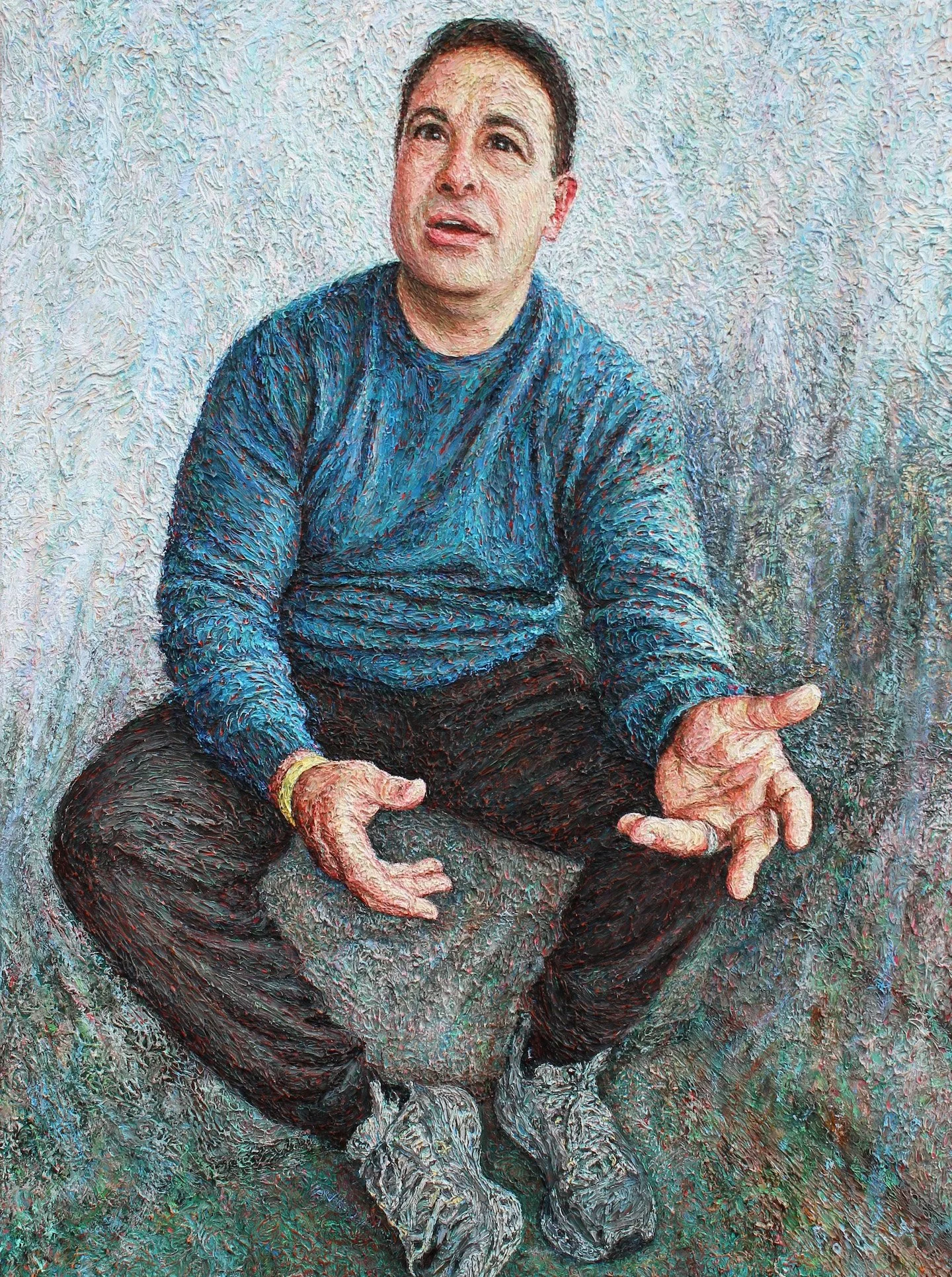
Teal (2026), oil on canvas, 40 x 30 in., by Joyce Polance. Courtesy the artist.
**
I work from photographs I take at the end of our in-person sessions. It’s become a ritual. I’m usually still holding the feelings about whatever we’ve discussed, and it’s difficult to make the shift. I haven’t been watching the clock. He forgets to leave much time for pictures, and I forget to check how he’s sitting or whether there’s light on his face. Increasingly, I try not to manage it. I do ask him not to fold his hands—because I’ve painted a couple like that already. I wonder if he’s feeling impatient, which makes me nervous, so I shoot the photos in a few minutes. Often, I’ve accidentally cut off the top of his head.
I’m different while I’m taking the pictures. Being (marginally) in charge of my art gives me some sense of agency. I’ve learned to ask him to talk because it activates his hands and face. I might bring up random subjects: a movie, standup comedy, something in the news—anything that isn’t about my deepest self. Sometimes we laugh together. For a moment, it feels as if we’re peers. And then we aren’t.
My Android phone is set to Top Shot, which takes a dozen photos in quick succession, all in one second. I pore through them on the train ride home, searching snapshots of his face for something I can’t name. At times I don’t respond to any of them. And then I’ll be scrolling through the nearly identical images, and there’s suddenly a single blurry frame that shows a sign of vulnerability. I have an emotional reaction to it. That’s the one.
**
It’s impossible to show all the complex aspects of someone in a single painting. The series itself is the portrait.
But when we have spoken of our work together, he has often said that everything he does is a mirror of me. So, when I choose a photo because it moves me, am I really catching him in a revealing moment, or is it just a reflection of something inside me? The whole series is my personal way of relating, he says. I hear him, but I can’t separate the paintings from our connection.
Three years. One face. A way for me to illustrate attachment has wound up pushing my work in directions I never could have foreseen. The first painting, looking back, has an almost childlike innocence to it. Then there are the pieces where I was experimenting with styles, before I surrendered to painting him as I saw him. And because I can’t ever keep painting the same way—I constantly need to be challenged—I’ve had to look more deeply at him and at myself.
In the last year or so, a new way of finger painting has emerged for me, one I’ll stay with for some time to come. Each piece builds on the last one: new levels of texture, removal with my fingernails, reapplying paint with my fingertips. Increasing complexity on the canvas echoing increasing complexity over the Zoom screen, all of it inside a frame.
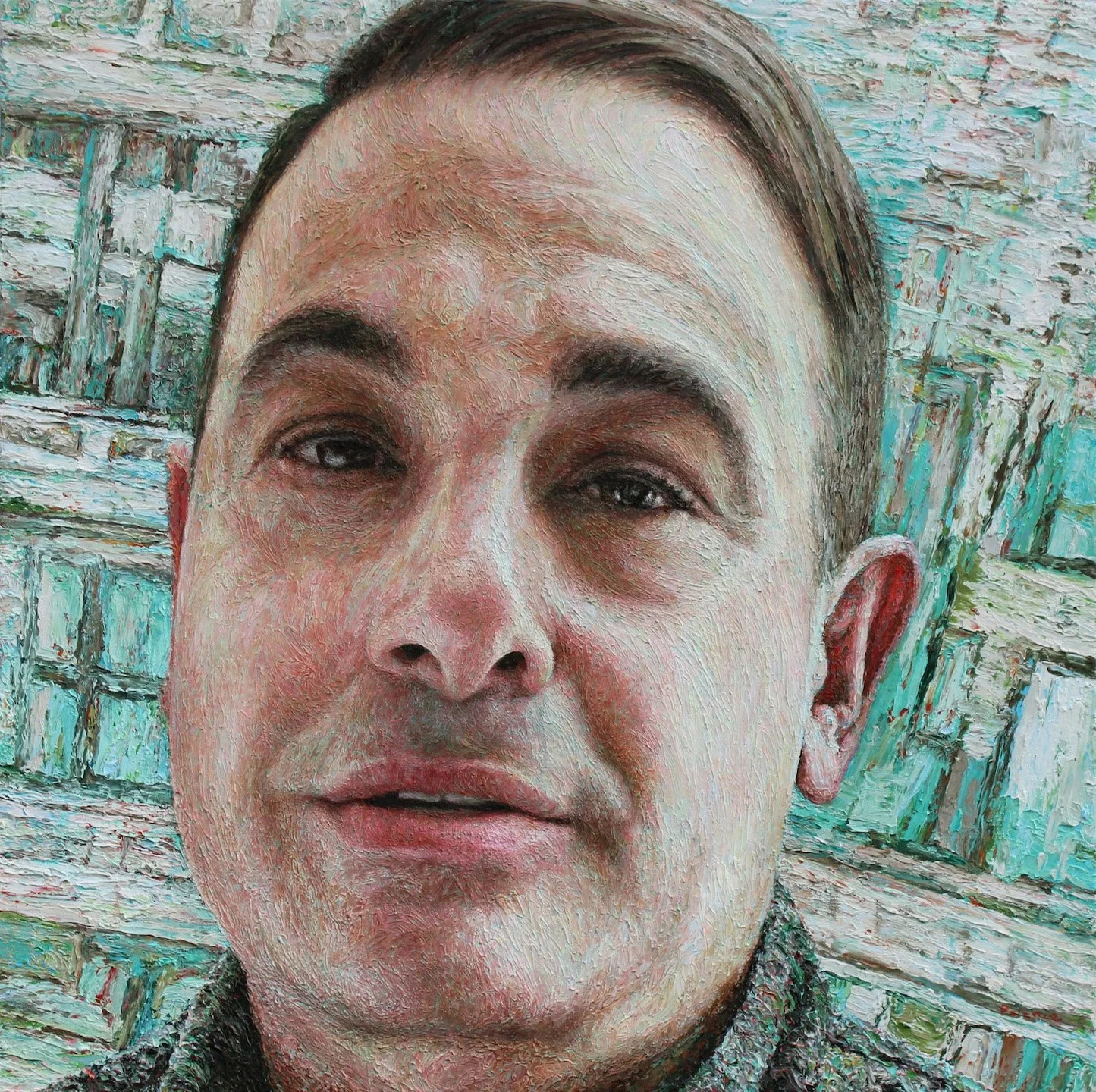
Gray (2025), oil on canvas, 36 x 36 in., by Joyce Polance. Courtesy the artist.
**
When I asked my therapist if I could paint him, I promised him anonymity, but perfect anonymity isn’t possible. He’s always acknowledged that someone might recognize him when I show the work publicly. He’s made it clear he wants me to get my work out into the world and not be held back. That it isn’t my job to take care of him or imagine his feelings about it. But I’ve still wondered how much is okay to show and to say. I have some anxiety that if he is recognized, and it affects him in any way, it could alter our relationship. And because he’s constantly protecting me from his personal experience, he wouldn’t tell me if it actually affected him. The part of my brain that historically sought safety by making other people comfortable has to take him at his word that it’s fine with him.
Several of the paintings depict his face. Others, his body: the ever-present sneakers and an array of colored shirts, which have given me the titles for the paintings: Pink Plaid, Another Blue Sweater, Gray ... Lately, I’ve been zooming in for closeups. I’m working on a six-foot piece right now; his nose is twice the size of my head. Tropical Print, I’ll call it.
The determination in that first painting has become a part of me. As I allow myself to embrace my own intensity, it reverberates through my paintings and through my desire to get this body of work into galleries. I tell my therapist I’m having an exhibition of the series at Vassar College in September and October of this year. It’s called The Patient Looks Back. He says there should be a parade. I make it clear again that I won’t share his name. I’m doing some press outreach. Because he’s so protective, I may never know if this troubles him. But where are the edges of consent?
**
I’ve written about how I paint: My ADHD brain chooses to work with my fingers because I’m closer to the subject. I can use five different digits without having to stop and pick up a different brush, which aligns with my need to hyperfocus. When I work, I back up from the painting and figure out the next color and where to put it. Then it’s a race to get the color mixed and onto the surface before I forget that information. Using my hands, I can place a left-handed finger where I want the paint to go and hold it there while I mix the color with my right hand, pick it up with a finger and apply it. It’s an adaptation to my strengths and to my limits.
I tell him I’m writing an essay about this project. I ask him if I can send him a draft. I offer to edit out anything that makes him uncomfortable. We argue. He doesn’t want me to give away my agency. I say I won’t change the heart of anything—art I make isn’t sacred to me. As an artist, I often go back into my work and alter it. He insists it’s sacred, and I need to be unapologetic about it—even with him.
I want him to see the work in person. I think he’d be proud of me. I think he’d be impressed by my talent and emotionally moved in some way I can’t anticipate, and I’m curious to see if he’d share any of that with me, because as with this series, I always wish to know him. I want his validation even though he tells me I can validate myself. He says he’s already seen the work—on the screen. I tell him that means he’s never seen it. I say he has absolutely no idea how different and powerful the work is in person. Will he come to my show? I don’t know. I haven’t pushed the question. Yet.
I’m nearing the end of Tropical Print. I’m at the stage where I scrutinize every mark the size of a pinhead. The adjustments I make get smaller and smaller. The paint has gotten so thick, it casts shadows. The surface changes with the light, with how high it’s hung on the wall, with where I stand. I back up from the painting. I walk up close to it. The nearer I get, the more the surface dissolves into abstraction. I step back again, and he returns.
Joyce Polance is a painter based in Catskill, New York. Her solo museum exhibitions include the Wausau Museum of Contemporary Art and the Dubuque Museum of Art. The Patient Looks Back: Portraits of My Therapist opens at Vassar College’s Palmer Gallery in September 2026.
Published September 2026