A psychoanalytic understanding of Alzheimer’s dementia
Betsy Nettleton
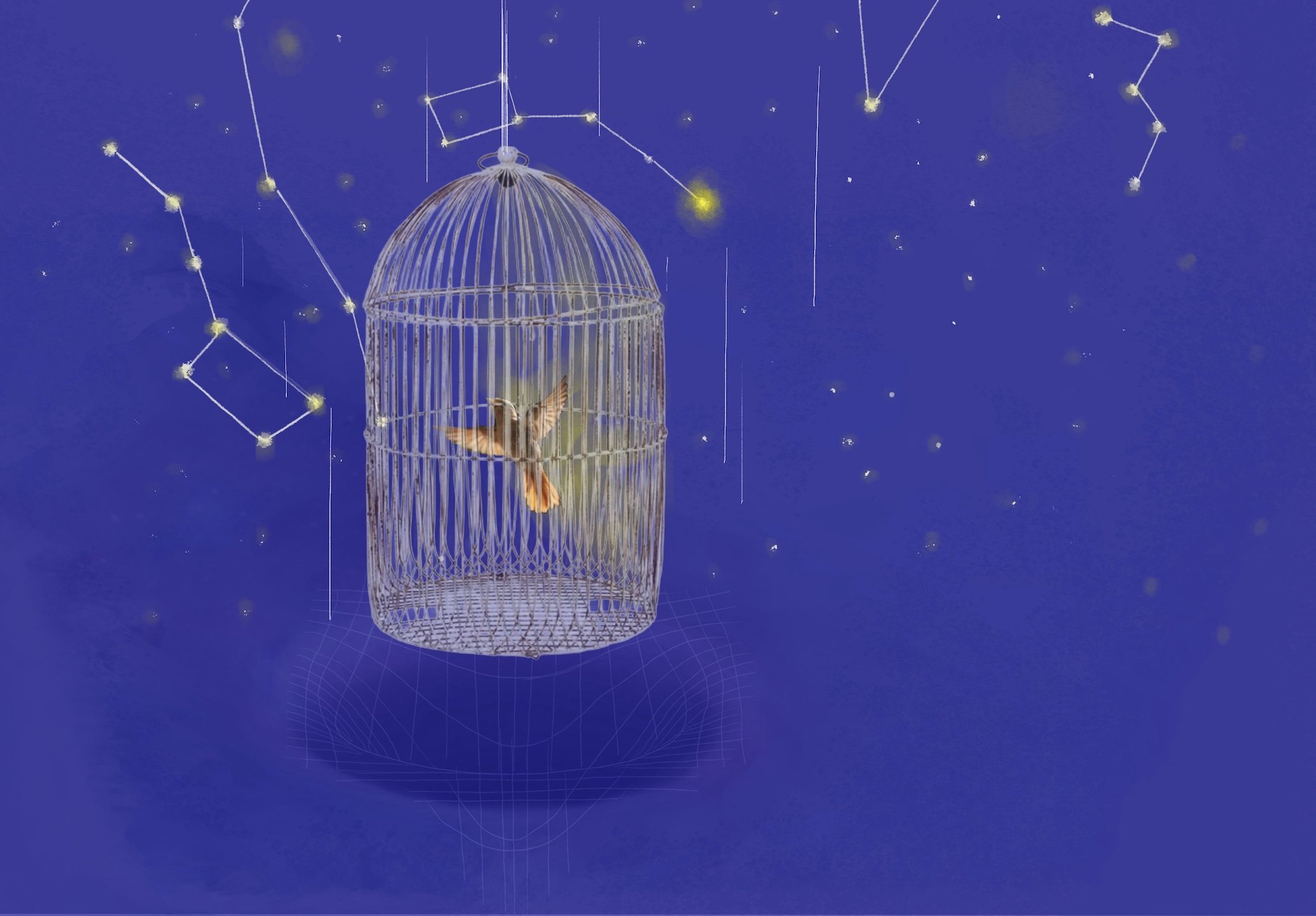
Illustration by Tati Nguyen
My former supervisor recently sent me an article about the navigational feats of migratory shorebirds. She’d always had a keen eye for discerning the psychological in unexpected places. The essay arrived in my inbox between near-daily text alerts from Audubon and the Chicago Ornithological Society about the start of fall migration.
Her voice had already been echoing in my mind when I received her email. “Betsy,” she’d once told me. “A mother is a north star.”
Migrating birds orient themselves to the stars during their journeys north and south, using Polaris as true north. A landmark ornithological study, “The Ontogenetic Development of Orientation Capabilities,” detailed the internalization of cognitive star maps in early avian life. In humans, an inner compass is established through early mothering experiences. These repeated interactions of holding and containment create a sense of safety and security in the mind’s landscape.
My own mother is losing her orientation and mental map. She is determinedly searching for home even while she is uncertain where or what this is. I wonder whether the wandering or homesickness in patients with Alzheimer’s dementia (AD) like my mother is not so much a quest for a concretely remembered place as it is a desperate search for this inner north star, this early experience of being safely held by another’s arms and mind.
AD is a cruel and debilitating disease. There is no cure. Even the best pharmaceutical interventions only slow it down, temporarily, in some people, some of the time. Neurobiology and genetics tend, understandably, to dominate the AD research. Recently, some psychiatrists and psychoanalysts have paid more attention to the interplay among biology and psychology, but this kind of study remains uncommon. Psychiatrist Sandra Evans wrote about the sway of neurobiology in her paper on psychoanalysis and dementia. She asked what analysis might offer both at diagnosis and as the disease progresses. She then speaks to the anxiety felt by clinicians of missing something physical while being perhaps less concerned about missing something psychological.
I am curious about the psychological. Not in lieu of neurological advances, but rather as a way to understand, be present, and mourn.
**
This spring, as the birds arrived back in Chicago and my mother returned to her hometown from her annual winter migration, I opened the book The Hardest Passage by psychoanalyst Maxine Anderson. My own analyst had recommended it to me. The book describes Anderson’s work with “Sally,” a former control case who reached back out at the onset of her dementia. Anderson writes in her introduction that the defensive turning away from the terror of memory loss—whether in caregiver or in the dementia sufferer—might hasten the course of dementia.
The book arrived at a difficult time. The waning of my mother’s capacities had become increasingly obvious upon her arrival to a home that seemed, to her, to feel unfamiliar and disappointing, even devastating. Perhaps this is why the book initially seemed like a combination of instruction manual and homing beacon, and why I locked onto it for dear life. But in my denial, I made the mistake of reading too much into Anderson’s idea. I imagined that facing the illness head on might slow the loss down. I imagined slowing it down so much that a happy ending of sorts might be possible, an ending where memory was wobbly or impaired but life could still go on “as normal.”
I raced through the chapters, waiting for confirmation of my hypothesis. I imagined something like a book I’d read in my History of Medicine class, The Discovery of Insulin. I already knew the ending to the diabetes story. It was right there in the title. That book showed before and after pictures of young children given insulin. Before, they were emaciated. They could barely stand. After, they were healthy, rosy-cheeked, plump and smiling. Cured. Perhaps analysis for an AD patient was a bit like insulin, an injection or introjection of something necessary and good.
At the end of Anderson’s book, I found a picture of her patient, Sally. She was sitting in a nursing home holding a doll. This wasn’t the picture I wanted. “She’s in a … a … a nursing HOLE,” I sputtered, my slip betraying the utter horror I felt at seeing what I was so defended against.
Anderson speaks of this denial. She speaks of shock and psychic voids with wisdom and compassion, encouraging us to stay with what is true rather than evade through reassurance or avoid through defense. Her book is the opposite of manic flight. Now, reading it again, a season later, I recognize the richness of her work with a woman who is terrified of repeating what she saw in her own mother. Sally had watched her mother succumb to dementia. At one point in their work together, Sally told Maxine about her own “deep black hole” and her worries of disappearing into it. She feared falling into a place where she would no longer be reachable by the people she loved, a place I resonated with, unconsciously, in my slip of the tongue. A dark place so off the map of everyday human experience that there is no signal, no guide, and no resources.
I wonder whether the wandering or homesickness in patients with Alzheimer’s dementia (AD) like my mother is not so much a quest for a concretely remembered place as it is a desperate search for this inner north star, this early experience of being safely held by another’s arms and mind.
**
Cognition is a guide and resource. When emotions are dysregulated, cognition can be leaned upon as orienting device. “Think, just THINK,” we may instruct ourselves when faced with an onslaught of distressing feelings. When our capacity to think is massively overburdened, we are faced with Winnicott’s unthinkable anxiety, the state of affairs associated with breakdown. Anderson speaks to this anxiety and the impact of a decaying neurological cortex on the AD sufferer. She argues that raw affect, no longer regulated by the frontal cortex, is part of what leaves the individual so alienated and alone. She also contends that such emotional surges are experienced as reality and not just affect. Simply put, “What if I fall into the hole?” becomes “I will fall into the black dark hole.” The terror becomes too great to be felt as a what-if. Part of the task of caring, psychoanalytically, for the AD patient is to contain this terror. This is done, in part, by speaking directly to anguish while not flooding with anxiety, to anchor feeling as internal state. For example, Anderson named Sally’s turmoil and gave it a voice: “[Your guilt says] you will go the way of your mother, having the same thing happen to you.”
Anderson also speaks of an orientation in AD that shifts from the outside world to internal stimuli—or, in common parlance, hallucinations—as the disease progresses. Internal fantasy, like intense affect, is a faulty navigational device, as the internal dream world is now unmodulated by external reality. In her paper, Evans details the example wherein the caregiver “must” be having an affair. The AD sufferer cannot come to terms with the experience of a waning mind and presumed diminishing attractiveness. These struggles are instead imagined to be mocked by the beloved caregiver. The patient is unmoored by the resurgence of old oedipal conflicts. With the orienting capacity of cognition diminished, the vagaries of the paranoid-schizoid position can lead the sufferer to even more torment. It is no surprise, then, that the AD patient seeks to take flight and escape a damaged mind.
Rage might emerge as the AD sufferer witnesses friends or loved ones leaving after a visit, an experience wherein someone else seems to be turning or flying away. This rage can be a frightening thing to witness. Evans writes about the temptation to lean on pure biology at these points, to attribute rage only to neurological deterioration and not to the unwanted character traits that were previously managed, at least to some degree, by a functioning neocortex.
But I wonder if the rage is more than the reemergence of disavowed parts of the self. Intense rage belies the terror at feeling left alone with dwindling internal resources. Rage may also stem from the sufferers’ projection into the loved one that they are leaving with purpose and cruelty, an intentional attack or abandonment. It is difficult, with a fading mind, to grasp that the attack is internal, that the abandonment also stems from feeling lost and alone in an unfamiliar mental terrain.
Rage might also be a last-ditch effort to fend off annihilation. Anderson wrote of Sally’s “feistiness” as a desperate attempt to stay alive and not fall into an abyss. I like the word feisty. It reminds me of a friend’s work with the Chicago Bird Collision Monitors. She would rescue injured birds and gently place them in little boxes, temporary containers to help them recover their equilibrium on their migratory journeys. The healthier birds would protest: They would chirp loudly and repeatedly pierce the boxes with their beaks. Feisty, to me, means a wish to survive, a fierce clinging to life.
**
I initially had a rather feisty response to my analyst’s recommendation of Anderson’s book. I didn’t outright regress to being five years old, telling her I hated her stupid book with its dumb nursing home ending. But my protest was evident. She was able to recognize my pained and terrified response to the shifting constellations of my familial world. Over time, we began to contain my dread and to understand that a dimming outer light does not mean the wholesale erasure of an inner brightness.
I am coming to see this photo of Sally from this new perspective. Her diminished capacities do not necessarily reflect annihilation. Now, the photo seems to indicate arrival at a safe harbor. She has traversed an arduous passage through the ravages of a decaying mind, and she seems to feel held together in her new home. She has found some kind of peace along the way, a peace made possible by the attentive containment and holding offered by her analyst and her loved ones, a peace reflected by holding a doll as perhaps she feels held.
Betsy Nettleton is a psychologist in private practice in Chicago. She is completing analytic training at the Chicago Center for Psychoanalysis. She has an undergraduate degree in biology. She has worked and volunteered at natural history museums and remains an avid naturalist.
Published November 2026