The uncanny Beloved (of) Toni Morrison
Vera J. Camden
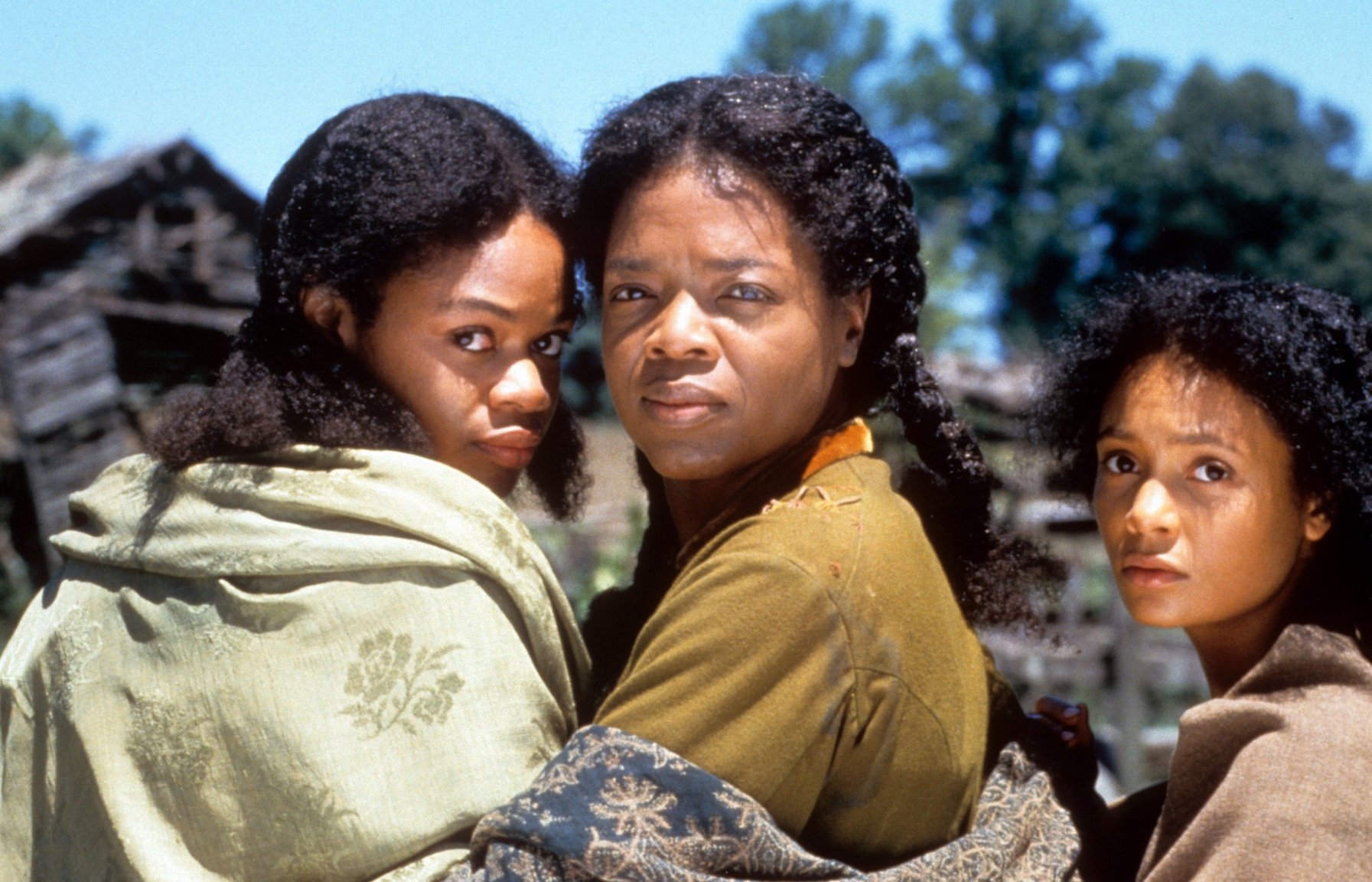
Left to right: Beloved (Thandiwe Newton), Sethe (Oprah Winfrey), and Denver (Kimberly Elise) in Jonathan Demme’s film adaptation of Toni Morrison’s Beloved. © 1998 Touchstone Pictures.
In Toni Morrison’s story Beloved, ghosts are in the everyday world, and her main character, Sethe lives in a haunted house: “124 was spiteful. Full of a baby’s venom.” A baby’s venom. The novel’s first line confronts us with an angry and sad baby-spirit. But when an unexpected figure from Sethe’s past, her brother-in-law Paul D, visits her house, he is outraged by the persistent torments of this baby ghost. With positively biblical authority, he casts the spirit from the house. Thus banished, the baby-spirit materializes in the flesh as a grown woman now of the age she would have been had she lived when, uncannily, she emerges fully clothed from the pond behind the house. Assuming the name Beloved off of the baby’s tombstone, this dripping-wet stranger soon is recognized by Sethe and her surviving daughter Denver as the incarnation of their familiar ghost.
Decades after its publication, Morrison’s novel retains its power to unsettle readers and revamp their relation to the past. In 2026, the year in which America celebrates its 250th anniversary, Toni Morrison’s (and my) home state of Ohio has launched a statewide commemoration dubbed “Beloved: Ohio Celebrates Toni Morrison” in conjunction with programming of Ohio Humanities Council and Literary Cleveland. The Nobel Laureate’s literature, life, and legacy are the subject of multiple events across the state and across Cleveland, including the Cleveland Psychoanalytic Center’s discussion of the film adaptation (1998) of Beloved. Inspired by this discussion of Morrison’s novelistic depiction of a resurrected, angry, yet loving baby, it has seemed to me that what Freud calls the uncanny might be the psychoanalytic place to start a discussion of Morrison’s magisterial novel. The uncanny is what Freud called the heimlich and the unheimlich, the familiar and the foreign, “that class of the frightening which leads back to what is known of old, and long familiar.” The uncanny sensations that Morrison frankly claims will “kidnap” her reader may offer a new knowledge of the self and the world. Not unlike, perhaps, the claims of psychoanalysis itself.
Part of the power of this novel from a psychoanalytic standpoint is how Morrison captures the desire and rage of the toddler contained in the body of a woman. Beloved reincarnated is greedy to make up for what she has lost, yet she is at the same time charming—seductive actually—in her confused longing and passion. Morrison has created a character who literally embodies the processes by which repressed material that may emerge unbidden from the unconscious unsettles and drags us back to primitive memory and desire. Beloved materializes Freud’s concept of the uncanny as that which is known and unknown, present and absent, alive and dead. For Freud, the experience of the uncanny in art, like psychoanalysis, throws us off balance and divulges unconscious knowledge. But crucially it can also offer new paths to creative expression and enlightenment. Morrison’s novel thus drags us into this psychic space unrelentingly and it does so through her depiction of enslaved characters emerged from the depths of American history. It is notable that the film version of Beloved, produced by and staring Oprah Winfrey, costarring Danny Glover, directed by Jonathan Demme was critically acclaimed but not a commercial success. Perhaps audiences in 1998 were not ready for such a bold confrontation with rage, resistance, and even recovery. Now, at the close of this year—2026—we listen again to Morrison’s story of one enslaved family’s fight to the death for freedom. Yet it does feel uncanny—frightening yet fitting—to do so alongside our great nation’s birthday, and its celebration of freedom.
The Audacity of the Archive
I believe it is Morrison’s archival work that allowed her to be so bold as to tell a ghost story—and one that has taken its place among the great American novels of our time. The story of Beloved derives from history: It has been taken from the legal case of an enslaved woman, Margaret Garner, who in 1856 escaped from her plantation in Kentucky to cross the frozen Ohio River onto freedom. Margaret Garner’s former slave-master then hunted her down under the Fugitive Slave Act of 1850 and recaptured her in Ohio. Trapped in a woodshed, rather than allow her children be subjected to slavery, she cut the throat of her toddler and attempted to kill the others. Margaret herself was tried in a court of law, but was found, by the presuppositions of the prevailing culture, not to be human but property. Being so defined, she could not be imprisoned for the crime and so was was returned to her slave master.
Morrison has made it clear that while her story derives from the Margaret Garner case, she is not writing “historical fiction.” Rather, the resonance of history offers her a portal into the past. She encounters the past experientially and she takes her reader by the hand to do the same. This means of transport allows her to tell her story in such a way that it seems no longer a fiction but rather a rendition of a life. She tranmutes events, encounters, conversations, and catastrophes into a realm into which the reader, too, is transported. Memories tremble in houses and furniture, throb on the scars of bodies, animate objects like earrings. In Morrison’s world, things cry out the truth like the stones in the gospels. This is history told Morrison’s way, but it is not, she has said, “magical realism.” The author eschews this literary categorization because hers is not a tale of enchantment. Her novel draws from the “unthought known” of the archive in order to revivify records that can be integrated from and into American history. Where the historical archive records what happened, its documents may not capture the subjective experience of those events. In the novel, Sethe beats back the memories not bearing to know and yet not able to resist her craving for memory and knowledge so brilliantly captured in the knowledge that her mother tells her before she fully is able to understand what it means that she has the brand under her breast and this marks her as her own in a world where she is not able to attach beyond these furtive encounters. It is this memory that fuels her determination to get milk to her baby and likewise fuels her unthinking decision after only three months of freedom, to slit her baby’s throat rather than let her be murdered in her soul.
Beloved confronts how under American slavery motherhood itself becomes a site of trauma. Her depiction of such an appalling act of biblical proportion alienates us from her character, but if we allow it, Morrison will also alienate us also from ourselves as we are ripped from our familiar world of “natural order” into anxious uncertainty. Morrison’s effect of derealization, the blurring of instinct, reality, and morality, lifts the veil of repression from her characters and readers alike. When art thus revives primitive and unconscious feelings through lifting repression, the experience of the uncanny may reveal, again, life-altering truths.
Wheras psychoanalyst Christopher Bollas has called “the unthought known” that knowledge from infancy that precedes conscious awareness or articulation, Morrison presents us with her version of the unthought known as a knowledge that is unthought because it is unbearable. Despite her efforts to “beat back the past,” Sethe must daily resist the intrusions of her “rebellious brain” that is always greedy to revivify the horrors of memory. The novelist, too, lifts the veil of repression to tell the story of American slavery.
More than an history book, and certainly more than any politicized treatise, Morrison tells the story of American slavery cathartically, through the pity and fear of one family’s human tragedy. She writes, “I wanted the reader to be kidnapped, thrown ruthlessly into an alien environment as the first step into a shared experience with the book’s population.” From such abductions, we psychoanalysts can learn new things.
What Do We Talk About When We Talk About Slavery?
It is generally understood that the traumatic core of the novel for Sethe is not, ironically, the slaughter of her baby but rather another scene upon which her escape from the plantation, Sweet Home, is predicated. This scene in which the adult nephews of the new slave master (named schoolteacher) hold Sethe down and with “mossy teeth” steal her baby’s milk institutes mayem. This one assault where Sethe’s breast milk is “stolen” from her breasts may be said to spectralize the entire novel. The fraternal merriment of the young slave masters, so gratified by their perversion, is counterpointed by the silent and scientific precision of schoolteacher, who documents Sethe’s reactions to her breast-rape, listing in careful columns with animal traits on one side and human on the other. In this episode, Sethe’s past, present, and future collapse. Her character is now possessed by the one compulsion to get milk to the baby who has a natural right to it, the baby who has been taken into safekeeping over the river in Ohio and has been feeding on a “sugar teat.”
In such a scene the layers of signification are overwhelming. But its traumatic, catalyzing core is the perverse mockery of the primal scene of infantile bliss that presumably defines our shared humanity. Freud is correct that there is nothing more beautifully erotic than the tableau of the nursing baby and mother; indeed the patriarchal mantles of Western Christianity are perhaps mollified to the point of mutability by the prevailing representation—and sometime worship—of the Madonna and child. Baby Jesus at the breast is thus empowered to accomplish his world altering mission by what D. W. Winnicott would identify as early reliability! Louise Erdrich captures this drive in her poem “Birth,” as she writes, “When they were not yet human / When they could have been anything, / I was on the other side ready with milk to lure them.” Thus in this crtical scene, the nephews’ triumph depends upon this trope. She must be (and we as witnesses too) reduced by rape: taken down from her maternal pedestal and, so to say, treated like an animal. Melanie Klein might observe that these brothers envy Sethe’s breasts. Morrison’s ability to bring the experience of slavery to life is at its most disturbing in her depiction of Sethe’s violated motherhood.

If Sethe’s breast-rape is the traumatic core that propels the plot of the novel, then the climax of the novel comes unconventionally revealed—like almost everything else in the novel—through memory. This climax, too, draws from the archives when Paul D, in what Aristotle calls recognition and reversal, discovers from an old newspaper clipping that Sethe had been tried in a court trial for, of all things, murder of the same baby girl she risked her life to feed. Just as Morrison does not look away from Sethe’s blood-red crime, the film director Jonathan Demme does not look away: Brought into bold relief, the scene is forced upon us all. But what has brought us to this pass? What shift in worldview, in morality, and indeed in reality itself allows the inexorable tragedy to take its course?
We remember here that the “uncanny is in reality nothing new or alien, but something which is familiar and old-established in the mind … something which ought to have remained hidden but has come to light.” At the deepest level, there has been an uncanny shift in the way the “population” of Sweet Home—its slaves—come to know themselves and their world. With the death of the plantation’s original owner, Mr. Garner, there arrived a new slavemaster to run the plantation. The widowed Mrs. Garner is ill an unable to run the plantation. This new slavemaster, called schoolteacher, has instituted a new way of thinking. And that new way of thinking and knowing has instituted a new way of of being for the enslaved workers. Things change literally overnight with not just their status but their being in the world. Morrison offers in her narrative an example of what psychoanalyst Leonard Shengold calls “soul murder” by providing an acute, existential depiction of how identity is shattered by what one may call schoolteacher’s “theory” of race, and a new world order.
Whereas the old world of Sweet Home, under Mr. Garner was sour indeed, it remains a central premise of the novel that the relatively benign patriarchy of Mr. Garner set him apart from his own peers. His beliefs allowed him to hold men as slaves but, as he brags, “still let them be men.” He allows normal things like marriage and such spare mercies as, in Sethe’s case (at the age of fourteen), being permitted to pick a husband instead of being bred like livestock. Against this risable modicum of decency, schoolteacher’s new regime of a more controlled sadism is constrasted. For schoolteacher is educated and rational. He is the modern man who uses logical categories to destroy not just the body but the soul. The author herself makes these necessary, searing connections in her nonfiction essay The Site of Memory when she drily remarks that the “Age of Enlightenment” had as “its twin, born at the same time, the Age of Scientific Racism” in which great thinkers like David Hume and Immanuel Kant “documented their conclusion that Blacks were incapable of intelligence.” Old Mr. Garner permitted enslaved men to “Be men and to Do as men,” because they were determined to be enslaved by Providence, not unlike the slaves mentioned throughout the Bible, including, of course, the bedraggled and wandering Jews who were always understood to be human. No one who suffered under the yoke was expected to like it, but no one, by the same token, doubted their humanity. Meanwhile, the widow Mrs. Garner weeps, sick and helpless after hearing of Sethe’s torture. Though some might call them crocodile tears, I do not think Morrison depicts her grief that way. However one reads her compassion (along with her wedding gift to Sethe of the crystal earrings which will live as sentient objects in the memory of Beloved from infancy), such empathy is unthinkable in schoolteacher’s world of careful columns.
To find a way to get at the rigid rationalism that thus becomes the explanatory core of the novel, Morrison found inspiration if one might call it so in the archives. She herself is haunted by an entry from one Virginia slaveholder named William Burr who writes, “Put the bit on Jenny today.” Morrison adds, “He says that about 19 times in six months—and he was presumably an enlightened slave owner.” Enlightened for Morrison is a term which reaks of irony. She explains that the bit in the mouth, a contraption that had bells to track an enslaved woman’s movement was not so much for punishment or restraint as for degradation. Bits were “things that you wore while you were doing the work. Amazing. It seemed to me that the humiliation was the key to what the experience was like.” Such insight provides Morrison with her turning point in Beloved. For when Paul D finds out that Sethe killed her child, he lashes out by telling her she has “two legs, not four.” The depth of this insult is, of course, endless: what we psychoanalysts call projection. But its wounding effect allows the couple eventually to face what happened to both of them under the new regime at Sweet Home. Paul D confesses to Sethe that learning about her crime forced him to extrude from the “rusted-shut tobacco tin of his memory” the secret of his own soul murder by schoolteacher. Here Morrison confounds us once again with an essential, uncanny question: What makes a man, a man? What makes a mother? And after all, what makes a human? These supposedly civil insitutions were upheld by a denial of violence framed as enlightenment. In reckoning with the ease with which, historically, Enlightenment rationalism fostered a science of race that precluded the humanity of certain populations of human beings, we end up reckoning with how science may be used in our time to rationalize violence that threatens all humanity, and the planet itself.
Sweet Home: Where Chickens Come Home to Roost
If the scene of Sethe’s breast-rape is the catalyzing crime at the heart of this novel, then Sethe’s discovery that Paul D was there in the barn when it occurred and could do nothing because of the bit in his mouth brings the novel to its denouement. Paul D lets Sethe into secret dread that “I have never talked about … Not to a soul,” when he further confesses that his helplessness, however, was not due to the bit but rather his humiliation. Deranged by the “wildness that shot up into the eyes the moment the lips were yanked back,” destabilized, and nearly psychotic, this powerful man dreads most of all the mockery of the roosters.
“[I]t wasn’t the bit—that wasn’t it.”
“What then?” Sethe asked.
“The roosters,” he said. “Walking past the roosters looking at them looking at me.”
Paul D says he noticed the one dominant rooster named Mister, whom he had, in fact, raised from a chick, was “smiling” at him. The cruel smile of the rooster signals to the man that whatever fleeting and fractionated identity he had is now gone. Paul D, the last of the Sweet Home men, is now just “me licking iron with my hands crossed behind me.”
The castrating effect of schoolteacher’s methods which are directly designed to not allow Sweet Home men to be men is thus interpreted:
Mister was allowed to be and stay what he was. But I wasn’t allowed to be and stay what I was. … wasn’t no way I’d ever be Paul D again, living or dead. Schoolteacher changed me. I was something else and that something else was less than a chicken sitting in the sun on a tub.
The rooster whom he had raised as chick now struts his vibrant red comb, the signifier that he is, so to speak, cock of the walk: “I watched that son of a bitch grow up and whup everything in the yard.” The rooster lords his essential, animal nature over Paul D who has lost his human nature by the stroke of schoolteacher’s pen, and the animal bit that forbids sustenance and speech. The cock at least can crow. If, as we have suggested, schoolteacher’s calculated sadism paradoxically reinforces Sethe’s maternal drive to get milk to her baby and propels her to the desperate decision to protect her baby’s soul by sacrificing her body, Paul D, by contrast, is driven into the self-demeaning surrender of his manhood and condemned to wander the world still in chains, his heart locked in a rusted tin can. His degradation of Sethe is thus a projection of his guilty self-loathing and dread of his own instinctual appetites. Morrison renders for her readers a world that feels unimaginable until experienced, recognized, and brought into conscious thought through her art.
As an author who generously and frequently explained her intentions, Morrison repeated that she wanted her writing to function as a new form of thinking and that, paradoxically, she wanted to write the unthinkable. Sethe and Paul D, lone survivors of Sweet Home, share a traumatic history that has been banished into the unconscious only to return as a ghost that knocks around the house, unbidden but inescapable, and impossible to beat back. Morrison was perhaps no psychoanalyst, but any psychoanalyst can see that she is an artist who prophetically depicts the return of the repressed in the lives of fictional characters whose stories feel uncannily familiar in our own time of global slaveries, inhumane treatment of innocent populations, and disasters in the natural and animal world that are manmade. As she states in the foreword to a 2009 edition of an early anthology from 1974 that she coedited titled The Black Book, the very “health of the nation”—and we might add, the whole earth—depends upon remembering, imagining, and thinking about the lives of others, hauntingly familiar, then and now. Ars longa, vita brevis.
Vera Camden is a supervising and training analyst at the Cleveland Psychoanalytic Center, emerita professor of English at Kent State University, Associate editor of American Imago, and American editor of the Journal of Graphic Novels and Comics. Her edited Cambridge Companion to Literature and Psychoanalysis won the 2024 APsA book prize.
Published November 2026