Freud on the Brain
Mark Solms on why psychoanalysis and neuroscience need each other
By Lucas McGranahan
Collage by Austin Hughes
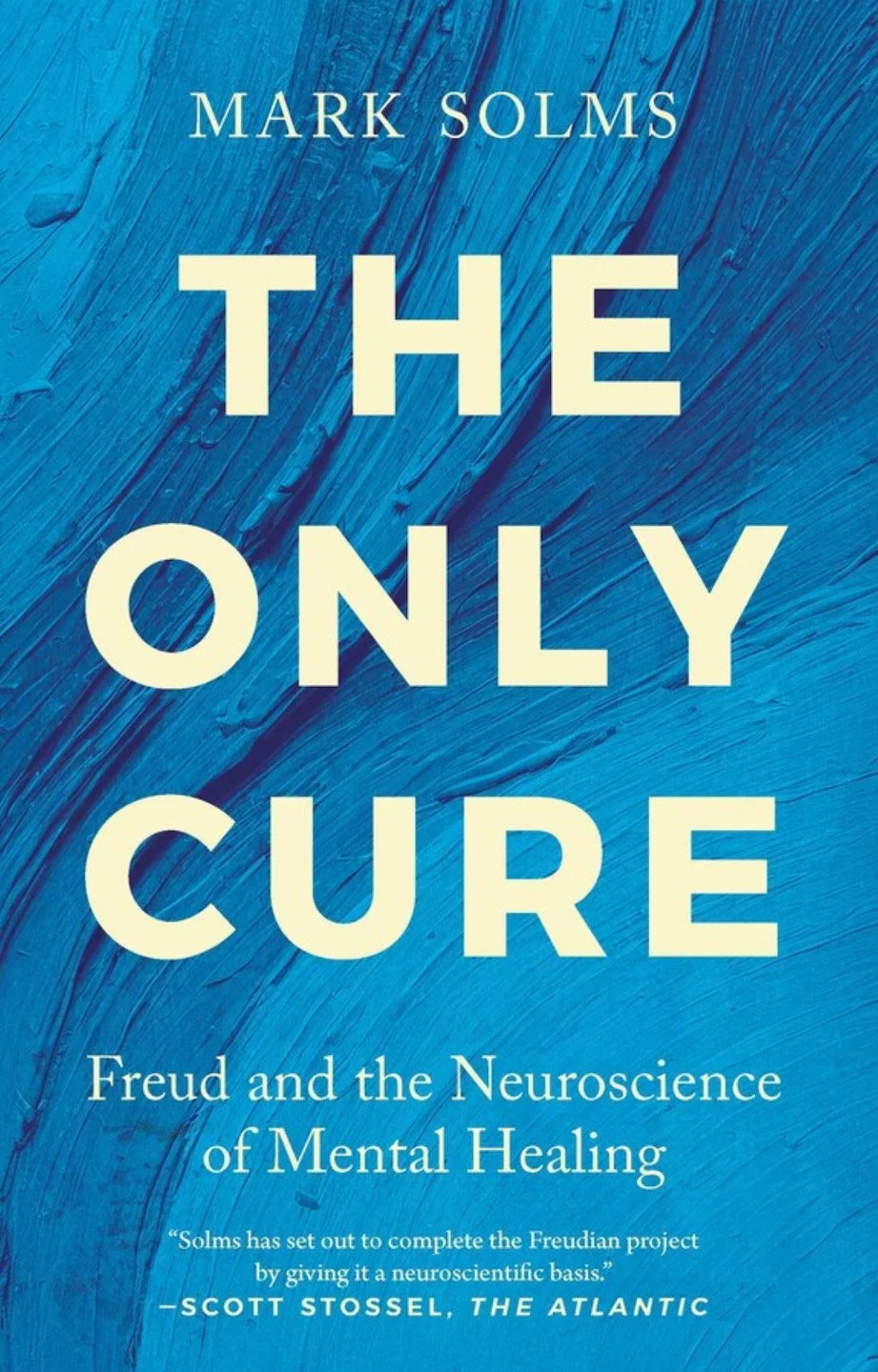
Mark Solms has built his career where brain and mind meet. A neuroscientist and psychoanalyst, he is the translator and editor of the Revised Standard Edition of Sigmund Freud’s works and author of the recent book The Only Cure: Freud and the Neuroscience of Mental Healing (Pegasus, 2026). Solms spoke with TAP’s Lucas McGranahan about science and subjectivity, the nature of unconscious memory, the limits of psychopharmacology, and the impressive clinical efficacy of psychoanalysis.
What misconception about Freud would you most like to correct?
The misconception of what Freud means by sexuality. People think, Oh, Freud is sex-mad. Freud is not. Freud is merely drawing attention to an extremely important thing, which is that what motivates human beings is feelings. We are driven by the pursuit of pleasure and the avoidance of unpleasure. That’s his pleasure principle. The word libido, he says, is by analogy with the word hunger. It’s a desire for pleasure, as opposed to a desire for food. Libido is a pleasure hunger.
It’s absolutely reasonable, what Freud’s saying. And it shows you why we need psychology, in addition to biology. Because what drives the human being’s behavior is partly determined by the subjective side of human being. We are bodies, we are animals, but we’re also subjects. Freud was trying to bring the subjective side of the human being into medicine, and thereby into science.
We still have trouble reconciling science with subjectivity.
Science doesn’t like subjectivity. It tries to exclude everything that’s subjective. They say, “Oh, that’s hocus-pocus, medieval, or animism.” But sorry, subjectivity exists. It’s part of nature. Because you and I know, from our most everyday experience, what you feel has consequences for what you do. So, if you don’t take account of the subjective side of things, you’re going to get horribly lost.
How do you bring psychoanalysis into conversation with contemporary neuroscience?
Psychoanalysts are not just interested in free associations. They want to know what the underlying organization is that produces them. Likewise, neuroscientists are not just interested in looking at neurons. They want to know what’s the underlying organization. That’s the common ground between the two disciplines.
The exercise of correlating psychoanalysis with neuroscience is to correct viewpoint-dependent errors. We [psychoanalysts] have contributed to the cognitive neuroscientific understanding of the unconscious by bringing in the motivational dimension, which is a very important part of it. From a neuroscience point of view, we’ve also learned a lot about what we call nondeclarative memory systems—the cognitive unconscious, as they call it—that Freud couldn’t possibly have known using the methods that he used.
How does neuroscience depict the unconscious?
Many psychoanalysts seem to think that the unconscious memory system is like a movie going on in your head. There are all kinds of internal objects, like, eating each other’s breasts, sticking their penises in each other’s eyes, and God knows what. It’s a phantasmagoria. But the way that we understand it in neuroscience, these are subcortical memory systems. They’re not even representational. The cortex is where the images are. Once they get consolidated down into the subcortical memory systems, they’re no longer images, they’re not mappings of the perception of the world. They’re not rerunning movies. They are running the action policies that we have generalized and learned.
Freud himself, in a very famous paper, said that whereas the preconscious systems give rise to remembering, the unconscious system gives rise to repeating. And we psychoanalysts know that the unconscious is enacted in the transference. It’s an enactment, it’s a repetition, it’s a doing. It’s not a thinking. We can’t think those things.
You say that unconscious memories are not revisable. They can’t be deleted or edited. Isn’t that what psychotherapy is for?
In my view and in my experience, the unconscious repressed impulses don’t go away. That’s why we can get worse again. We can go back to our bad old ways because our bad old ways are still there. The best we can hope for is the patient feels inclined to do that automatized thing, but now they know it. They recognize it. Oh, here I go again. And then they change their minds. It’s called free won’t.
You can veto the impulse.
Yep. By the way, that’s an eminently Freudian view, that the preconscious inhibits the unconscious. It doesn’t eliminate it. It doesn’t replace it. The mature Freud speaks not about undoing repressions, he speaks about construction and reconstruction in analysis.
Your book The Only Cure has two main goals: to show that Freud was a prescient neuroscientist and to show how clinically effective psychoanalysis is. How do they connect?
You can see a red thread from Freud’s work on the single cell to his work on aphasia to what we nowadays call functional neurological disorders, which were called hysteria then. Eventually, you have to start thinking in functional terms. You’ve got to think about the aggregate functions and the virtual arrangement of functional systems. Freud was beautifully clear about this stuff. He said mental functions are not located in the elements of the nervous system but rather distributed between them. In that way, Freud was led to conclusions about what the underlying organizing principles are. And those conclusions proved to be absolutely prescient, because neuroscience now has caught up, and we’re seeing the same big picture.
If that’s the case, then maybe Freud’s therapy is also not as old-fashioned and unscientific as everybody claims. And so, I looked at the evidence. And the evidence is, yes, it works! That’s the best-kept secret in psychiatry. It’s a bloody effective treatment.
And don’t forget that we’ve shown the high effectiveness of psychoanalytical therapies playing by their rules, the rules of people who don’t understand a thing about how the mind works. With our hands tied behind our backs, we still have a highly effective treatment measured in the way that they want to go about measuring it. But that’s our own fault, because we weren’t there when the rules were drawn up, because we stayed aloof of the whole business of measuring the outcomes of our treatments.
You make strong claims on behalf of psychoanalysis in the book. For instance, you say that nearly every psychiatric disorder is best understood psychologically, as opposed to pharmacologically. You say that drugs can only treat symptoms, not causes.
I want to be clear that I’m not saying there’s no place for psychopharmacology. I had a patient today with a spinocerebellar ataxia. She’s as depressed as can be. And my view is the only treatment for her is an antidepressant. It’s got nothing to do with the history of her life. These patients get severe endogenous depressions. So, there are conditions, but they’re neuropsychiatric conditions, where you’re actually fixing the problem with drugs. But in the patients that we see as general psychiatrists and psychoanalysts, that’s not the case.
You note that Freud speculated about one day curing patients by acting directly on the brain. But you are skeptical about that possibility.
Your whole predictive model, as I call it—what Freud calls your ego, the individualized memory traces of your trajectory through the world—can’t be changed by a chemical. It’s literally impossible. It’s an incredibly complicated lattice of mechanisms that regulate the chemicals, in other words, the drives. How do I go about dealing with these forces? It’s a whole model of how the world works, how I get my needs met in that world, and so on. To tweak that, you need psychoanalysis.
But, I also said that I wouldn’t bet against Freud too quickly on anything. There may be undreamt-of possibilities. Nobody can predict what’ll happen. The problem is that we’re living in a present where everybody believes this bullshit that chemical imbalances are the causes.
If you could redesign mental health care today, what would it look like?
Psychopharmacology would be used for the very most part as an adjunct to psychotherapy, or as a facilitator of psychotherapy. There is a place for psychopharmacology, not only in neurological patients of the kind I described earlier, but also in crisis management. But the mainstay of mental health services would be trying to understand what has gone wrong in this person’s life and how we can intervene.
Not everybody needs, or even can benefit from, psychoanalysis. But there are all sorts of derivatives of psychoanalysis, all sorts of psychotherapies. The most important thing is distilling the active ingredient of psychoanalysis, which is treating the predictions and supplementing the bad predictions with ones that work better.
What’s in the way of that? Is not cost-effectiveness. There’s been very good studies done on this, like a 2020 study which was fantastic on showing how cost-effective even low-frequency psychoanalytic therapy is. The total health care burden is reduced, let alone the contribution that the person can make to the economy as an effective member of the workforce, and so on. The main impediment to getting this kind of treatment delivered on a public health care scale is the profit motive of the diabolical pharmaceutical industry and its unholy alliance with the state, especially in your country. They’re just laughing all the way to the bank.
As translator of the Revised Standard Edition, you have spent probably more time than anyone alive thinking about Freud and reading Freud. How have you internalized Freud?
I’ve internalized Freud to such an extent that I am able to draw upon his thoughts without even knowing I’m doing that. I just know what Freud might have thought, I don’t even know that I know what Freud might have thought. So, I’m applying a Freudian frame of reference to problems that Freud didn’t even try to apply them to.
If you go through Freud with a fine-tooth comb in the way that I’ve had to—not because I’m a hero worshipper, but because I’m a translator—you’ve got to understand him. And I understand what an absolutely brilliant scientist he was, what an extraordinary mind he had, what things he saw which I would never have understood. So, on a personal level, I admire the guy. He’s greatly underestimated in terms of what a brilliant contribution he made to science, not just psychology, not just psychiatry, but to the whole of science. I think it’s precious, and it mustn’t be lost. I think Freud was no more of a genius than Einstein or Niels Bohr or Newton or Darwin, but he’s on that level.
There are things that I disagree with Freud about because I’ve got access to data that he didn’t have, derived from methods that weren’t available then. And I really wish I could argue some issues out with him. I find myself fantasizing an argument, trying to persuade him, trying to show him where he was wrong. In my fantasies, in the end, he always says, “Ja, ja, I think you’re right.”
This interview has been edited and condensed.
Published September 2026