Hoarding the Future
A manifesto and a plea
By Brian Ngo-Smith and Teresa Méndez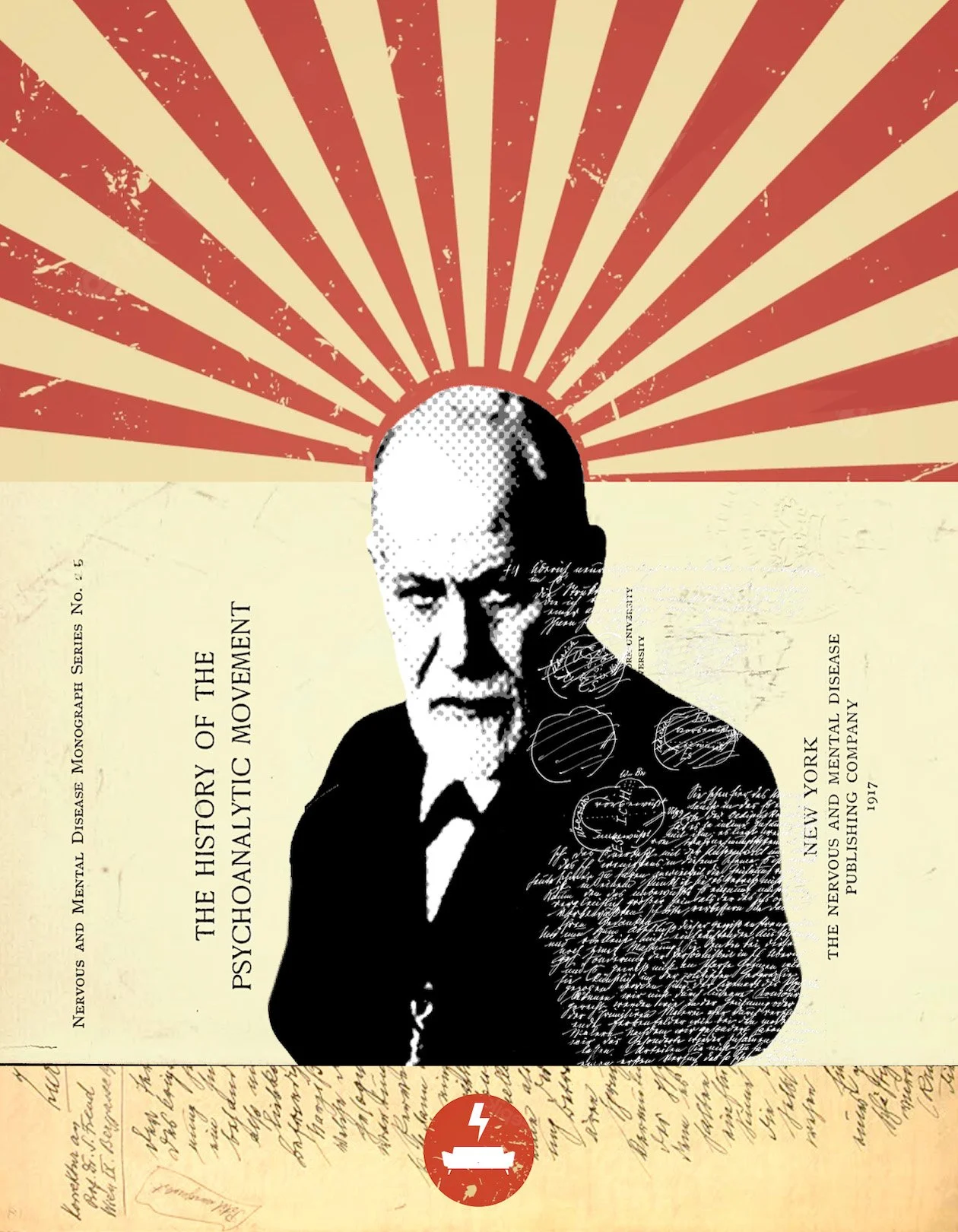
Illustration by Austin Hughes
We believe the field of psychoanalysis is failing to intervene at a moment of tremendous generational anxiety. Our task is to think these anxieties. Only then can we loosen the reflexive binds that knot us to our elders, and to their elders in turn: the inherited identifications and loyalties that shape institutional psychoanalysis.
In his 1914 essay “On the History of the Psycho-Analytic Movement,” Freud insisted that psychoanalysis confront not only psychic conflict in the consulting room but also the rivalries and resistances over institutional inheritance within its own ranks. Writing at a moment of generational tension himself, he understood that the future of psychoanalysis depended on tending to these dynamics. Freud often failed at this. And the history of psychoanalysis is riven with splits and defections, bitter disputes and excommunications.
We write today in this same spirit of critical engagement with our legacies, out of concern for what becomes of a psychoanalysis whose generational anxieties remain unthought and are instead enacted within our psychoanalytic institutions and communities. We understand these anxieties as murderous fears and wishes: parricidal, filicidal, and siblicidal. They emerge in rigid and sometimes punitive training cultures that can produce stalemates and loyalty binds—the quiet hardening of hierarchies that cannot imagine succession, alteration, or replacement.
Many of our senior psychoanalytic colleagues, for example, take their mentoring roles very seriously. Yet still they find ways to interminably extend the requirements of our training. They repeat the innocent refrain: What’s the rush?—as though we (and, by extension they) have all the time in the world.
While our field has long acknowledged the regressive nature of psychoanalytic training—the dependency, rivalry, and competition—our institutions have not meaningfully attended to the narcissistic injuries of aging and mortality, wounds that confront us all.
Until our communities develop a greater capacity to encounter and work with these vulnerabilities, we question how fully our institutions, and therefore our field, can engage with any question of otherness. Experienced as a breach in the imagined psychic lineage, difference—of race, gender, class, or perspective—so often signifies a threat to institutional continuity. Those who represent some Other perspective, whether theoretical or cross-disciplinary, or whose affiliations seem suspect to those with power, may come to embody a contamination of the purity (the eternal life) of psychoanalysis itself.
These dynamics are rooted in narcissism, that perennial bloom, forever animating our allegiances and our revolt in the face of the Other, whose ancestry diverges from, and is felt to endanger, our own. When generational anxiety remains unthought, difference becomes intolerable. Our field risks replicating the very exclusions and violence it claims to analyze, turning psychoanalytic insight into a badge of privilege rather than a practice of understanding.
Psychoanalysis is narcissistically challenging work, inherently and by design. Yet rather than fostering collective thinking and shared futurity, we have constituted our professional communities and learning environments around individualism-nurtured-in-pairs, a retreat from the challenging realities of group life. Our existing institutional structures do not offset this narcissism. They magnify it. They act as an accelerant, not an antidote, to the isolation and cults of personality that too often abound.
We acknowledge both the wisdom and the human vulnerability of our predecessors. But if psychoanalysis is to endure, it cannot be hoarded by any one generation. Since its earliest days, we have been tasked with using the tools of our craft to reflect on ourselves, not strictly in our analytic and supervisory dyads but in our broader professional organizations as well. These efforts often falter, leading back to a homeostasis motivated by the wish for immortality, averse to the inevitable losses ushered in by time.
We are making a plea to stay with us in the pain of these losses, a plea to share the future.
Brian Ngo-Smith, LCSW, FABP, a psychoanalyst and clinical social worker in Denver, Colorado, and Teresa Méndez, LCSW-C, LICSW, a psychoanalyst, clinical social worker, and former journalist in Baltimore, Maryland, are past presidents of the American Association for Psychoanalysis in Clinical Social Work (AAPCSW). Together they are founders of the Sharing the Future Project and offer facilitation, presentation, and consultation on organizational succession and grieving. They can be reached at brian@ngosmiththerapy.com and tmendez@baltimorepsychotherapy.org.
Published March 2026