The Compulsion to Click
Surplus enjoyment in Kurosawa’s Cloud
By Kyle Sossamon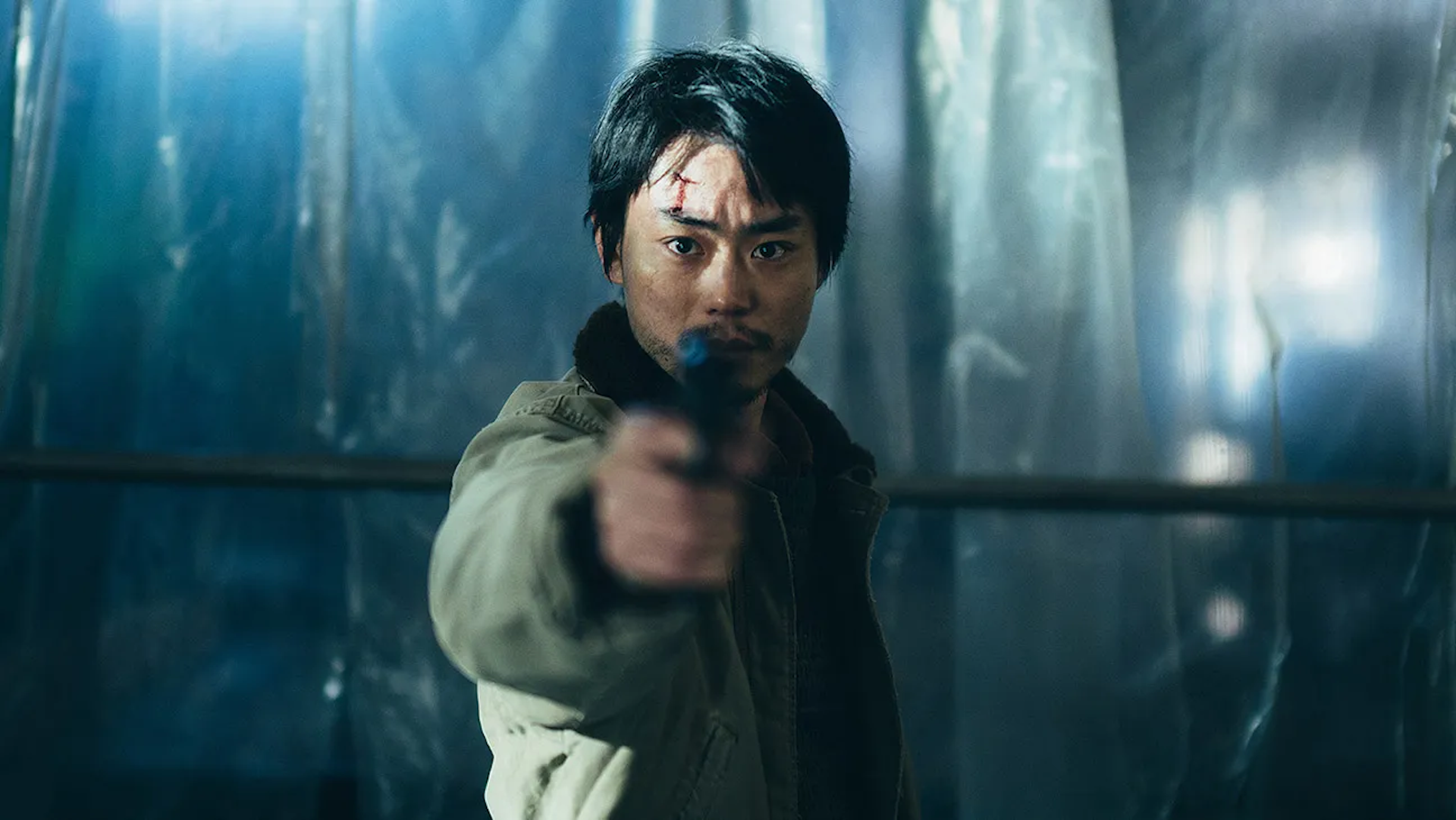
Movie stills courtesy Nikkatsu Django Film. ©2024, Cloud Production Committee.
It is midafternoon. Sitting at his desktop computer in a dimly lit, cramped apartment cluttered with packages, internet reseller Ryosuke Yoshii’s (Masaki Suda) finger hesitates over the mouse—the tension builds as if the inevitable click were the pulling of a trigger. The cursor hovers over the familiar icon on an Amazon webpage: “Buy Now.” The tension is offset by interjections from Akiko (Kotone Furukawa), Yoshii’s girlfriend, who muses on a possible future together—if they only had the money to make it possible. The cursor moves off the “Buy Now” button and Yoshii adjusts the quantity of his purchase—not 20 but 30 copies of Fiber Embalm (a fictionalized version of the Fire Emblem series), a hot new tactical role-playing video game—and back to the “Buy Now” icon. But he hesitates. Akiko wants to know if they should go out for dinner, Yoshii turns to answer in the affirmative. But the video game is now sold out. Just a click away, as they say.
Kiyoshi Kurosawa’s latest film, Cloud (2024), follows a protagonist who supplements his factory wages by moonlighting as an online reseller, buying up all of a particular commodity and then reselling it anonymously for an exorbitant markup. If Yoshii is measured and unmotivated at the factory, he is impassioned as a reseller. Operating on impulse and instinct, Yoshii serves the digital gods of e-commerce, who bestow their blessings on the just and unjust alike: Chance and risk are the masters of fate, and one must act impetuously to seize momentum. Yoshii does not care if the goods he hawks are authentic or of good quality. All that matters is that they sell.
What is of interest in the scene, and what the film as a whole captures so poignantly, is the psychic investment in the physical act of the click. Speaking psychoanalytically, we might ask where the object of desire is in this exchange, or how the drive relates to this repetitive action that governs so much of our daily lives online. What is Yoshii fixated on in this moment of hesitancy? What ascribes so much existential weight to such a small gesture?
In other words, how does the click organize enjoyment?
In the film, the click is primarily a means for controlling the prices Yoshii sets for his questionable goods. When he needs to unload items quickly, or grows anxious that his items will not sell, prices can drop astronomically in mere minutes. At a deeper level, however, in a world organized by digital exchange-value—and where black-market dealings are structurally enabled—the click is an instrument of feigned intimacy that creates the appearance of immediacy: an anonymous gesture that keeps exploitation at arm’s length.
In its role as a habitual action that shapes behavior, the click is precisely where desire and drive intersect, unveiling the character of enjoyment for both Yoshii and his customers.
The click is haptic: It stimulates the sense of touch. The connectivity of cyberspace finds its personal anchor in the contact between hand and device: a union that facilitates virtual communion in a state of isolation. Stimulation gives way to simulation, however, since this gesture of contact actually produces deferral and distance. Instantaneous is how we often think of it: transactions, comments, likes, and so forth seem to be immediately carried out by a click. But its result is always delayed, while the underlying process remains invisible. The user must sit and wait for the effects to manifest—as captured by the slogan popularized by George Eastman for Kodak when the snapshot camera was first introduced: “You press the button, we do the rest.” The promise of immediate gratification in screen culture, from the camera to the computer, obscures the delays and mediations on which it depends.

In a sense, the click brings pleasure accompanied by the sting of a latent “wait and see.” The excess of that sting is tinged with an emptiness—and not an immaterial emptiness, either. For a reseller, the object purchased is of next to no inherent interest. The period of time between purchase and arrival—the resale gap—is not filled with expectancy, or anticipation for the potential enjoyment to be had while using the object, since the latter is only meant to be exchanged again. A paradox of clicking emerges here for Kurosawa: Far from a digital means to procure an object of satisfaction, the resale gap reveals the click as an activity whose pleasure results from never possessing the objects that are procured. The packages that clutter Yoshii’s home are the physical embodiment of this emptiness; while they do contain objects for others, they are, in effect, perpetually empty for Yoshii.
Had Yoshii not missed his opportunity to secure his Amazon order, he would still have had to wait for the product to arrive, meticulously photograph it and post it online, and await the clicks of potential buyers. Such delays may appear, of course, during any goal-oriented process. My point, however, is that there is an enjoyment peculiar to waiting in our digital culture that is exemplified by the constancy of clicking. Kurosawa’s film shows us how libidinal investment is mobilized by the haptic act of the click; and, as a site of investment, that the click retains a quotient of this enjoyment unto itself. Pleasure is induced through this repetitive cycle of clicking and waiting in the very disturbance of immediacy, in the restlessness of delay.
What we have here, then, is an important, if counterintuitive, adjustment to classical Freudian doctrine that the French psychoanalyst Jacques Lacan introduced. For Freud, pleasure is primarily a means to reduce excitation and return the psyche to a homeostatic state. Lacan, by contrast, gives us the concept of surplus enjoyment (or jouissance), which accounts for the experience of becoming psychically invested in a habitual and meaningless act. The delay in the activity—a frustration that is necessary to the completion of the act—far from being a simple disturbance, generates an excessive enjoyment to accompany the absence of any real gratification. Not a pleasure in pain, per se, but an enjoyment in futility and beyond utility.
Following Freud’s insight, Lacan also recognized that that which is irreducible to the pleasure principle must, in some sense, be beyond it. Thus, surplus enjoyment is intimately bound up with the death drive.
Surplus enjoyment, then, particularly in the form of clicking, is a waste of energy. A senseless expenditure oriented towards the perpetuation of a flawed system. Which is why Yoshii’s practice of objectless investment and his excitement in states of deferral are representative of the truth of clicking. Clicking generates more clicking—such is its general purpose.
Halfway through the film, Yoshii sits alone in a new house, after he and Akiko have fallen out. He watches as the flickering icons underneath images of some twenty unique figurines that he has recently acquired and posted for resale begin to change. The icons blink, reading “SALE” (highlighted in blue) until they are selected by a buyer, at which point the icon blinks “WANT” (in orange) and then finally “SOLD” (in red). The moment marks a suspenseful pivot in the film. Yoshii, having quit his factory job and committed fully to the e-commerce hustle due to a big score earlier in the film, is now desperate for another major turn of luck. As the flickering icons progress from stage to stage and the promise for a reward heightens, the “SOLD” message is accompanied by an unsettling noise from within the house. While investigating, Yoshii is confronted by a surprise.
As it turns out, Yoshii has become the target of a doxing campaign waged by his dissatisfied customers, whose rage has turned to blood lust as Kurosawa now revels in satire and suspense. The digital exploiter is here literal prey to a hunting party acting on behalf of an online messaging board community, and Yoshii’s execution is set to be livestreamed for all those wanting extrajudicial justice, as soon as they log on—via a click.
This turn of luck is inaugurated in the film by Yoshii’s fixed attention, with bated breath, as the virtual buyer clicks on their own device some unknown distance away. Kurosawa’s use of shot-reverse shot heightens the tension here. As the film cuts back and forth between close-ups of Yoshii and his computer screen, it is as if the virtual buyer—who is surely to have become another exploited dupe in the end—is suddenly given a material presence in Yoshii’s home, in the form of the hunting party, as the structural violence perpetrated by Yoshii’s market practices is turned back on him in the form of real violence at the hands of vigilantes.
The delay of the click collapses here, to Yoshii’s detriment. Just before the home invasion, one of the disgruntled buyers-turned-hunters encourages another member to “enjoy” himself during the affair, for that is what it is really all about: the procurement of an enjoyment that they have been robbed of. This is where Kurosawa’s film comes to a psychoanalytic head. If the click is a site of libidinal investment where satisfaction is both excessive and wanting precisely because it must remain indefinitely stifled, then the acting out of the hunters is a means to eliminate that delay. Their violence is a shortcut to enjoyment. Enjoyment can only be had, in this digital economy of dissatisfaction, either through the protocol of the click or an affective outburst, figured in the film as a heinous pursuit of bloody vengeance.
The click brings pleasure accompanied by the sting of a latent “wait and see.”
Curiously, then, we have in Kurosawa’s film an explicitly Freudian conception of how aggressivity is coopted and tamed for the sake of managing social (dis)harmony, but with a slight twist. Yoshii uses clicking to enact a violence of swindling whose mediation by the cloud anesthetizes users to the exploitative encounter. Disgruntled and duped, their obvious recourse is to simply find another reseller and go on clicking. By contrast, those willing to step outside the cloud, as it were, are in effect rejecting the dominant means of sublimation provided by e-commerce. More clicking will no longer suffice, for them. The hunting party embodies a destructive impulse, without a system of delays.
What Kurosawa shows us is therefore twofold. First, that a sublimated activity can be automated, handed over to a technical system. Such is the case with the click, which, without an object of investment, takes on the role of housing psychic energy itself. We might say, then, that the click is an indiscriminate and totalizing means of contemporary sublimation—but there is an important caveat to consider: the role of deferral. And this is the import of Kurosawa’s second insight. Far from simply displacing the pleasure in aggression from one site to another, the click facilitates an everyday enterprise of chronic wastefulness. That is, instead of transforming libidinal energy through redirection (sexual frustration channeled into the production of a work of art, as a common example runs), the click now suspends that energy, holding it in a state of indefinite deferral.
A feedback loop of compulsory action through which the eruptive or transformative excitement of a would-be destructive outburst is exchanged for the monotonous and profligate expenditure of time and energy. That is how the click organizes our enjoyment.
We are all bound by an appearance of immediacy that is not simply thinly veiling an aggressive tendency, but needs that very tendency to remain in abeyance in order to uphold the appearance. Such is the crux of Kurosawa’s unsettling narrative: the waste, that is, a seemingly inessential obstacle, is in fact essential to maintaining a certain minimal social cohesion, however bleak. In effect, this wasteful expenditure of energy, and time, embodied in the practice of clicking, provides an outlet for a dormant aggression.
Cloaked in the anonymity provided by the titular cloud, Kurosawa’s film implies that the jouissance of the click—this surplus enjoyment as waste of energy—may be preferable to its violent alternative. Precisely because the aggression is irremediable. Most unsettling, then, is not the combination of structural and physical violence the film depicts, but the suggestion that our own aggression is silently and efficiently operative every day—unconsciously working through our fingertips, in the compulsion to click.
Kyle Sossamon is a PhD candidate in Art History at Binghamton University, writing on photography, psychoanalysis, and media theory. His academic work has appeared in Critical Inquiry, the Journal of Visual Culture, and Psychoanalysis, Culture & Society.
Published April 2026