Horse Medicine
What equine therapy can teach us about grief, trust, and healing
By Natasha Davani
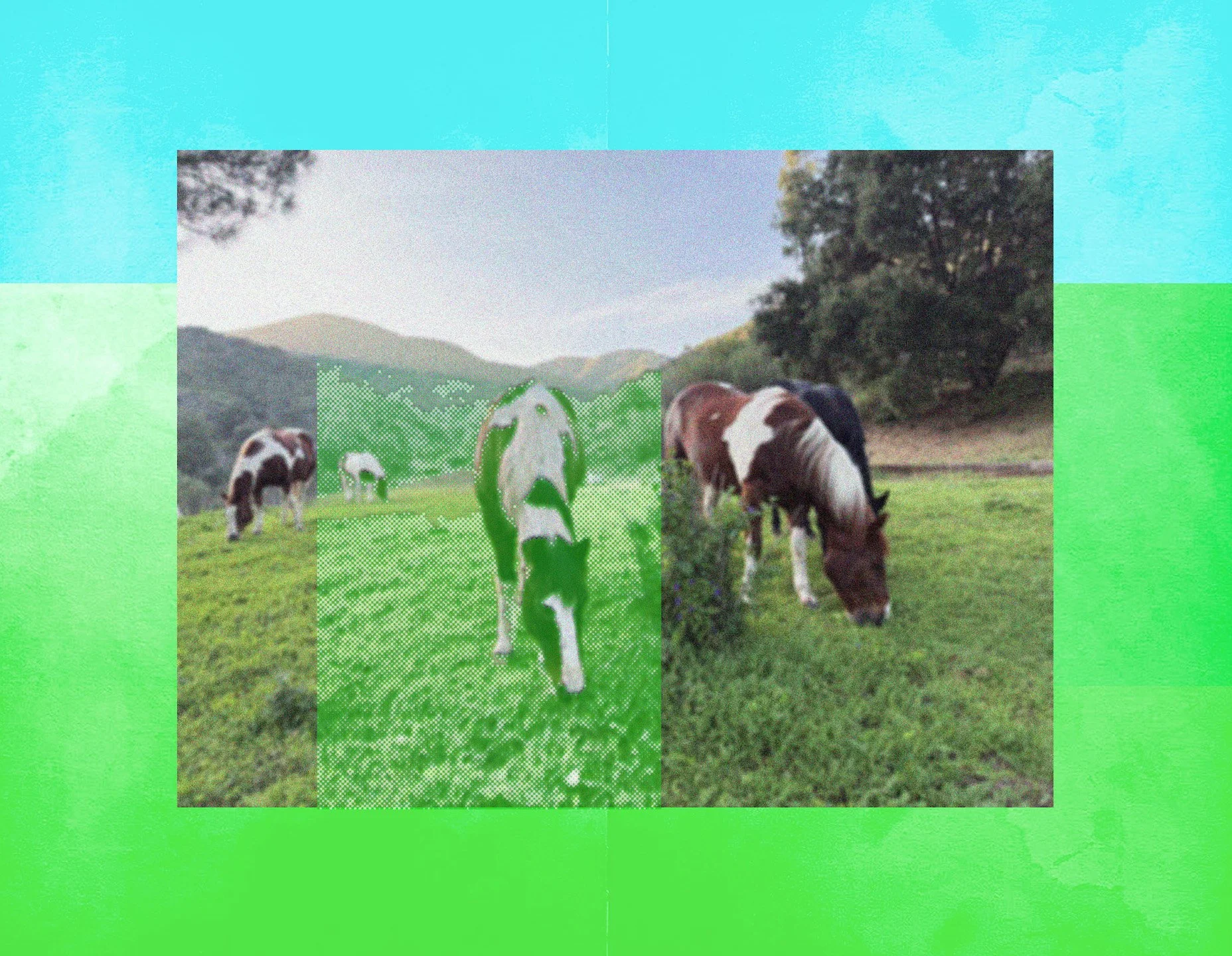
Photo rendering by Austin Hughes
I arrive at the ranch just before the late morning sun becomes unforgiving. I park my car on the dirt road and am greeted first by Storm, a spirited white Arabian gelding, who trots eagerly to the gate. I glance at my phone: 9:59. Right on time. His mane is characteristically knotted; he’s the only horse who won’t let anyone brush him. He’ll merely tolerate a swift curry comb, running in rhythmic circles on his back and withers. Upon seeing me, his ears flatten angrily.
I slowly lower the brush—a peace offering. His ears contentedly rise: the ceasefire.
“Hey, big fella,” I murmur. “It was worth a try.”
My phone lights up with a message: My client, Iris, is running late. I take a quick visual inventory of the present horses, and exhale.
The Old Agoura ranch where I conduct my equine sessions is particularly free-form: A small herd of geldings resides in a large corral with an adjacent hillside, earthed on historic Chumash land. It’s not uncommon to see any of the horses triumphantly perched on the hilltop, looking down curiously at the ranch’s various visitors—an eclectic mix of riders, boarders, and therapy clients—and slowly lumbering down the hill to greet or examine them.
Noting my forfeited attention, Storm turns flippantly, trots to the other side of the corral, and nips at his herd-mates. I marvel, as I often do, at how brash and brawny he is with his own kind, yet how even-tempered and gentle he becomes with young children who want to pet him. Watching him now, a young mother and her son, set for a trail ride to begin soon, approach him. The mother hoists her son onto her hip.
The little boy yelps in delight. Storm dutifully lowers his head, not even snorting when the boy inserts his fingers into his flared nostrils. The ranch’s resident Great Pyrenees leans languidly against my leg, and we wait patiently together, side by side.
***
Therapeutic equine work can remarkably simulate secure attachment in a way that feels achievable for even my least trusting clients. Many of my clients have been deeply betrayed, ostracized, abused, or abandoned by other human beings—sometimes even their therapists. The immensity of their vulnerability in even coming to see me—another human with great capacity to fail them—can feel Herculean.
With horses, the emotional stakes are lower. A horse won’t cheat on you, suddenly leave you, or tell you nothing you do for them is good enough. Due to their sensitive nature as prey animals, their trust is harder won than a dog’s. But like most secure attachment, it can be reliably earned through consistency, respect for their boundaries, and honoring their needs. In real time, you can often observe clients’ clenched jaws unspool or their posture relax as they knead their hands through a horse’s braided mane or brush their palms along their necks, creating the beginnings of a mutually nurturing bond.
Horses’ sensitivity manifests in their profound attunement to humans. At the ranch, clients tend to take deeper personal inventory of how they carry themselves, their bodies, and what can be expressed beyond words. While many lament the language barrier between themselves and such a massive animal, I remind them it’s a language they can learn to speak.
Yet working with horses can still be extraordinarily dangerous and unpredictable. As a former dedicated equestrian, I now walk with a very slight limp from my own experience with such risk: a horseback riding accident I got into as a young teenager. The scar tissue also presses lightly on the nerves in my back, a neurologist informed me years later. It’s why the left side of my body is permanently slightly asleep. He informed me, rather grimly, I’m very lucky I can still walk. I don’t forget it.
When people ask me why I only offer ground-based equine therapy, this is partly why. While riding horses offers its own therapeutic benefits, it significantly increases risk of injury, both in magnitude and velocity. Being thrown from a horse at a full canter or gallop, as I once was, tends to lend more impact to physical damage than being nudged roughly or bitten by a horse standing beside you (though the horses I work with never bite or kick humans—a basic condition for equine therapy suitability).
But the main, deeper reason for ground-based equine therapy lies in a certain symbolism I often directly note: In ground-based work, clients aren’t asserting any true dominion over a horse, as is inherently done when riding; they become equal partners in the therapeutic journey. Ground-based work is structurally democratic in a way that tends to resonate with what trauma survivors often need most: a secure relationship where they’re not being commanded or commanding, only met.
***
Upon her first visit to the ranch, thirty-something Elena was in the throes of traumatic grief after the sudden, violent loss of her sibling. In my West Hollywood office, she’d previously described symptoms particularly receptive to equine therapy: a mind-body disconnect, difficulty trusting others and accepting help, and vacillating between emotional repression and emotional flooding. When I broached the topic of supplemental equine therapy, her face lit up. On the heels of profound grief, my office offers limited and tightly controlled respite. A ranch, on the other hand, can be boundless.
Weeks later, when she finally arrives at the ranch for her first equine session, Mijo is the first horse to approach her.
“I forgot how big horses are!” Elena marvels. “Can I pet him?”
“Of course you can,” I tell her. I also offer up a tidbit: to blow gently into his nostrils. Blowing into a horse’s nostrils, or “sharing breath,” is a traditional bonding technique that emulates the greeting horses use with each other. When Elena tries it, Mijo moves slightly closer to her. She pets his long, silky neck in rhythmic motions, elated. Despite the depth of her grief, she is always able to find little flutters of joy—a testament to her resilience.
“You know what some Indigenous cultures call equine therapy?” I ask her now. She shakes her head, and I smile. “Horse medicine.”
“I love that,” she says, shielding her eyes from the sun with one hand and petting Mijo with the other. She wishes aloud that she could come here more than once a month. Her demanding work schedule, plus the commute and cost, won’t permit much more. It’s a dynamic I often have to work around, but the appreciation clients have for a more sparing, slow-paced intervention tends to be especially meaningful.
Over the course of several months, the somber heaviness of Elena’s grief gives way to a quiet rage. One day, at the ranch, while we hose off dirt-caked horse supplies next to the tack shed, she lets me know.
“I’m so angry, Natasha,” she says quietly. “I’m angry all the time.” Her eyes well with indignation. She drums her fingers lightly on Shadow’s soft nose, which he allows. They’ve progressed past strangers into fond acquaintances, along with the rest of the herd.
“Who are you most angry at?” I probe her. “The health care system? The universe?”
“The universe,” she says, decisively. “But it’s strange … I don’t feel so angry when I’m here, like this.” She pauses, looking at me for direction, or anchorage. It’s something I know she’ll soon find again in herself. In the here-and-now, I nod. Somewhere down the road, a rooster yodels triumphantly.
“Go on,” I encourage her, still nodding. Mijo approaches us, his salty gray mane glistening in the sunlight. As if echoing my cue, he nudges her.
“Mijo,” I sternly warn him. Elena laughs through her fresh tears.
“I guess … here, I feel like I’m somebody else. Somebody softer … somebody … safer. I feel like who I used to be.” The tears flow freely now, without her customary apologies or harried explanations about hormone cycle phases. Mijo nearly nudges her again, but stops himself, with a light almost like understanding in his solemn brown eyes.
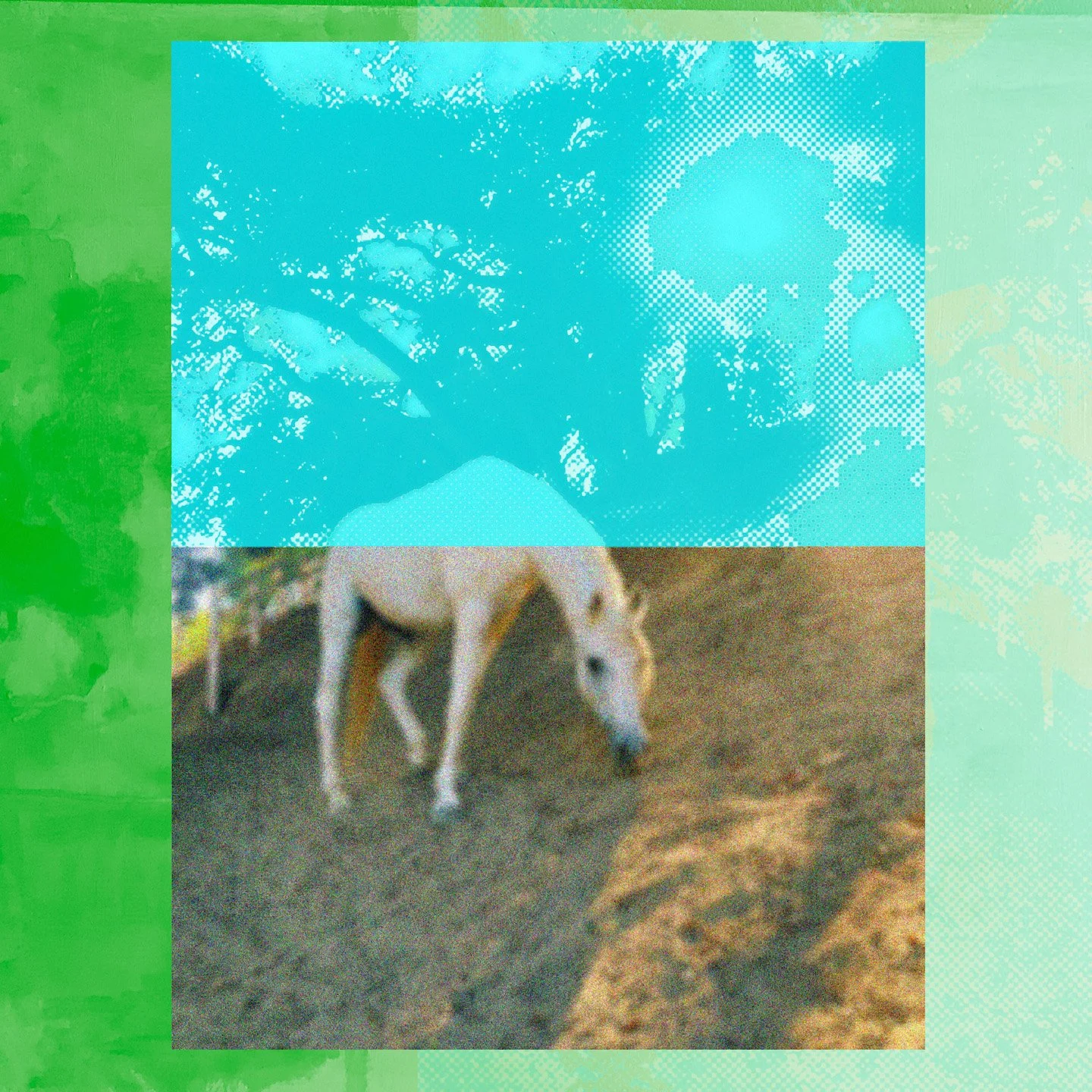
Photo rendering by Austin Hughes; source image courtesy Natasha Davani
***
Iris often arrives at the ranch flustered, in stark contrast to Elena. She loves the horses but hates the heat—one of many sensory pinpricks for her.
“Sorry I’m late,” she says quietly. “Traffic was really bad.”
“I understand,” I tell her, smiling. She makes quite a trek for these sessions. “Shall we?” We walk to the tack shed, which contains a tangled web of bridles, halters, saddles, and inexplicable supplies, like bags of fertilizer or wasp repellent. I instruct Iris to select a halter. She tentatively picks up a purple one. I compulsively start to organize the shed but then stop myself. Ever-observant, she immediately notices, and asks why.
“You’re always keeping your office perfectly neat,” she says. “Why not here?”
“I guess I try to let go of control a bit here,” I answer. “Wherever I can,” I amend. She nods wanly. She knows a modeling intervention when she sees one.
We walk into the corral. A few horses congregate in their stalls, eating their late breakfasts.
“Who would you like to work with today?” I ask her.
Flash, who’s taken to Iris, lumbers out of his stall. Iris claims to have no favorites, but watching the two, she clearly has a soft spot for him, with his grizzled chestnut muzzle, speckled white with age, and his discolored legs: a remnant, the ranch owner told me, from his exploitative racing days, when his legs were so tightly bound that they hypopigmented. Iris forever loves the underdog—a commonality we share.
“Flash,” she says, decisively. She begins to flap her hands excitedly when he sidles up to her, his way of asking to be pet. Some friendly neighbors walk by with their dogs and wave at us. She quickly stops herself.
“Iris,” I begin. She already knows what I’m going to say.
“I still feel self-conscious when I stim in front of strangers,” Iris confesses. This is a deeper layer of our work—autistic unmasking. Self-stimulatory behavior (“stimming”) is highly regulatory for autistic people like Iris. In early origins of behavioral therapies, stim-extinguishing was a regularly practiced and harmful intervention. Masking stimming often leads to burnout and dysregulation, something Iris and I have regularly discussed, and have also observed firsthand in her. But Iris is still a teenager, and her desire for social acceptance sometimes outweighs this consequence.
“That masking habit took you years to develop. It’ll take time to unlearn it.” She nods miserably—the heat is beginning to rise, and beads of sweat are dotting her forehead. “Do you want a cool washcloth?” I ask. She shakes her head, determined. Tolerating some sensory discomfort is another element of our work, but sometimes it teeters on the line of martyrdom. She’s learning to differentiate between the two.
We spend the rest of the session quietly grooming and lunging Flash. At one point, when I’m tying his halter to the grooming post so Iris can pick his hooves, Flash notices a nearby bag of oats and tears it open with his teeth. “Dammit, Flash!” I blurt out. Several songbirds flit to the accidental buffet and excitedly peck at the oats. Iris begins flapping, animatedly, triumphantly. When she’s done, on her own terms, I beam at her with pride.
“You know,” I say, still smiling, “I think I’ve seen you stim here more than anywhere else.” She modestly smiles back.
I hand her the hoof pick. She massages the back of Flash’s mottled front leg, and he promptly delivers his hoof for her to hold. She excavates the dirt from his hooves meticulously. When she carefully unearths a large pebble from one hoof, she remarks happily on the relief he must feel.
“You did that,” I tell her, watching the pair out of the corner of my eye while I sweep up the remaining oats.
***
The sun is beginning to set as I leave the ranch. I rub gently at a callus developing on my left hand. The rooster yodels have transitioned into the yips of coyotes, and the hills soften into a shade of grayish green concealing their packs.
As I merge onto the highway, I feel the satisfying physical ache of a finished day of work, my clothes caked with horse sweat and hay dust. But the gears of emotional labor still whir, and I think of my clients, as I often do. I think of Elena, habitually picking up her phone to call her favorite sibling, but not being able to. I think of Iris, overwhelmed in the unforgiving halls of a high school, one of just a few places that inadvertently ask her to hide the totality of herself. The ranch can’t dissolve the insoluble.
But it can be its steadfast container.
My mind drifts to Storm, somewhere now in the moonlit foothills of the ranch, his mane still hanging in tangled snarls as he locks his joints and closes his eyes to sleep. The unused brush still sits in the cluttered tack shed, gathering dust.
There’s a reverence in the grit of ranch work, one that bids us to surrender control to nature’s messiness, whether horse or human.
I may never get those knots out, but here, I can take my time.
Natasha Davani is a licensed psychotherapist, equine therapist, and writer based in Los Angeles. Her work explores attachment, grief, trauma recovery, and the quiet ways relationships with animals shape our inner lives.
Potentially personally identifying information presented that relates directly or indirectly to an individual, or individuals, has been changed to disguise and safeguard the confidentiality, privacy, and data protection rights of those concerned.
Published October 2026