Rilke’s Angels and Demons
The great poet feared psychoanalysis might destroy his creativity
By Daniela Oliveira Grund
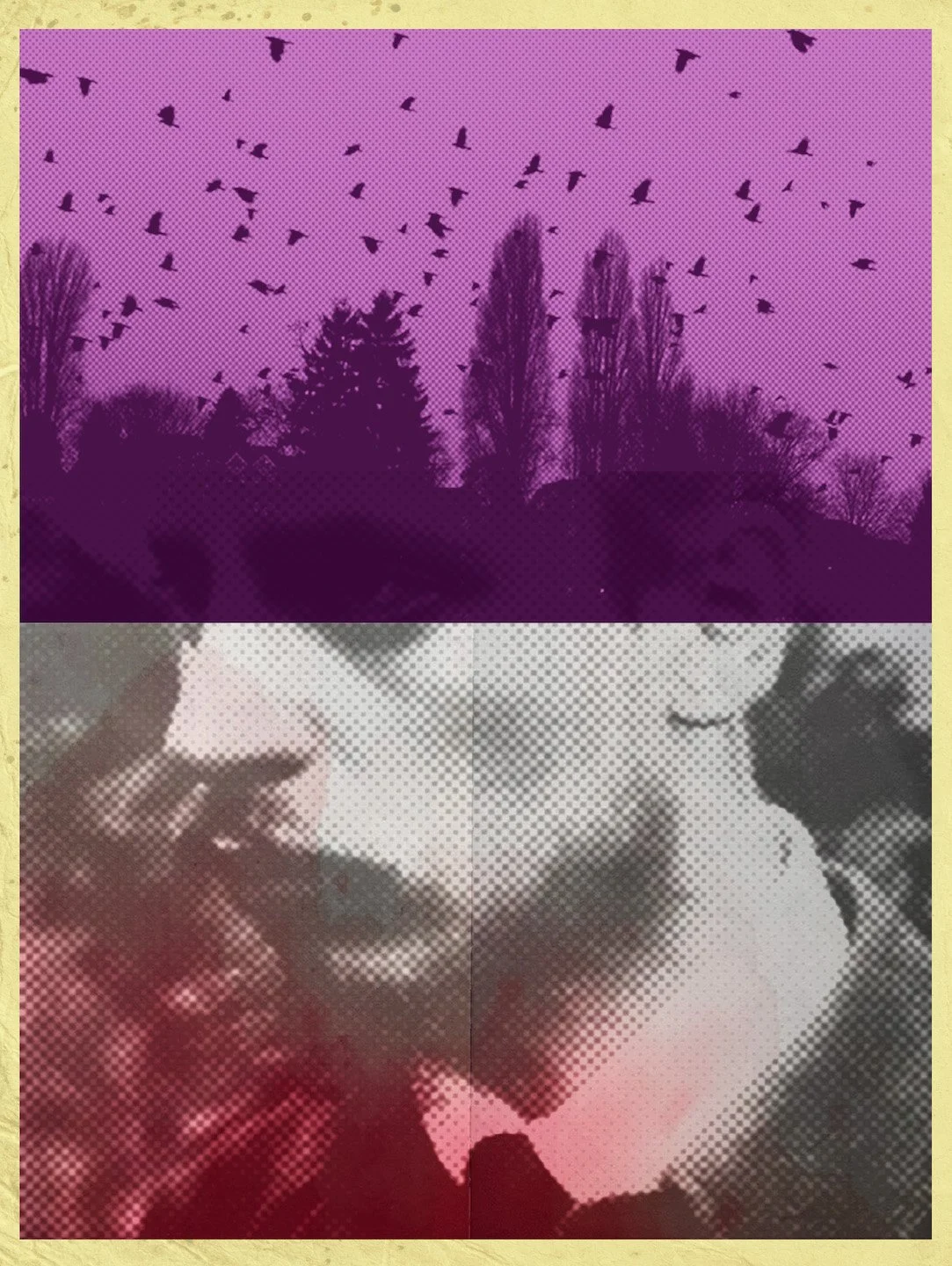
Collage by Austin Hughes
Who, if I cried out, would hear me amongst the ranks
of the angels? Even if one of them clasped me
suddenly to his heart, I would wither in the face
of his more fierce existence. For their beauty
is really nothing but the first stirrings of a terror
we are just able to endure and are astonished
at the way it elects, with such careless disdain,
to let us go on living. Every angel is terrifying.—Rainer Maria Rilke, “The First Elegy” (1923)
Rainer Maria Rilke (1875–1926), born in Prague during the Austro-Hungarian Empire, is known as one of the most important German-language poets of the 20th century. His profound and evocative writing continues to speak to readers across generations, exploring the relationship between creativity, suffering, and the human condition.
What is less well known is that, for four years, Rilke seriously considered psychoanalysis. Rilke’s poetry was never simply literature. In a letter from January 20, 1912, he writes, “work has, in a certain sense, been from the start a kind of self-treatment.” Psychoanalysis represented a different possible treatment, one with unknown implications for his art.
Rilke was introduced to psychoanalysis by Russian-born writer Lou Andreas-Salomé, with whom he had shared an intense four-year love affair. After their relationship ended, they remained close friends until his death in December 1926. Rilke described meeting Andreas-Salomé as his “second birth.” At her suggestion, he changed his name from René to Rainer, although he continued to sign the letters to his mother as René for the rest of his life. Ralph Freedman’s Life of a Poet widely explores Rilke’s ravaged relationship with his mother.
When they met, Rilke was 21. He lacked experience but had the energy and vigour of youth, together with an androgynous look that fascinated Andreas-Salomé. At 36, she was an independent feminist deeply interested in questions of sexuality and gender. She had already been a close intellectual companion of author Paul Rée and his friend Friedrich Nietzsche, both of whose marriage proposals she declined. Rilke and Andreas-Salomé often discussed “what actually makes a man a man and a woman a woman,” apart from physical anatomy, as noted by Lesley Chamberlain in The Last Inward Man. Such a queer couple of the early 20th century!
Around 1911, Andreas-Salomé began her psychoanalytic formation. One of the reasons she was drawn to psychoanalysis was that she was witnessing Rilke’s extraordinary artistic development while, at the same time, his mental health was falling apart. After the publication of The Notebooks of Malte Laurids Brigge, Rilke struggled with depression, poor health, and, above all, an inability to continue writing poetry. More than his suffering, what distressed him most was the loss of his creativity.
**
While staying at Duino Castle in Italy, Rilke began writing a series of letters to Andreas-Salomé asking whether he should undergo analysis with German physician and intellectual Viktor Emil von Gebsattel, who was analysing Rilke’s wife Clara Westhoff, a German sculptor in Munich. Although what Rilke knew of Sigmund Freud’s writings was “unpleasant and in places hair-raising,” he believed that Gebsattel employed Freud’s method “with prudence and to good results.” Nevertheless, at the end of 1911, he wrote, “Psychoanalysis is too fundamental a help for me, it helps once for all, makes a clean sweep of things, and to find myself swept clean one day might be even more hopeless than this disarray.” Rilke seems to imagine psychoanalysis as a radical intervention, as if it could be too much of a solution, one that might leave him with something even more unbearable than his suffering. Eventually, Rilke wrote that analysis would make sense only if he were truly prepared for “that strange thought” of no longer writing. He called analysis “an experiment,” questioning whether he was ready for the transformation it might entail.
He eventually declined Gebsattel’s offer, explaining that “if my demons were exorcised, my angels, too, would suffer a small fright—and that is precisely what I must not let happen at any cost.” Indeed, this decision coincided with the return of his poetic inspiration. Around the same time, Rilke began writing the Duino Elegies in what translators and editors Edward Snow and Michael Winkler describe as “a burst of inspiration,” leading commentators to question whether this was merely a coincidence.
Despite his continuing ambivalence, Rilke repeatedly returned to the question of psychoanalysis, considering treatment with a few analysts, including Freud, whom he met through Andreas-Salomé during The Fourth Congress of the International Psychoanalytical Association in Munich in September 1913. Their first meeting appears to have made a good impression on both men. By then the first and second Elegies, whose theme is transience, had been completed, and commentators have suggested that Rilke discussed these ideas with Freud.
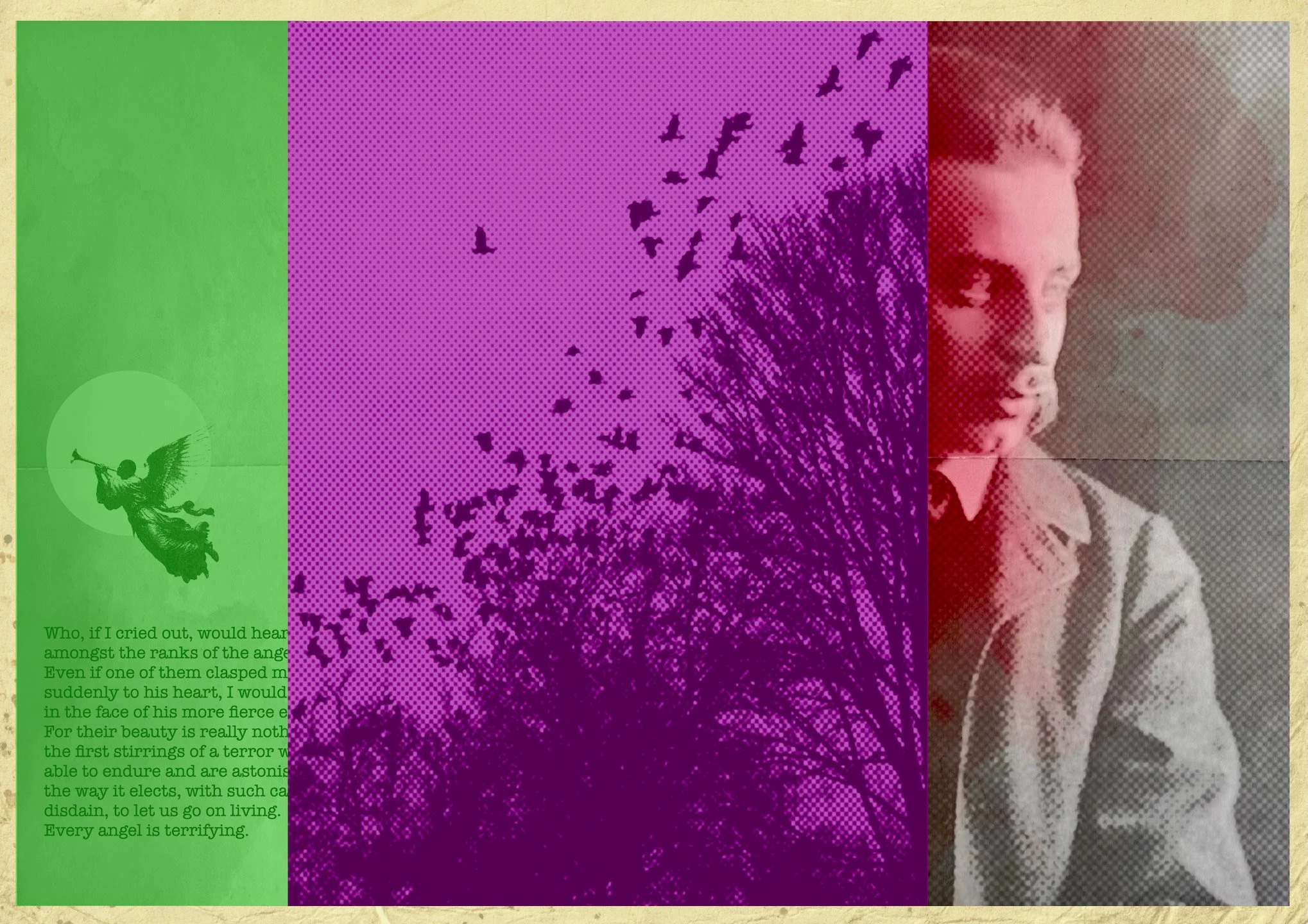
Collage by Austin Hughes
Significantly, Freud wrote his essay “On Transience” in November 1915, just one month before his second meeting with Rilke, during the second year of the First World War. It is a short but powerful aesthetic essay in which Freud recalls a walk with “a taciturn friend and ... a young but already famous poet.” Neither the friend’s nor the poet’s name is mentioned. (The idea that the poet is Rilke was first proposed by Herbert Lehmann in a 1966 paper based on his reading of posthumously published diary entries by Andreas-Salomé.) Looking at the beauty of the landscape around them, the poet admired but found no joy in it, overwhelmed instead by the certainty that winter would soon erase everything before him. Freud, on the contrary, argues that precisely because we know we will lose it, we must value, even more, what is still alive, despite its transience.
Rilke and Freud met again privately in Freud’s home in Vienna in December 1915. Did Rilke go to discuss the possibility of beginning an analysis with him? There is no record of their conversation. In July 1916, Freud wrote to Andreas-Salomé expressing his pleasure at Rilke’s regained creative freedom following his release from military service during the First World War. At the same time, Freud observed that Rilke did not want to form a “lasting alliance” with him. “Cordial as he was on his first visit, we have not been able to persuade him to pay us a second.” Freud’s remarks convey a sense of resignation at Rilke’s unwillingness to return.
It appears that Rilke chose not to enter psychoanalytic treatment following his visit to Freud. In his subsequent correspondence with Andreas-Salomé, he no longer returned explicitly to the question of analysis. Nevertheless, he continued to express an intellectual closeness to Freud, occasionally asking Andreas-Salomé to pass on his greetings, which Freud returned.
In December 1921, Rilke wrote to Andreas-Salomé, “Are you in Vienna, dear Lou? Then, greetings to Freud - it’s a pleasure to see that he’s beginning to become a significant influence in France, which for so long preferred to ignore him.” The remark reveals Rilke’s continuing interest in Freud and his awareness of psychoanalysis’s growing influence, while reminding us of the mediating role Andreas-Salomé continued to play between them.
**
Although Andreas-Salomé’s replies to Rilke during that period have not survived, his letters suggest that she helped him formulate the conditions under which psychoanalysis would make sense for him. Gradually, the question shifted from one of symptom relief to one of subjectivity.
Rather than viewing psychoanalysis simply as a means of alleviating suffering, Rilke came to realize that analysis might call into question the origin of his symptom formation. Since he could not imagine himself without being a poet, he hesitated to pursue the treatment that, if successful, might transform the source of his creativity.
Why did Rilke imagine that his creativity and his suffering might be so closely bound together? Reading his letters to Andreas-Salomé through this question offers a way of interpreting his resistance to psychoanalysis: For Rilke, poetry was not only a way of bringing language to its limits in an attempt to articulate what could not otherwise be said, but perhaps the very symptom through which he had found life possible.
Correspondence between Rainer Maria Rilke and Lou Andreas-Salomé is taken from Rilke and Andreas-Salomé: A Love Story in Letters, edited and translated by Edward Snow and Michael Winkler (Norton, 1975/2006).
Daniela Oliveira Grund is a practising psychoanalyst in London, UK. She is a member of the Centre for Freudian Analysis and Research (CFAR). Alongside private practice, she contributes to research, teaching, and community initiatives within the psychoanalytic field.
Published October 2026