Left Turn
On getting locked inside my analyst’s office
By Jessica Leinsdorf Reik 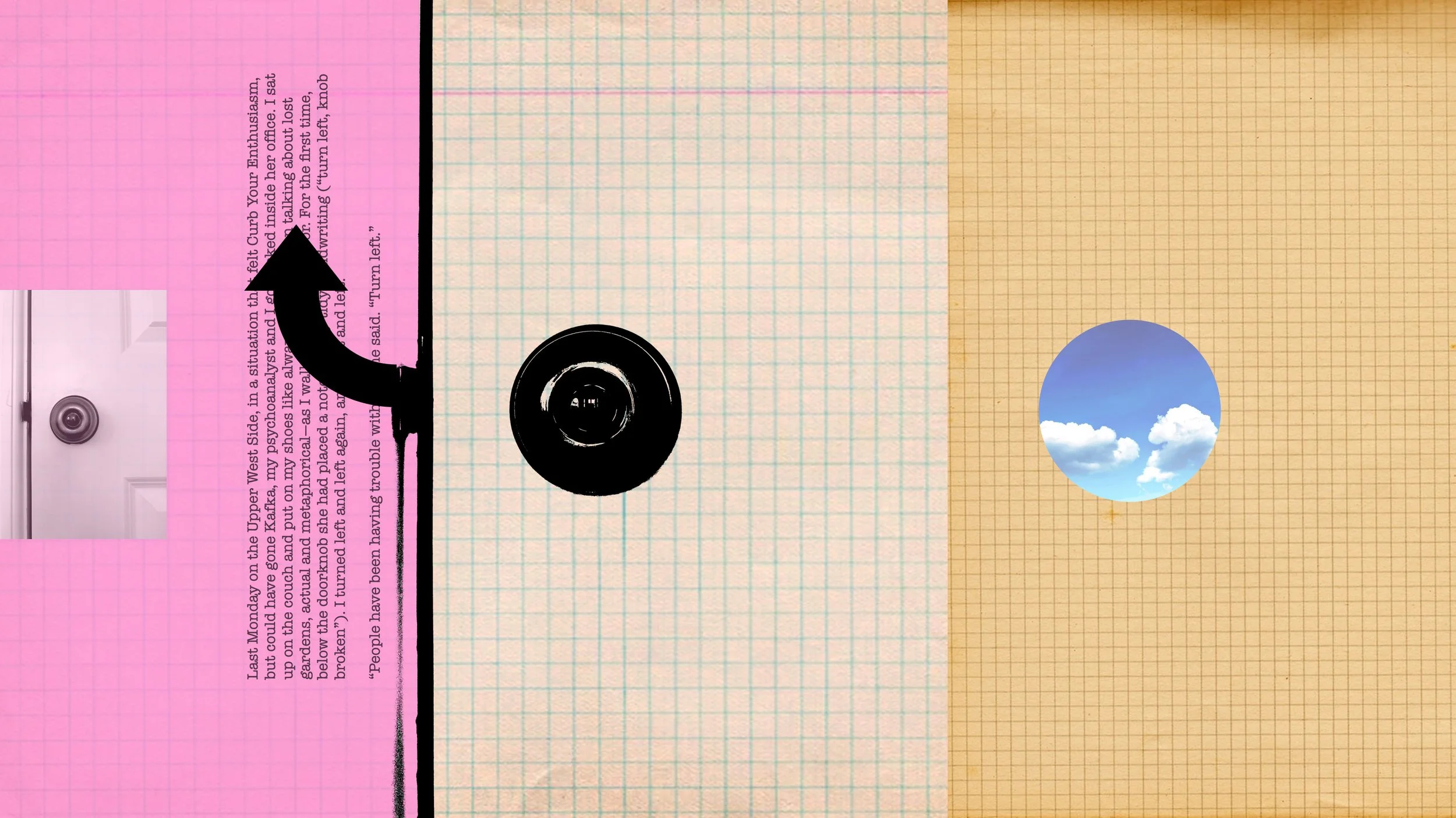
Illustration by Austin Hughes
Last Monday on the Upper West Side, in a situation that felt Curb Your Enthusiasm, but could have gone Kafka, my psychoanalyst and I got locked inside her office. I sat up on the couch and put on my shoes like always—we had been talking about lost gardens, actual and metaphorical—as I walked over to the door. For the first time, below the doorknob she had placed a note in very tidy handwriting (“turn left, knob broken”). I turned left and left again, and right and left.
“People have been having trouble with it,” she said. “Turn left.”
She came over to look.
Lots has been written about the psychopathology of being trapped inside one’s mind. Much less has been written about being trapped inside one’s therapist’s office, where one’s mind comes out to fill space and get examined.
“It’s broken,” she said.
“It seems that way,” I said. I have two similar broken doorknobs at my apartment, but didn’t tell her.
“You’re trapped in here with me,” she said with a chuckle.
I made a joke related to our increase in sessions. She said she was going to call the doorman in the main entry but would first text her patient to say she was running late. Her phone had died and she walked over to a charger in the bookcase.
“One second. It just needs a minute to get going.”
I sat down in the chair right next to the door, laughing to myself. What happens when you’re outside the frame but inside the room?
On the sidewalk on Riverside Drive, the gas company was doing work and started up their jackhammers, making it hard to hear what she was saying. She went over to close the windows. “What a racket!” she said. “This has been going on all month.”
“Why don’t you move over to the couch?” she asked, taking a sip from her water bottle, which had butterflies on it.
I realized I liked reserving the couch for sessions, for lying down and letting go of my mind. “OK,” I said, finally noticing that when the door was opened from the outside it would hit me if I stayed on the chair.
She went to unplug her phone, and I grabbed mine, texting a friend that I was stuck in my analyst’s office and that someone should write about it. “What an uncanny crucible!” he said.
I’ve had a few everyday experiences with my analyst that traditionalists would consider a breach—but this was by far the most extraordinary. The defined analytic relationship is one of the most unnatural I know, entirely asymmetric. The knowing, by design, goes in one direction and contact outside the frame is usually unethical. Lately, I’ve begun to wonder if a solid frame is less about being in a particular place at a particular time than about the therapeutic relationship itself: something unique and organic and resilient enough—if the two people allow it—to be strengthened by ruptures and intrusions. The frame holds the relationship and the relationship holds the frame.
A few years ago, in response to a question about whether or not I worry about my therapist, I said, “Well I don’t know you, really.”
“You don’t know me?!” she said, “You know a lot about me.”
What she meant, I realized when I started seeing my own patients and could hear her voice during sessions, wasn’t that once I saw her carrying flowers to the office and now know she likes tulips, or that in summer she prefers her suits to be dark linen, but that I know and feel who she is, how she responds and where her mind goes when we talk, after all these years.
After texting her patient, she stood up to further inspect the door and call the doorman to rescue us, but as she started fiddling with it, it opened.
“You’re free!” she said.
It was torrentially raining outside and I had no umbrella and she saw me putting my hood up and tucking my pants into my socks.
“Do you want to borrow an umbrella? There’s an extra one.”
I really could have used it but didn’t want to do more unusual things. I told her I’d just get a taxi. “It’ll be an adventure,” I said.
That night I had a dream I was going to our session—which is a seven-minute walk from my Upper West Side apartment—but this time I was in a driverless, Uber minivan. I had mistakenly ordered a shared car, which while en route also picked her up. I told her I didn’t think the driverless car was all that safe. In the dream, her office was under construction (locked “out” and not “in”) and we had to go to Midtown, where we were dropped off at what looked like the rubble of an exploded building.
“This is pretty horrible,” she said.
I told her I knew of a garden around the corner and maybe we could just sit on a bench there and have our session, but when we arrived the park was overflowing with people. The garden was a unicursal labyrinth and along the meandering paths were peonies and foxglove and lady’s mantle, all tended to with impossible care.
On a back bench I saw my grandmother alongside a group of friends from college. My nephew sped past a fountain on his bike, a childhood dog racing behind.
As my analyst approached the gate, I held back, unsure whether I should look or look away, follow, or disappear. A crowd of her colleagues walked towards, offering her hugs and outstretched arms. In the distance I saw a young woman who looked slightly younger than me, with hair the exact color as my analyst’s. My analyst turned around to look at me and shrugged her shoulders and smiled, “I’m sorry! Who could have predicted?!” The session was over. I shrugged back and turned around to leave, looking over my shoulder until everyone faded from view, and walked uptown.
Jessica Leinsdorf Reik is a candidate at the Contemporary Freudian Society, writing multigenerational memoir about psychoanalysis, music, and memory. For her writing she has been awarded grants from the State of New York, Massachusetts Cultural Council, and Ucross Foundation, and was awarded the Lorna Sage Memorial Prize.
Published September 2026