Picturing My Sister
Transitions in gender and memory
By Clare Knudson
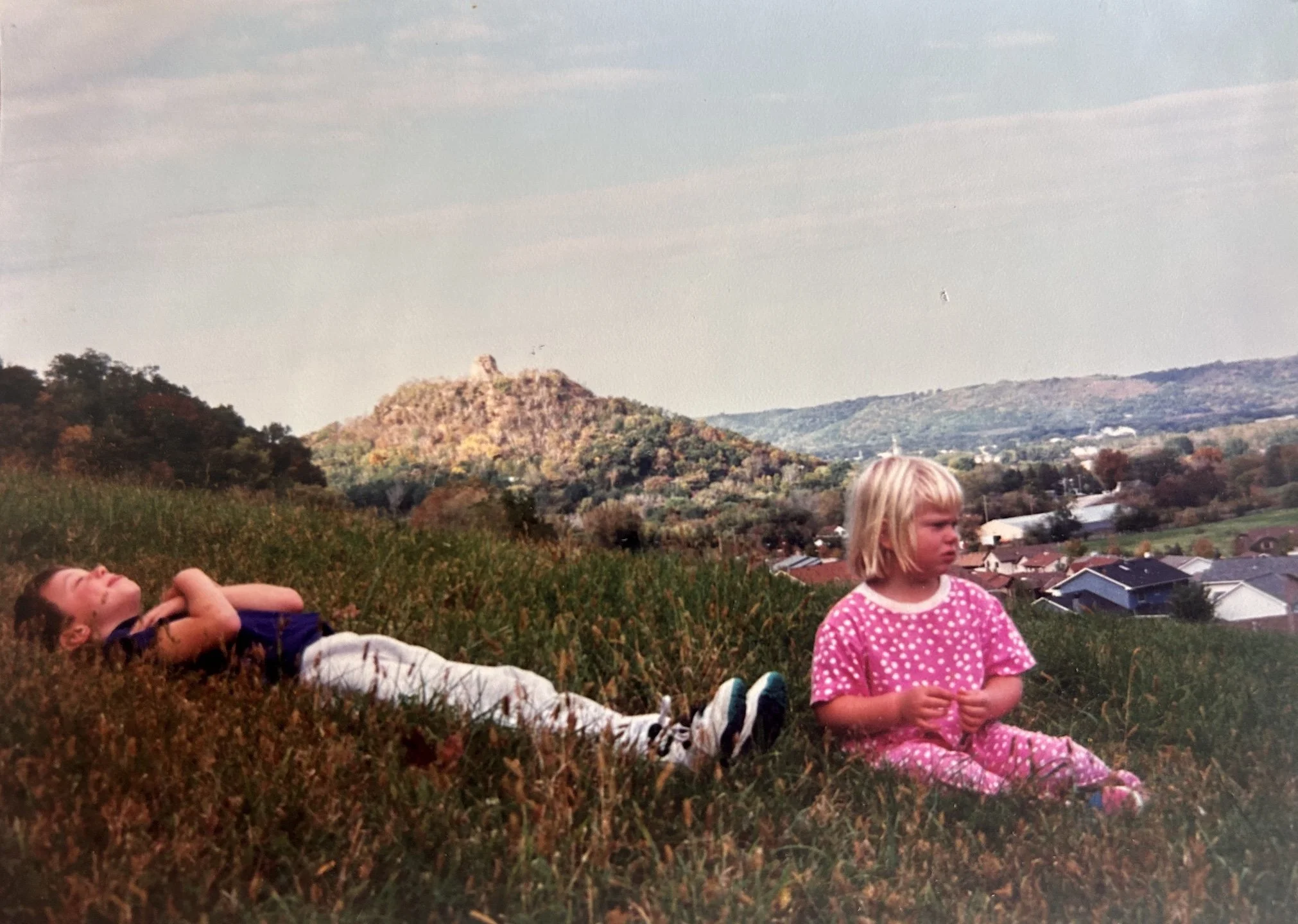
Photo courtesy Clare Knudson
There’s a picture my mom took of my sister and me on my fridge. My sister is five, I’m three. It’s early autumn in Minnesota. We’re on a grassy hillside. I’m sitting upright, with a blade of grass in my hand, staring off into the distance. Nora is lying in the grass, arms folded across her chest. A friend of six years was over for dinner recently and while looking at it said, “I thought you had a sister.”
“I never told you my sister was trans?” I responded. The photo is very much of a little girl, me, and what looks like a little boy, now my sister. She transitioned 13 years ago. At a certain point her change just became a part of my life. Today, when people ask if I have siblings, I say, “Yes, a sister.” I don’t specify, a trans sister.
She was 24 when she began her transition, I was 22. Now she is 37 and a geophysicist. Now I am a 35-year-old psychologist and psychoanalyst-in-training in Los Angeles. To say our sisterhood has changed over the course of those 13 years would be an understatement. Since her transition, we’ve lost our mom, completed doctorates in different fields, moved to new cities, and began our careers. It’s often complicated to have a sibling. I’m writing about the ways having a trans sister complicates it more for me.
**
In Tomboy, a film directed by Céline Sciamma, six-year-old Jeanne discovers her older sister Laure is living as a boy named Mickaël outside their home. She confronts her sibling and threatens to tell their mom. Mickaël then strikes a deal saying he’ll bring Jeanne to play with his friends. The next day, Jeanne lovingly accommodates her sibling’s identity. She brags to other children “I have a big brother, which is way better ... cause a big brother can protect you.” At the dinner table that evening, Jeanne is unable to eat, her expression pensive. The family begins talking about the children’s days. A smile grows across Jeanne’s face as she says, “My favorite one is Mickaël. One of Laure’s friends. He played with me, carried me on his back, and now he is my buddy too.” She and Mickaël begin giggling, and Jeanne appears elated by the secret the two of them share.
The dynamic between siblings the film captures is something I felt with Nora. Before Nora became my sister, I knew her by a few names and sets of pronouns. For a period after college, she lived in the San Francisco Bay Area. During that time, I referred to her using they/them pronouns and by a name that would prove intermediary. We were “ride-or-die” then. I would stay with her for weeks at a time during my college breaks. However, when we walked off the plane at the Minneapolis–Saint Paul International Airport for holidays or other family functions, I would refer to her by the name my parents gave her and use he/him pronouns. It felt like an honor to be a part of all the hidden facets of her life. And frankly, it was fun to share a secret with her.
On a road trip together, the summer before Nora transitioned, we stopped at a gas station on I-70 in Colorado. We turned down the hall under the fluorescent lights inside the station. She, still using they/them pronouns and the intermediary name, veered towards the men’s bathrooms, as there was no gender-neutral option. Two steps ahead of me, she pushed open the door. I saw a man exiting who looked her up and down with a sense of confusion that then morphed rapidly into a glare of hostility. My stomach sank. She continued, confidently passing past this man’s gaze without pause. I turned to the right and entered the women’s room. I sat down to relieve myself. Until this point my body had always been the more vulnerable one.
When I felt my sibling’s gender evoke more hostility than mine, there was a dread I could not relieve myself of. Nora wrote a series of short stories about me when we were young. I lived in a giant cactus with a wolf dog as my protector. For the entirety of my life, I had her alongside me, two years older, gleefully referring to me as “my baby sister!” She was someone I strategized getting through the next level of Pokémon with on our Game Boys in the back seat on the way to family functions, the time on the road easily slipping by. She stayed up late with me after school dances, making tea and sitting on the kitchen counter discussing my eighth-grade gossip. Sophomore year of high school Nora made me my first mix CD, titled in green sharpie “Pop Goes the Suck Music,” introducing me to several early 2000s indie bands that would forever shape my taste in music. By circumstance, and by pleasure, I blithely obliged to my role as “baby sister.” Of being shown the world. Of being protected. By the wolf dog, by the cactus, by her.
“My big brother was my sister, waiting to become herself.”
**
On a Sunday afternoon in early November after that road trip, I got a text from Nora: “Hey, can we chat later this afternoon about gender stuff?” I was studying at the University of Colorado Boulder library, in front of floor-to-ceiling windows that looked out over a lawn with sere grass and a large oak tree. “Of course,” I responded. “How’s three?”
At three o’clock I was outside, sitting under the oak that had already lost most of its leaves. The light came through the mostly bare branches in a quality unique to autumn in the Front Range mountains. I picked up the stem of a leaf with crimson veins and spun it between my thumb and first two fingers.
“I’m going to start taking hormones and use she/her pronouns and go by the name Nora,” she said over the phone.
The angled sun pierced my vision with a golden glare. I shifted my gaze and an oak branch reaching out over the lawn filtered the light.
It was only 11 years later, when the light coming from my mom’s stained-glass lamp and the yellow pajamas she wore when she died were visually seared into my mind in a similar way, that I recognized how profound that afternoon call under the oak tree was.
What I grieved most was Nora’s physical form. Specifically, her chest, her embrace, a place I had found comfort over the course of my life. What would it be like for her to grow the breasts she was so excited to have? I wasn’t aware of the way her physique molded into mine until that phone call. Leaving an impression in me where the illusion of a big brother, a wolf dog, a giant cactus home, a protector was.
**
After Nora came out to our family, I fielded calls from my parents, my aunts, uncles, cousins, answering questions and facilitating their understanding. “Can you just convince her to save her sperm?” my parents pleaded, “We’ll pay for it.” Though I initially took on these calls with the utmost love for my sister, I eventually grew resentful. During an argument with her a few years later, after she thought I had failed to protect her, I held back a spiteful, “You have no idea the hours I spent on phone calls for you!” Eventually my parents joined a small support group with two other families in the rural Midwest. Eight months later my dad called: “I raised my hand during Joys and Concerns at church today. I said we had a joy to announce, that we had a new daughter in our family.”
But it was not all acceptance. At Christmas that year, the four of us were in the kitchen. Nora was to my right, our parents across the island counter. Between us was an array of holiday desserts, Fraser fir garland, bowls of citrus, candles. We were discussing plans for hosting the extended family. Seemingly out of nowhere my mom said, addressing Nora, “If you really want to be a woman you can get down on your hands and knees and scrub this floor.” My jaw dropped. My sister gasped. “Faye!” my dad exclaimed.
My mom had never expected me to clean. “I don’t want you to grow accustomed to doing women’s work, sweetie,” she told me when I was young.
She had struggled with her desire for a professional career, which she gave up for the sake of being a mother and home maker, only to have an illness grip her just as my sister and I left home. By this point, the disease had impaired her ability to control her verbal impulses, leading to rather mean slips of the tongue. In the kitchen that Christmas, I was torn between my already ailing mom and my sister daringly becoming herself. “Sorry about what mom said,” I told my sister later, sitting at the foot of her bed.
**
Nora had her own ideas about what it means to be a woman. Early in her transition, she started to scrutinize my expressions of femininity. “You really like your earth tones, don’t you,” she would say, looking my outfit up and down. I didn’t like the way she noted how I wore my hair, my lack of makeup at the time, my unpainted nails. The comments hit hard. Instead of confronting her, because the situation felt so complicated, I let them fester inside and withdrew. Where did the older sibling who handed me a copy of Kate Chopin’s The Awakening at Green Apple Books in San Francisco go?
As it turns out, estrogen and testosterone blockers can really change someone. I was putting away groceries on a call with my sister when she told me, after a year of being on hormone replacement therapy, “I finally understand how you feel things so deeply in your body.” I paused, set the groceries down, a relaxed smile across my face. She had spent my entire life dismissing my feelings.
On a hike with Nora, three years after her transition, she casually asked, “What’s your cup size? I want to know what I can expect when I grow them.” We were in Wildcat Canyon east of Berkeley, and I stayed steady in our lockstep but froze inside. I felt her body alongside mine. The height of her, the leanness of her muscles. I noticed mine, some eight inches shorter, petite with curves that occasionally fell out of my clothing. I recalled a moment, a decade prior. We were teenagers, it was summer, the humidity heavy in the air and a season of cicadas. I brought a bowl of vanilla ice cream with strawberries on the porch where she was reading. She looked up, set her copy of Kurt Vonnegut’s Cat’s Cradle down, and grabbed the bowl. “You already have enough fat on your body,” she told me, taking a bite of the ice cream.
Unable to navigate the immediacy of everything I felt, I told her my cup size. And promptly following I asked, “What are you bringing to Julia’s picnic later?” an uneasiness in my stomach.
In another photograph of Nora and me, she is six and I am four. She’s done my hair, filling it with pink bowtie barrettes. Unlike other girls my age who had older brothers, she never beat me up, at least not physically. She has always known just where to cut me with her words. I can’t help but look back at certain memories, like these, and feel another scrambling negotiation in myself. My big brother was my sister, waiting to become herself.
**
A decade after Nora’s transition, I was visiting my parents and getting ready to go to the gym with my sister and dad. My mom was ill and in a precarious decline, which had prompted the visit. I went to pick up my hairbrush and noticed strands of long curly brown hair in it. My sister had arrived the night before, and I knew she was the culprit. My veins seared with frustration. I bundled up my feelings as I put on my parka to enter the brittle cold of winter. As we walked into the gym, my dad to my left and my sister on his other side, I said, “If you’re gonna use my hairbrush, you can take your long curly hair out of it.”
“Whoa, whoa, whoa,” my dad responded.
In the same breath my sister: “Okay, I didn’t think it would be a big deal.” I returned their words with a look, the rage electric between my sister and me. Is this what having a sister is like? I wondered later while swimming my laps.
In preparation for my mom’s funeral, I needed to clarify which photos were acceptable to display. I sent Nora a picture of the four of us at my grandparents’ house at Christmas 1992 and texted, “Would this be okay for you for inside the pamphlet?” She responded, “Yep! Little kid photos are cool with me. My favorite is the baby in hiking backpack one.” I thought to myself, In that photo, it’s you, Mom, and Dad. There’s no me yet.
I didn’t even look for the photo. We are, after all, sisters.
Clare Knudson, PhD, is a licensed psychologist and psychoanalyst-in-training in Los Angeles. Her writing has appeared in Critica and fort da.
Published September 2026