Psychoanalysis as a Public Good
The Foundation for Community Psychoanalysis pursues equitable access to treatment
By Lily Meyersohn
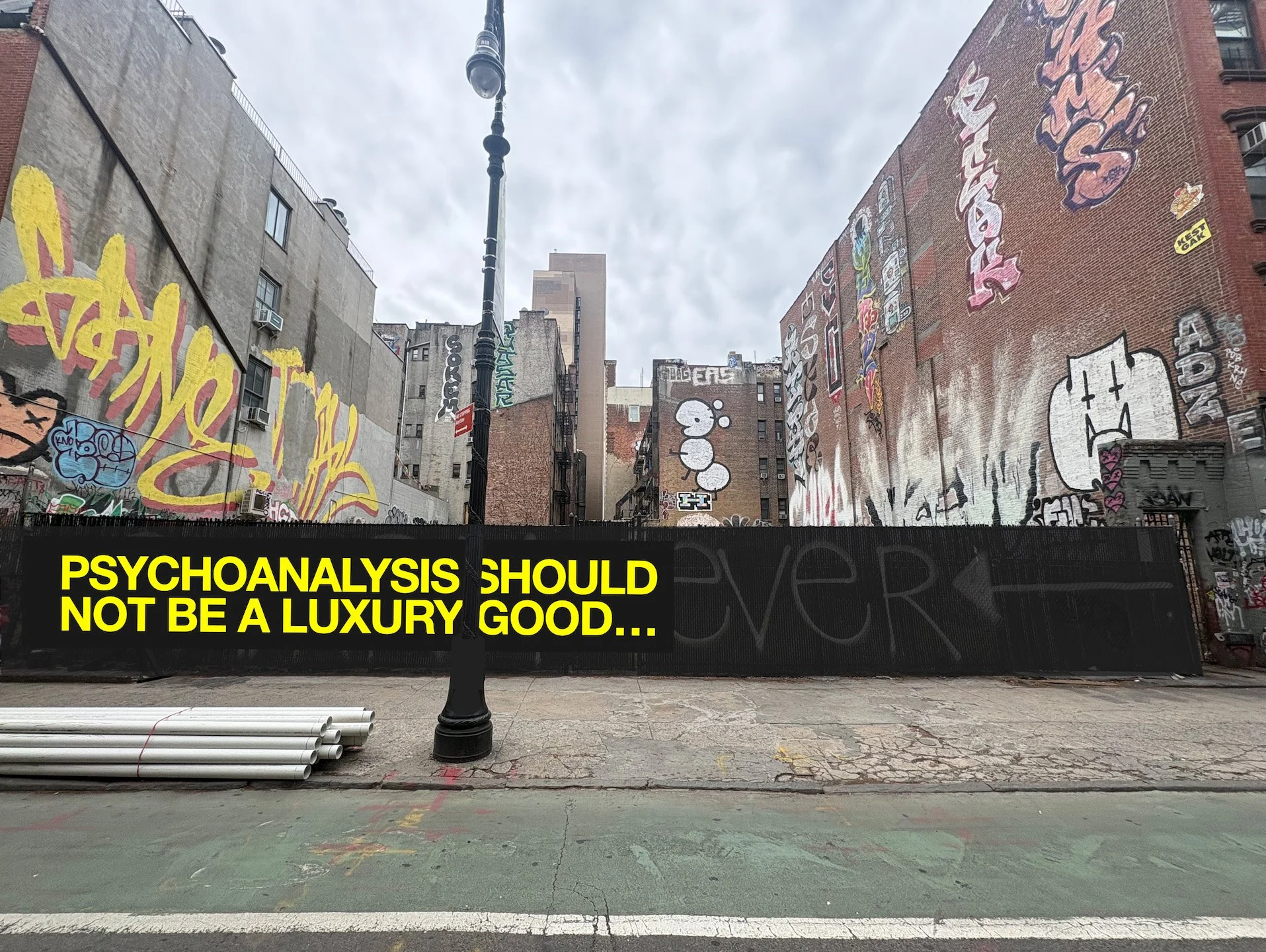
Photo rendering by Austin Hughes
“Outside of my marriage and being a parent, [psychoanalysis is] the most transformative thing that I’ve done as a person,” says Chris Hughes. “It was a kind of second adolescence.”
Hughes had barely emerged from his first adolescence when he cofounded Facebook, a company he left in the aughts and by 2019 was arguing should be broken up. He has spent the last decade dedicated to studying and changing our political economy: two books on economic history and inequality, cofounding the Economic Security Project, finishing a PhD in business ethics and legal studies.
Hughes doesn’t think it’s a coincidence that his turn toward “who wins and who loses in the material world” began around the same time as he began four-times-a-week psychoanalysis.
While Hughes’s analysis, which ended in 2022, opened up all sorts of frontiers for him, he remained frustrated by the fact that most people in New York, let alone the world, could not access this form of psychotherapy. After his own analysis, he wanted to “tip the scales a bit” to make psychoanalysis more accessible.
The Foundation for Community Psychoanalysis
Hughes is now board chair of the Foundation for Community Psychoanalysis (FCP) in downtown Brooklyn, a place for therapists, patients, activists, and theorists working to expand access to psychoanalysis to people who have been historically excluded from the tradition, namely, poor patients, patients of color, queer patients, and patients experiencing psychosis. Hughes sees the foundation as part of a wider resurgence of interest in psychoanalysis coupled with a mandate for access. “We’ve broken through the stale Freud debates, and there’s a new confidence that this tradition has value,” he says. But it needs to be reinvented for a new time. Hughes’s bottom line is that psychoanalysis should not be a luxury good. All too often, in the United States, it is.
Cassie Kaufmann––codirector of the Greene Clinic in Brooklyn, board member at FCP, and a high school friend of Hughes––says Hughes is grateful for “how psychoanalysis helped him reckon with his position, the reality of Facebook, and what it’s become” in action.
The problem became especially mobilizing during and after the Covid-19 pandemic, when an explosion of suffering gave way to the rapid expansion of tech platforms and often-flimsy mental health apps backed by venture capital investment. Hughes and others in his network––including Ben Kafka, Kaufmann, and two other Greene Clinic directors, Loren Dent and Matthew Oyer––started to collaborate on a very different type of solution. These conversations became the seed of the Foundation for Community Psychoanalysis, which opened in 2023.
Rather than a new clinic, FCP is a hub. This allows it to “work more broadly and experimentally,” says Kaufmann. The physical space at 81 Court Street spans two floors and includes five private therapy offices, a group room, and a library of donated books. The library is still seeking visitors and members for its monthly membership program, but the offices are full. The foundation has hosted events, established grants for early-career clinicians and community projects, and offered stipends and office space for clinicians building or expanding practices that include low-fee care.
FCP would like to pitch a big tent, avoiding psychoanalysis’s many schisms. Hughes, who still doesn’t know what school his analyst was trained in, does not want to get lost in ideological or political turf wars.
Initiatives like FCP are not unheard of, but they often pop up and then fade. To stay alive, they need different types of support. “In the analytic world,” Kaufmann says, “people like to volunteer and donate their time.” In particular, FCP has been successful in reaching out to a younger generation of clinicians––especially those coming out of social work professions and other disciplines interested in inequality and class consciousness––who have flocked to psychoanalysis in this period of renewed popularity, says Kaufmann. But when it comes to cash contributions, Hughes remains FCP’s primary funder. He says the organization “will be stronger when we have a diversified funding base.”
The Community Psychoanalysis Track
Despite a global legacy of radical free clinics (see Free Clinics, Public Clinics, Open Clinics, Social Clinics below), such experiments rarely exist within psychoanalytic institutes. The last few years have brought confrontation and pressure on the institutes to look at larger systemic systems and structures, notes Tracy Simon, a faculty member and supervisor at the NYU Postdoctoral Program and Pulsion Institute. But institutes have generally been slow to change.
The movement to make psychoanalytic care more accessible today is “impossible without simultaneously rethinking institutes: how they train candidates and what they teach,” says Simon. About a year ago, five psychoanalysts and psychiatrists from various institutes and independent psychoanalytic affiliations––Simon, Webster, Oyer, Dent, and Chris Landry––began developing a model known as the Community Psychoanalysis Track. The FCP-CPT, which Simon will direct, is launching this fall. CPT will bring institutes across the US together to build a community of practice.
Historically, analytic institutes have focused on training candidates in providing individual psychoanalysis, which directs candidates toward private practice after training. Meanwhile, community workers, who often work with the most vulnerable patients, may avoid psychoanalytic training because of the cost. As a result, the people with the least analytic training remain in community settings, where they face burnout, high turnover, and impossible caseloads, says Simon. Those that leave for extensive, expensive training, says Jamieson Webster, an FCP board member and Pulsion faculty member, “leave the community behind.”
The CPT model challenges the assumption that candidates should move on from community work to, in Webster’s words, the “‘hallowed ground’ of dyadic psychoanalytic work.” She sees the CPT as an intervention on three levels. “It’s an intervention on institutional psychoanalysis. It’s an intervention on who gets access to psychoanalysis. And it expands our ideas of psychoanalysis.” CPT does more than bring psychoanalysis to the community; community partners actively work to expand institutes’ and candidates’ ideas about psychoanalysis––ultimately changing the practice altogether.
CPT will build infrastructure connecting community mental health and psychoanalytic programs. Candidates in the one-year program will be placed in community agencies and engage in group consultation, supervision, and curricula developed with the Greene Clinic, with the intention of exposing candidates to social texts, the history of free clinics, and community work. “When I was in training,” Webster remembers, “I was flabbergasted that none of Freud’s social works were on the curriculum.”
The track is intentionally not housed within one institute or clinic or community placement, notes Simon. Instead, it will be a collaboration between all institutes, candidates, and public programs. The first New York institute to participate is Pulsion. The Chicago Center for Psychoanalysis is developing a parallel CPT track. FCP will act as a home base. The foundation is footing part of the bill, and the track has also received $100,000 in grant funding from the Three Cairns Foundation to support curriculum development, consultation, and supervision during the pilot year.
“We’ll keep going,” Webster says, expressing the hope that more institutes will come on board to participate in coming years. For now, the two participating institutes have different cultures and structures. Nancy Burke, who is spearheading CPT in Chicago, believes this will create a “productive tension” and a “transformative experience on all sides,” as differing perspectives “emerge in the interface between the two training sites.”
In New York, partnerships have been forged with organizations including University Settlement House, The Fostering Connection, New Alternatives, and the Rose Hill Pain Clinic. Candidates will provide free groups for program participants or frontline workers, offering spaces for staff to reflect on their work or their place in the institutional setting and experience the process and impact of a psychoanalytic approach on their own social environment. “The transmission of psychoanalytic experience occurs across these groups,” says Simon. All of the Chicago candidates are at two community mental health centers established under the Expanded Mental Health Services Act and under the leadership of Nancy Burke.
The new CPT has its roots in the CPT at the Psychoanalytic Institute of Northern California, the first of its kind when it got off the ground 10 years ago. The model there, which is housed within one institute, hinges on noninstitutionally trained analysts as supervisors and consultants. Candidates in San Francisco each run a nine-month-long reflective group for frontline workers in a community agency. The groups count as one of the candidates’ training cases and help the agencies expand their reflective capacities, says Lee Slome, a current program director. Cofounders Rachael Peltz and Francisco Gonzalez have written that the program “fundamentally transforms the formal definition and scope of psychoanalysis … who it serves and what is deemed teachable in a psychoanalytic institute.”
Slome notes that it took years to “plan, think, and socialize” the CPT in the Bay Area. In comparison, CPT East, as Francisco Gonzalez calls the new effort driven by FCP, is moving faster. “It will be interesting to see how it goes in this pilot year.”
Hughes agrees. “We’re learning together,” he says. “There’s no playbook.”
Sidebar: Free Clinics, Public Clinics, Open Clinics, Social Clinics
The question of who should fund and administer clinical programs is an old one. Freud himself suggested in 1918––at the Fifth International Psychoanalytic Congress in Budapest and in the context of Red Vienna’s successful urban socialist experiment––that free psychoanalysis for the masses would likely be provided by private charities until the state took responsibility and provided it. In the US, however, the state never got around to providing free treatment.
In 2005 historian of psychoanalysis Elizabeth Danto revealed how, contrary to the belief that psychoanalysis is only for the rich, the field had very early commitments to free treatment. This history, largely forgotten in the US, has now been revived, spurring thinking about community psychoanalysis and the origins of psychoanalysis in social democracy.
After World War I, free and low-cost clinics opened across Europe: the Berlin Poliklinik in 1920, the Vienna Ambulatorium in 1922. Paris, Budapest, and Frankfurt followed. Radical free clinics were crushed across Europe during Nazism but later emerged across the world. The ethnographic project FreePsy is now working to produce a global history of free clinics, including the ones in Western Europe as well as the US, Argentina, and Brazil (which is currently home to an impressive 1,000 of them).
Raluca Soreanu, FreePsy’s project lead, notes that we can’t take the term “community psychoanalysis” for granted. Outside of the US, we tend to see terms like “free clinics,” “public clinics,” “open clinics,” or “social clinics.” Each term is imbued with its own meaning, but they all intersect in their reference to that earliest moment in 1918, when Freud asserted that treatment should––and would––be free.
Lily Meyersohn is a licensed master social worker in New York City.
Disclosure: The author is a former social work intern at Rose Hill Psychological Services.
Published October 2026