The Way She Made the ‘K’
The splendor and spunk of my mother’s handwriting
By Janet Rivkin Zuckerman
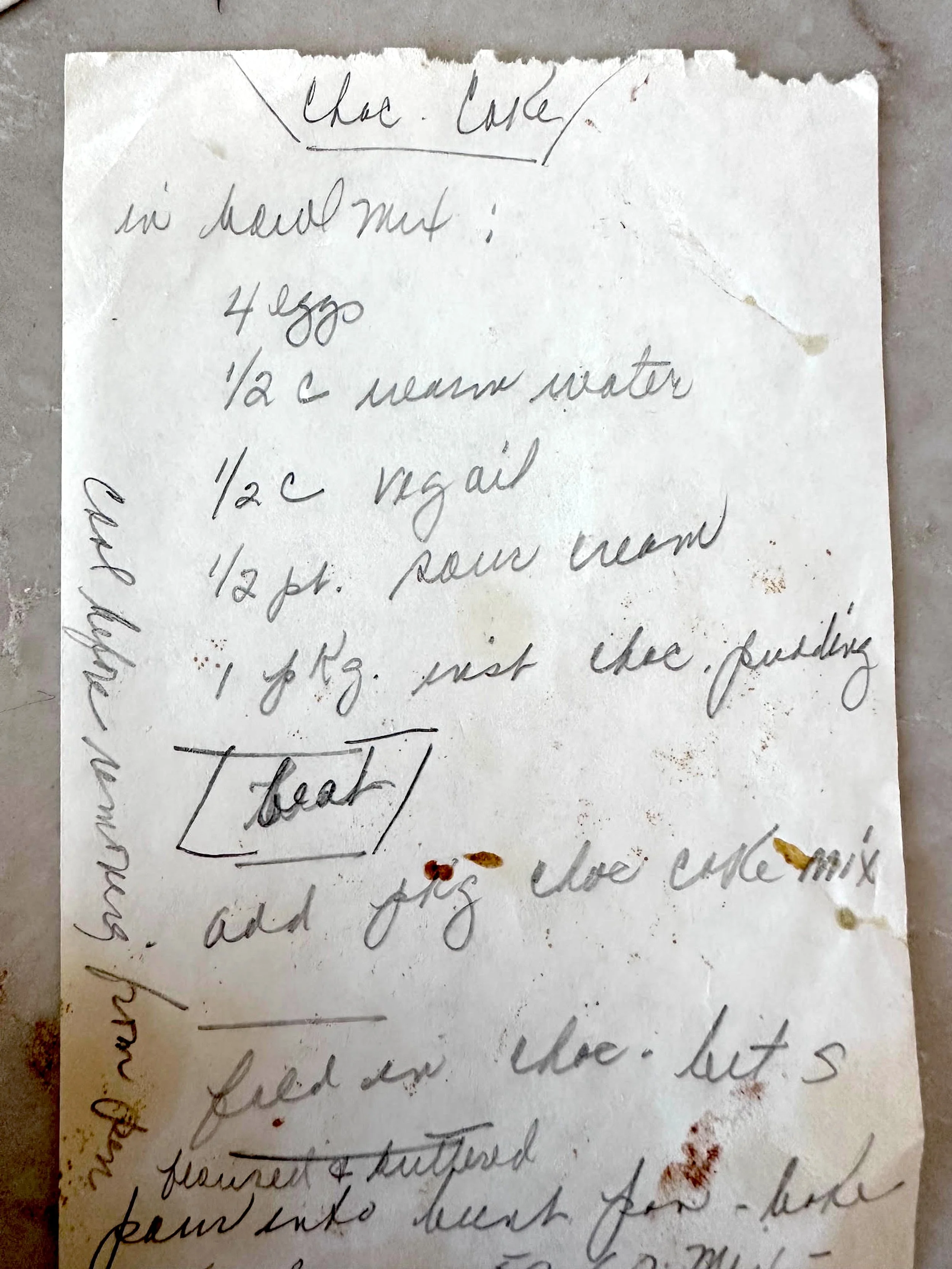
Photo courtesy Janet Rivkin Zuckerman
The thing that often caught my eye was the way she made the k. It wasn’t the customary way, and she penned it that way regularly as the fourth letter of our last name. The right arm of the letter swung up high beyond its intended border and presented itself as an artistic flair, a sweet surprise, a part that liberated itself from its more straitlaced surround. Its presence allowed me to immediately recognize that the piece belonged to Mom, whether in a letter to me at summer camp or on a grocery list left casually by the sink––kale!
The k was teeming with potential, a streak of irreverence, a spontaneous gesture in the Winnicottian mode. It was a piece of her that usually stayed hidden, though I knew she had it in her. It remained mostly closeted in her effort to obey the rules of her feminine role. I knew this gutsier part of her resented the constraint, but felt I couldn’t do much to help her out. My mother tried her hand at oil painting, and once her class assignment was to recreate a picture found in a magazine. Enchanted by her new artistic itch, I can still remember the young girl who emerged on the canvas after many weeks. She had shoulder-length brown hair with bangs, and she wore a green crew-neck sweater beneath a casually opened mustard coat. Sadly, though, she had a static pose and a faraway look in her eyes. I couldn’t feel the spunk and playfulness of the k.
As for me, I admired this bit of mischief in my mother and wished it would show up more. We could have had more fun and laughed more together, closing a bit of the gap between adult and child. Instead, Mom was generally prim and buttoned up. Her emotions stayed contained except when she became furious with me for defying her plans for me: a boyfriend with hair too long or my outfit that was a bit too daring¾low neck lines, in particular provoked her scorn. I remember one iconic time when we really had it out. It was family picture day, I was five. We all stood at the top of my driveway, and I was dressed up in the outfit my mother had insisted on––a navy pleated skirt with a short red, white, and blue checked wool blazer. White bucks had been freshly polished for the occasion. But that was not all. The completed outfit also called for a white crêpe blouse under the blazer that was crowned by a giant white floppy bow. And it was that bow that sent me over the edge. There was no way my mother was going to force a smile out of me with that bow beneath my face. Ironically, the fairy godmother who freed me from my torture was the savvy photographer, Betty. She gently took me aside and whispered in my ear, “You know what? I hate that bow too!” Never will I forget the force of that affirmation. It positively melted me.
Looking back, I believe that much of my mother’s insistence on controlling the action in myriad ways was an attempt to undo deep feelings of helplessness and fear over serial illnesses she endured with a partner who believed emotional support was unmanly. She was existentially alone in physical and emotional pain. I lost my mother at a young age—young for her and for me. No doubt this makes her preserved handwriting that much more precious to me. When I see it, I feel her presence viscerally, and for a few precious moments, the pain and guilt we all suffered from her very sad journey soften, and I can remember some of the sweet times.
I can appreciate how my mother’s handwriting, like a small accessory—an earring, sock or belt—offered her a safe peephole to flash her more daring and impermissible parts. It posed less risk of cultural reprisals that shame a woman for taking up too much space and strutting her stuff, whether through her creativity or her intellect. (I vividly remember a game of Trivial Pursuit we once played on a family vacation, and to my shock my mother was the winner of every single round. Who knew?) Maybe in a different time she could have let out more. Nonetheless, it struck me as sad then and it does now.
“The k was teeming with potential, a streak of irreverence, a spontaneous gesture in the Winnicottian mode.”
For me, writing by hand can also evoke a youthful joy and weave a seamless bridge between our earliest and later years. Time collapses and for a few moments, I am a kid again, practicing how to write a cursive a on rough manila paper with dotted blue lines through the middle so the lowercases have a safe ceiling. Like a fingerprint, handwriting is a unique and singular expression of who we are that remains itself over the lifespan, not dissimilar from a child’s face that retains glimmers of itself as she grows.
I have been told in earlier years that my handwriting was beautiful. As with my mother’s, I believe it used to represent less fully integrated parts of me: self-states such as artfulness, femininity, elegance that I generally side-lined for a tougher, less vulnerable exterior; I sported painter’s pants, flannel shirts, and clogs back then (still recovering from that white floppy bow). Like Mom, I could occasionally release these tendencies within the safer confines of a written piece with, say, a dancing capital J. These days, I feel less bothered by those previously colliding parts which thankfully feel better woven together.
I keep a wrinkled-up Ziploc bag holding some of my mother’s handwritten recipes stowed away in a back closet. Most were written by her decades ago, offhandedly on loose scraps of paper in her signature script. Many are soiled with food stains and ripped, gifted by relatives and friends with their names on top next to the recipe’s title, such as “Faultless Hollandaise.” One of them even has a quirky little figure on it that my mother drew on the side, another welcomed reminder of her playful side. The little guy looks a lot like a snowman with three buttons on his belly and a cap. Might it have been gently snowing outside her window that day? I cherish these mementos for the way they bring my mother back to me, not only in the caramel-topped pound cake or tangy meatballs they allow me to once again savor, but also in the beauty of her writing, an entirely separate creation in itself.
Once, when trying to break free from the daily humdrum of her “what to cook for dinner” duties, a ritual I knew was laborious for her (a kid just knows these things), my mother decided upon a fresh new approach by experimenting with different, more elaborate recipes. In the middle of putting one together—maybe it was her beef bourguignon or her brandy alexander pie—she looked over at me and said, “You know cooking is actually a very creative act.” I now realize that my mother was persistently dedicated to finding a home and means of expression for the artist within her––whether in the flouncy letters of her handwriting or a remoulade sauce I knew she was deeply proud of. Her true self was actually right there if I just looked. All encased in that renegade little k.
Janet Rivkin Zuckerman, PhD, is a clinical psychologist and psychoanalyst in Rye, New York. She conducts supervision and study groups in interpersonal/relational psychoanalysis and recently published “Nasty Women” — Reclaiming the Power of Female Aggression: A Psychoanalytic Perspective with Routledge.
Published October 2026