Teaching Freud to Gen Z
Elizabeth Lunbeck presents psychoanalysis as a profession and a guide for living
By Austin Ratner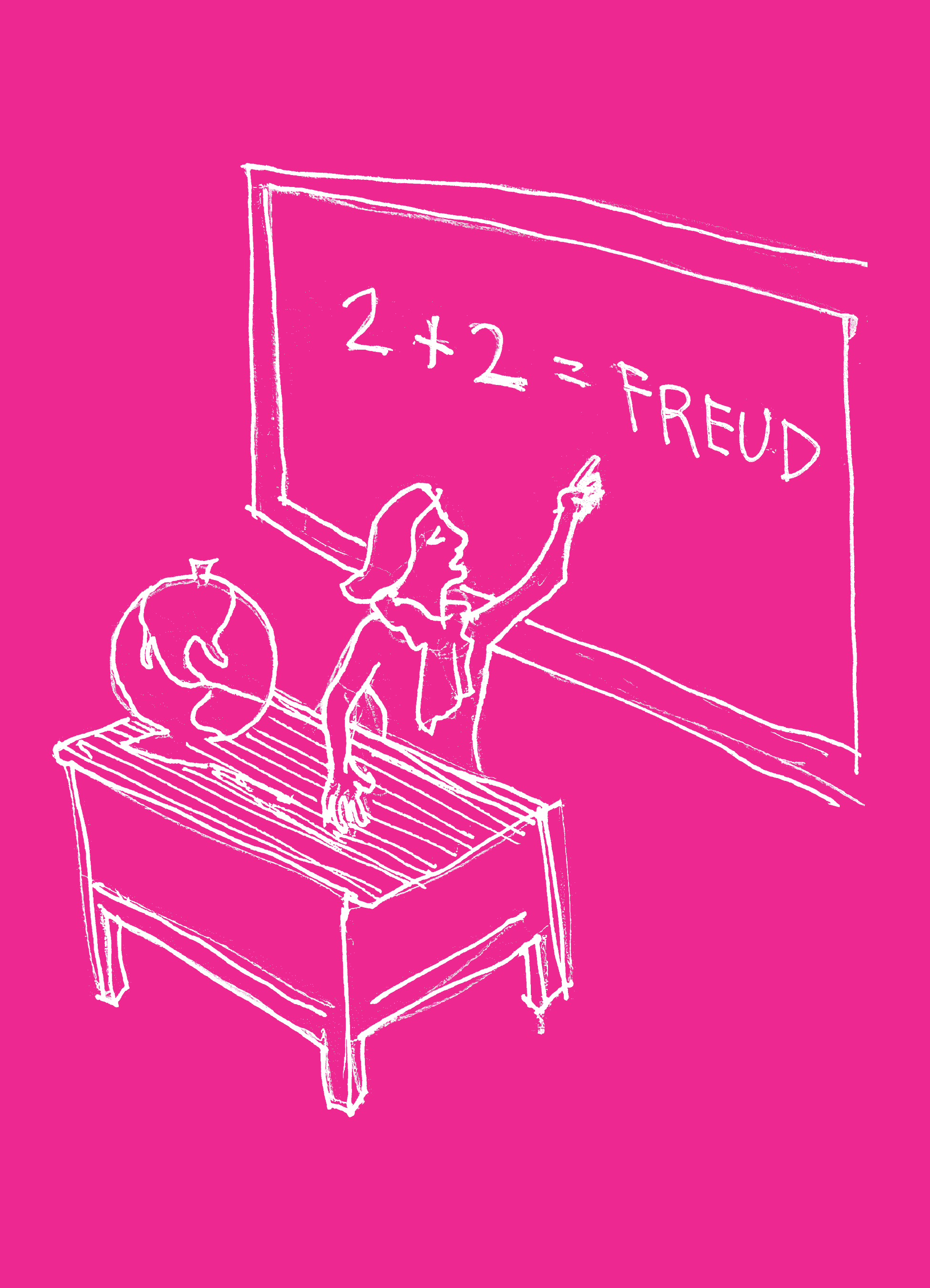
Drawings by Austin Ratner.
Elizabeth Lunbeck, chair of the Department of the History of Science at Harvard, has spent years teaching psychoanalysis to students encountering it for the first time. In her courses, Freud is neither a relic nor a doctrine, but a way of making sense of ordinary experience and human conflict. In this conversation with TAP’s Austin Ratner, Lunbeck reflects on how the value of psychoanalytic thinking can be made legible to students and to the broader public.
You teach courses about psychoanalysis as a historian of science. Why do you think it’s important that students learn about Freud and psychoanalysis?
As I see it, and teach it, psychoanalysis offers a really powerful way of looking at the world. Freud and psychoanalysis are not taught in psychology departments for the most part. There, teaching and research is focused on CBT as the gold standard for psychotherapeutic treatment. This limits students’ access to a whole range of ways of thinking about how we get along in the world.
I have found many students are really interested in Freud and psychoanalysis. But they don’t know where to start. If you look at the popular portrayals, you will encounter the Freud who is a kind of a sex-obsessed old guy who came up with these weird theories. We learn from our psychology professors that Freud is dead—as in fact he is. But I would argue—and this is a constant across all my courses—that Freudianism lives on, although not always marked as such.
This is a really interesting way to go through life, to look at things through a psychoanalytic lens. Psychoanalysis is a vibrant intellectual tradition, but I’m also trying to introduce students to a way of thinking they can mobilize themselves. It’s like lessons in living.
How do you approach Freud in the classroom to make him feel intellectually alive and relevant?
One of my aims, especially for undergraduates, is to de-exoticize Freud, to show how he is part of the way they’re already thinking. I try to make the material feel familiar and to defamiliarize it at the same time.
Transference, students love. It’s both incredibly simple and incredibly difficult to comprehend. And then repetition and reenactment, that also feels very native to them. I use everyday materials like advice columns and the example of, let’s say, your friend who is dating the same “wrong” person over and over. They’ve all had that experience.
I start out my psychotherapy course by looking at talk as a technique. We take it for granted that talk matters, but it goes against some cultural precepts, like “sticks and stones.” It had to be established as a technique, and Freud did that. And I go through all the different means by which he made talk into a therapeutic medium. I also assign Janet Malcolm’s book The Impossible Profession, a brilliant book. I think it’s the best single introduction to psychoanalysis. It captures so much of a time when there was huge ferment and change within the profession. Students respond positively to the book.
I don’t assign jargon-filled articles that are impenetrable to the outsider. I don’t expect students to become specialists in analytic thinking. What I want them to do, when they leave Harvard, is not blanch when they see the name “Freud” or the word “psychoanalysis.” This is the most basic aim of mine. I want to give them the tools to go deeper than the headlines when they see something about human nature, war, aggression, groups, the psychology of racism, and so on.
Part of what you’re doing is treating Freud as a kind of social thinker. How does psychoanalysis help us understand life with others?
In my current course, Reading Psychoanalysis in Turbulent Times, I’m introducing students to psychoanalysis as a way of apprehending the world around us based on the ways that psychoanalysts tried to make sense of the 20th century. It was a horrific century, most manifestly up through World War II, but the last half of the century wasn’t so great either. One of the questions I ask, is “Why can’t we all just get along? Why is social life so difficult?”
We start out reading Civilization and Its Discontents, which is evergreen and very bleak. I have found that students have a hard time with the idea that aggression is as fundamental as Freud asserts, but less of a hard time when you put it in terms of what’s going on in the world now. One of my implicit arguments is that analysis has always been about humans’ place in society. Analytic theory has always had room for being used in that way, to understand our place in the social world around us. We also read Group Psychology and Totem and Taboo, which has many current analogs—Band of Brothers and so on.
I don’t expect students to agree with everything Freud says. I just want them to understand why it’s proven so powerful and had such an impact through the years. Along with Freud, I assign other classics: Zaleznik, Bion, Fanon, Riviere, Kernberg, Adorno.

You’re teaching Gen Z students. I’m thinking about what they’ve been through in terms of COVID, in terms of the turbulence of the world around them. How are these students thinking about mental health?
What have they known but one crisis after another? It appears from many reports that rates of anxiety and depression have risen since COVID. COVID just did a number on all of us. The isolation in particular—we’re still dealing with that.
Students are very open to getting help. For them, there’s no stigma in the way that there used to be, which is a really interesting cultural shift. Every college or university will have a student health service, but they offer limited psychological help. The demand far outpaces the supply. Students will say that they or their friends are using ChatGPT or Claude for therapy and companionship.
One thing that has struck me is the different perspective on privacy that the young seem to have. It’s not an original observation on my part—they don’t seem that much concerned with privacy in the way that, say, my generation might have been.
Beyond the classroom, I feel like the myth is still out there that psychoanalysis has been discredited, despite all the evidence that has accrued about its validity and efficacy. How might the field convey this more effectively to a broader public?
First of all, TAP is fantastic. It’s colorful, it’s engaging, it’s about fun stuff. What you replaced, it felt like a magazine from the 1950s.
There have been various kind of summary articles in the popular press about how Freud is back. This is a hopeful sign. The Freud I’m teaching is more than a body of theory. It’s a Freud we can see in a live practice called psychoanalysis that has practitioners, training, journals, conferences, splits, etcetera. In these ways, it’s a profession like any other profession.
On the question of reaching the public, here I think psychoanalysts would be well advised to de-exoticize psychoanalytic thinking when they’re talking about ordinary events. Some of what has been written about Trump’s leadership style has been really useful and not that difficult to understand. To reach a larger audience, you need to avoid too much insiders’ language.
Every profession has its jargon, of course. It has meaning. But one of the things we’ve talked about in the course is using terms that have very vivid vernacular and psychoanalytic meanings—like container, deposit, and so on—to understand how minds operate, singly or together.
Published April 2026