Comping the Tune
Musical metaphor in a clinical moment
By Cornelius Dufallo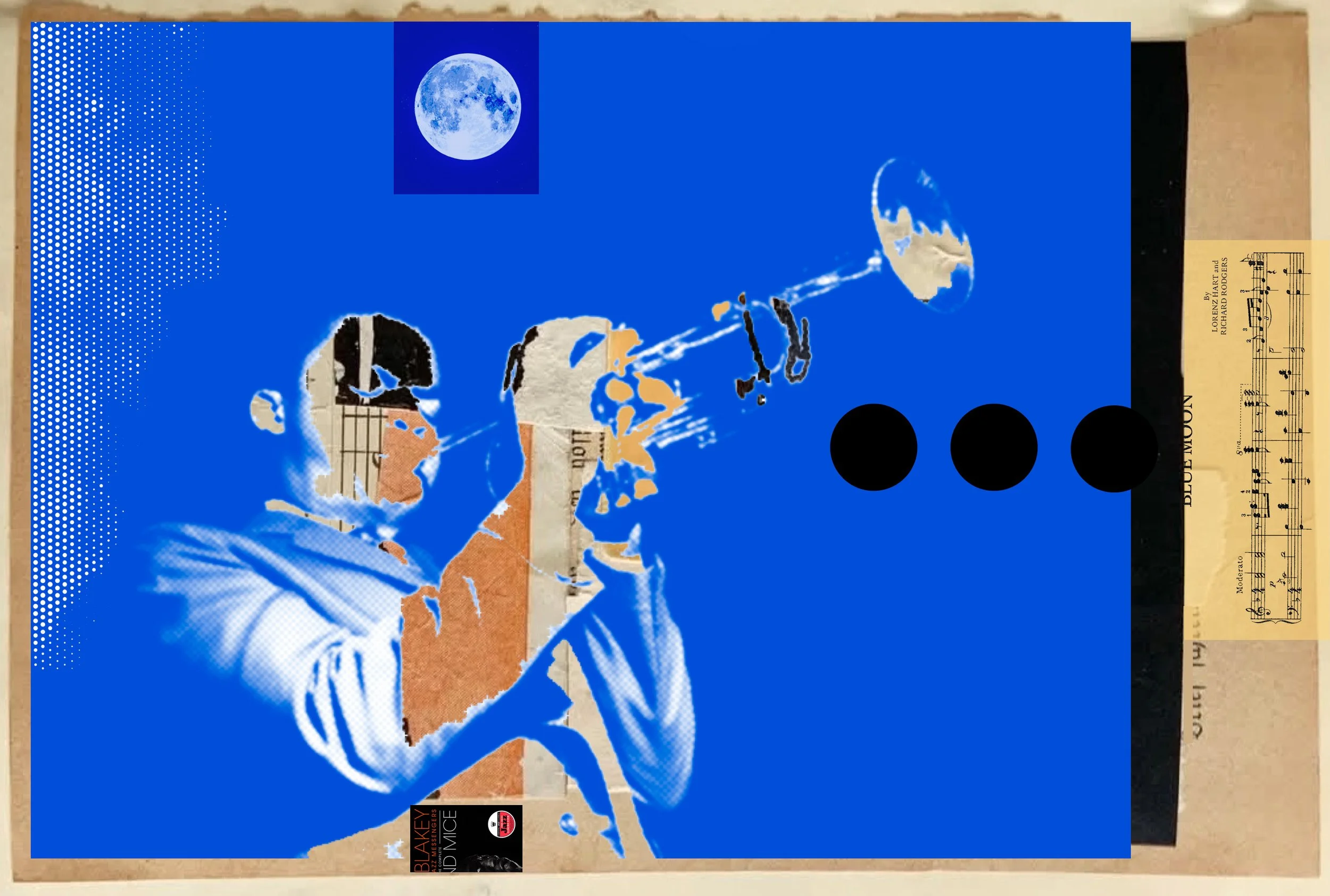
Illustration by Austin Hughes
In jazz, “comping” (short for both accompanying and complementing) is the art of playing chords and rhythms to support an improvising soloist.
My patient was meandering. The session seemed to be going nowhere.
I found myself orchestrating the sounds I was hearing. If this young woman’s voice were a piece of music, what would the instrument be? She sounded to me like a muted trumpet, playing abbreviated phrases and fragments—a trumpeter warming up before orchestra rehearsal.
I remembered that earlier in the day, during a break, I had been listening to the great trumpeter Freddie Hubbard. The recording was the mid-century jazz combo Art Blakey’s Jazz Messengers performing the standard ballad “Blue Moon.” No wonder the sound of the trumpet was in my mind. Such a gorgeous performance! But Hubbard is definitely not muted in that recording.
The recording functioned in this moment as the “day residue” for a brief waking dream, one I understood as a countertransference reaction to the session’s atmosphere. As my patient’s verbal wandering began to feel less like free association and more like a deliberate deadening, I found myself retreating into the vibrant, magnificent sound of the Jazz Messengers. I began to wonder: was she unconsciously using the sound of her voice to force a collusion, a shared avoidance of her anger?
Making use of the moment required a shift in perspective. While the trumpet is unmistakably a solo instrument—a bold, individualistic voice whose golden sound cuts through an entire ensemble—it is rarely heard by itself. There are few works for trumpet alone; as a voice, it belongs to, and is sustained by, the orchestra. Without that group resonance to ground it, the trumpet’s sound can become … meandering.
I considered my patient’s conflicts. A theme of the treatment has been how she always feels she has to “fall in line.” After she broke up with her ex-boyfriend, she told me, “I don’t even know what my musical tastes are … I just listened to whatever he liked.” As a girl, her mother decided everything, and her job was to attend to her mother’s needs.
I said, “I wonder if what you are saying today has something to do with thinking of yourself as an independent adult. Maybe the thought of being your own woman makes you feel like a trumpet without an orchestra, just noodling on the sidelines.”
She began to talk about her new relationship. This guy is so much nicer than her previous boyfriend, and he will soon be moving from another state to be with her. “I want to help him have a good time, but I don’t want to lose the things I have worked on; I don’t want to lose myself.”
My patient longs to have a golden sound that cuts through and soars above her supportive orchestra. That’s good, I thought. She needs to be a solitary voice until she understands that being part of the ensemble doesn’t mean losing herself.
Then I remembered the other angle. She was trying to deaden me. As I recalled the session, I became aware of a feeling of hatred. Hatred of what? I didn’t like feeling deadened that way, but hatred? I thought again of my patient, who is so pleasant and agreeable. Perhaps this is her split-off feeling of hatred, emerging in the music between us. My patient must be tremendously angry about the ways she was “muted” by her mother and her ex-boyfriend. Now she mutes herself, because to be golden, to soar, feels dangerous. To her, it feels like a dangerous amount of anger. For a woman who has always "fallen in line," the terrifying part of being a soloist isn’t just the isolation—it’s the responsibility of the melody.
She must feel muted by me as well, at times. I will address that, but not right now. Right now, I will contain that hatred until I understand it better and know how to comp that tune.
Cornelius Dufallo, LCSW, DMA, is a psychoanalyst in New York and a faculty member at the Contemporary Freudian Society, where he serves as chair of the Scientific Program Committee. A former professional violinist, his work explores the intersection of music and clinical practice.
Potentially personally identifying information presented that relates directly or indirectly to an individual, or individuals, has been changed to disguise and safeguard the confidentiality, privacy, and data protection rights of those concerned.
Published May 2026