The Telemachus Complex
Shame, inheritance, and paternal authority in Christopher Nolan’s The Odyssey
By Kyle Sossamon 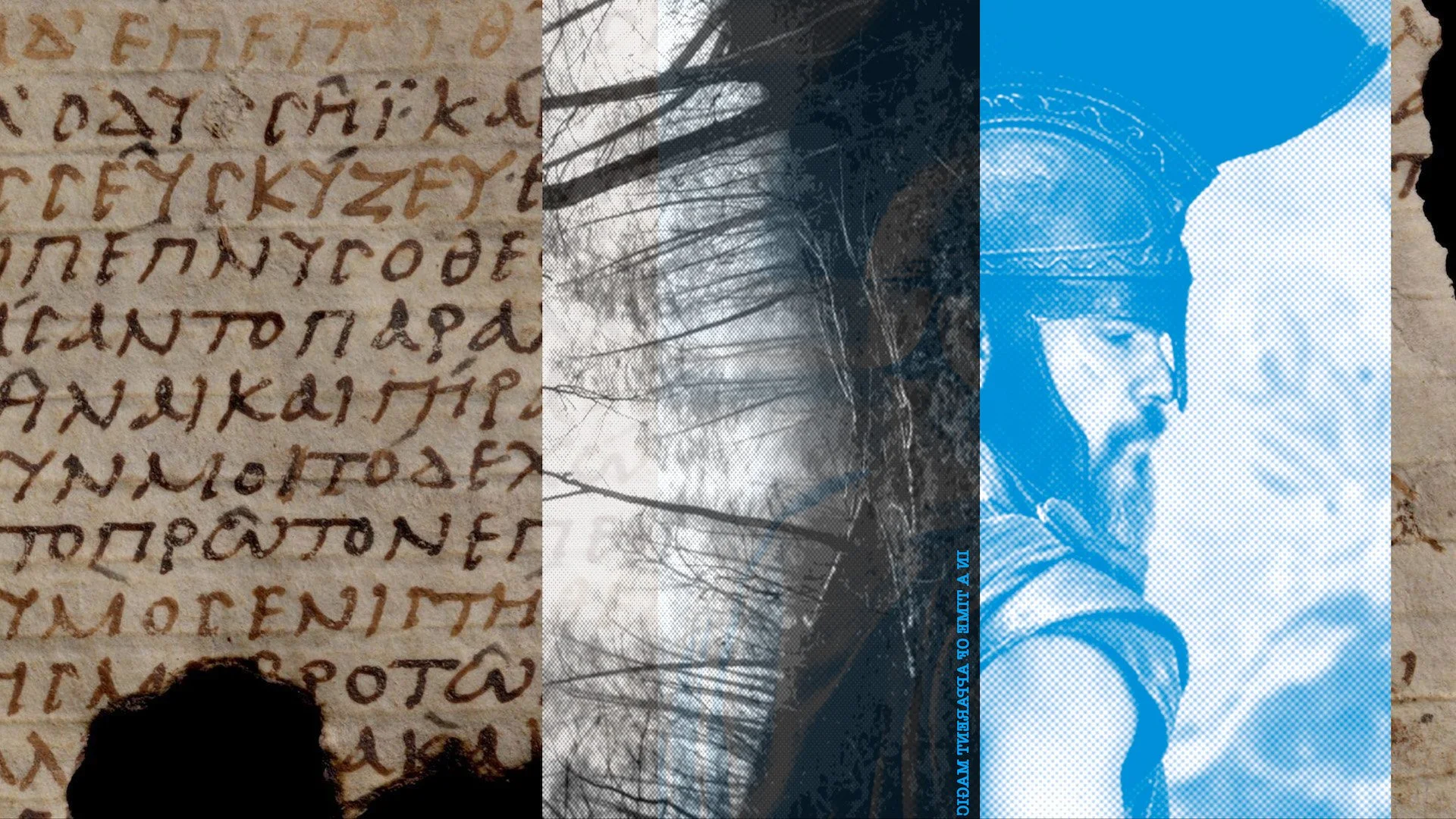
Collage by Austin Hughes
Midway through Christopher Nolan’s The Odyssey, Odysseus (Matt Damon) finds himself in Hades, seeking direction for his route home. While there, he encounters the shade of Sinon (Elliot Page), the Greek soldier who remained on the beaches of Troy to inform the Trojans about the significance of the peace offering. Sinon had no knowledge of Odysseus’s scheme involving the Trojan horse. Odysseus, therefore, dupes Sinon into being a deceiver; into dying as a lying fool. The dishonored soldier condemns Odysseus for his trickery, giving him a memento and a task. Upon his arrival in Ithaca, Odysseus must deliver this token to Antinous (Robert Pattinson)—who currently sits in the halls of Ithaca plotting for the vacant throne. Odysseus is charged with giving Antinous’s shame back to him.
This shame, however, is intentionally ambiguous throughout Nolan’s adaptation. The token was used by Odysseus when drafting soldiers into Agamemnon’s campaign for Troy. To avoid the war, a young Antinous secretly traded his marker with Sinon, a servant’s child who submitted to the conscription in Antinous’s place. The successful return of this token to Antinous signifies the culmination of Odysseus’s return. When his wife’s suitors are ultimately expelled, Odysseus can reclaim his throne and restore order to Ithaca.
But this does not happen. Instead, Odysseus enacts a self-exile, leaving his son Telemachus (Tom Holland), whom he barely knows, to ascend to the throne in an utterly destabilized world order.
What is of psychoanalytic interest here is the way Nolan grasps the current predicament of paternal authority, and what this predicament entails in times of grave uncertainty such as ours. When paternal authority flounders, as it is wont to do, sons no longer know how to become fathers or symbols of paternal authority.
***
In Nolan’s adaptation, the present and the past are bound together by a shared susceptibility to a specific illusion: the illusion of the father’s prestige, his incomparability. The first step toward maturity is seeing that this authority is weaker than it appears. Disillusionment, then, is the precondition for self-conscious action. But, as Jacques Lacan made clear, seeing through an illusion is not without peril. There is a difference between rejecting authority because it is flawed and assuming the right to authority for oneself.
This is Telemachus’s plight, for Nolan: an inheritance marked by shame; a plight that the Italian psychoanalyst Massimo Recalcati has explored in his book The Telemachus Complex: Parents and Children After the Decline of the Father. Whereas Freud’s Oedipus seeks to overcome the father through rivalry, and the anti-Oedipus of Gilles Deleuze and Félix Guattari seeks liberation from the father through a petulant rejection, Recalcati’s Telemachus seeks something from the father that can still be inherited. Telemachus, in other words, seeks reclamation in spite of the father’s fraudulence.
If fathers cannot authorize us to act in the present, then self-authorization is the ethical response to a shameful inheritance. And it is a precarious task at that. Nolan’s rendering of the Greek myth brings this all-too-contemporary problem to the fore: By what right can the son of a fraudulent father be expected to take on the mantle of a corrupted title?
* * *
“Victory has defeated you,” Bane (Tom Hardy) gargles at Batman (Christian Bale) before the hero suffers his most agonizing defeat ever pictured on screen in another of Nolan’s films, The Dark Knight Rises (2012). Superficially, the meaning of Bane’s pronouncement is obvious: Batman’s success—the near eradication of the criminal element that had plagued Gotham City in the previous two films—has made him complacent, ill-prepared for the likes of Bane.
There is, however, a more significant meaning at play here, one that touches on the central moral theme that not only orients Batman’s character arc in the Nolan trilogy but recurs in almost all of Nolan’s films—and provides the key for understanding his adaptation of Homer’s Odyssey.
Batman violates the very law he strives to incarnate in order to succeed. His “victory” at the end of The Dark Knight (2008) cost him his self-identity as a figure of authority. Bane’s mission in The Dark Knight Rises is to reveal to the people of Gotham that the law itself is compromised, illegitimate, and therefore pointless.
In other words, civilizations crumble when the law is fraudulent in Nolan’s filmic universe. His compromised heroes are always concerned with the imperfect restoration of a world whose destruction implicates them directly as progenitors.
In Nolan’s Odyssey, the characterization of Odysseus hinges on a similar struggle with self-recrimination. Odysseus is not traumatized from the war, exactly, but he is unconsciously aware of the guilt he has accrued through the ingenuity of his plot to penetrate the walls of Troy. The Trojan horse is effective because it exploits the logic of the gift. Its role as a phantom peace offering that leads to the destruction of the city is not strictly a heroic deed for Nolan. In fact, it takes on the status of an original sin.
What is Odysseus’s punishment for this sin? Whereas Dante has Odysseus punished for his trickery in the eighth circle of hell, Nolan depicts Odysseus’s punishment as a kind of purgatory experienced on earth. This is why, contra Homer’s account, Nolan’s Odysseus is never shown enjoying the spoils of his roundabout voyage: There is no recorded sexual exchange with either Circe (Samantha Morton) or Calypso (Charlize Theron), and for all his pining over Penelope (Anne Hathaway), he remains conflicted about completing the journey. The omission of these liaisons is not, for Nolan, a matter of rendering Odysseus more sympathetic or heroic. Rather, their absence emphasizes the source of his indecision: that his lack of direction is a form of avoidance.
Arrival is what he fears. The detours that complicate his return home are the manifestation of his own unwillingness to face the world that his illicit victory has ushered in—a reality Odysseus only intuits through the enigmatic appearances of the goddess Athena (Zendaya) throughout his journey. We, the audience, only learn at the close of the film why Athena takes this particular form: it is the form of a priestess who is ruthlessly beheaded in tandem with the destruction of a statue of Athena during the siege. Athena, wisdom incarnate, is another unsung victim of Odysseus’s trickery.
* * *
The moral weight of Odysseus’s deception lies not simply in the violence it unleashes but in the law it violates. Paternal authority is separated into two tiers in Nolan’s adaptation: the king’s law, or the law of man; and Zeus’s law, a law of general and unqualified hospitality—because any stranger could be a god in disguise. Surreptitiously entering Troy and unleashing such carnage irrevocably shatters the latter law.
Agamemnon (Benny Safdie) embodies the king’s law: He calls men to arms, to fight in service of his aims. This law is partisan because its appeals will either be willfully submitted to or else a price will be paid. When Odysseus tells Penelope about the ensuing war and his enlistment, she pleads that they take their infant son and flee. Odysseus then recounts the sacrifice of Iphigenia, which Nolan presents with sparse commentary and disruptive, briskly edited imagery as Agamemnon carries a small child to the edge of a cliff in stormy weather. Penelope is appalled at the act and the implication. “Monstrous,” she says, as the camera cuts to a sleeping Telemachus. Agamemnon will shamelessly sacrifice anything at the altar of his desire—a shamelessness that his wife, Clytemnestra (Lupita Nyong’o), repays with murder upon his return home.
The contrasts between these fathers are carried throughout the entire film. If Agamemnon is committed to the war and the expansion of his empire above all else, Odysseus is committed to preserving a way of life, the future of his son and the stability of his home—a home that, as Penelope informs a grown Telemachus, resolutely abides by Zeus’s law: hosts must offer unqualified service and provisions to guests, and guests must be respectful of their host’s graciousness.
Zeus’s law compels Penelope to endure the disrespectful and conniving suitors who have taken up a leisurely and exploitative lifestyle in her home, in Odysseus’s absence. Their parasitic existence is twinned with the poisonous gift Odysseus offers the Trojans. Guests are now untrustworthy intruders whom you admit at your own peril. While the suitors compete to replace Odysseus, they are led by Antinous—a man whose very presence in Ithaca rests on the lie that he was never conscripted for war.
As the sacrifice of Iphigenia makes clear, the king’s law is not the highest law. It is secondary to the laws of the gods. In Hades, Odysseus discovers Agamemnon’s tragic fate. Agamemnon, now among the dead, warns Odysseus not to take the straight route home, not to return through the front door as if all that has happened at Troy left their homes unaffected. Here, Odysseus learns the true significance of his original sin and the shame that becomes Telemachus’s inheritance.
Crucial for Nolan, then, is the fact that the father’s sin will be repaid by the destruction of the ties that bind not only the family but the home itself.
The event of the Trojan War thus signifies that home is no longer a place to which the father can simply return. A world without hospitality, Odysseus suspects, is what awaits him. A world in which gifts are unreliable, even poisonous. A world in which the foreign(er) will never again be trusted, accepted on faith. An inhospitable world. Which is precisely what he eventually finds at home.
Odysseus will have to violently reclaim his house and refound it without the law that originally built it. That is, he is tasked with bearing his shame honestly, by knowingly sinning again and repeating his trickery, this time against the suitors, with full knowledge of its cost.
“Telemachus, therefore, is an heir in suspension. He is a son deprived of the condition for wisdom: He has not yet known his father.”
***
Reclamation is, then, the true topic of Nolan’s adaptation. It is a task that extends to both Telemachus and Odysseus. Throughout the film, Telemachus, true to Homer’s myth, longs for a return to order in his father’s house. As Recalcati makes clear, this is not simply a nostalgic desire for the return of the father as a master or disciplinarian, but a more basic desire for the return of something concerning the father. Telemachus wants news of his father. Crucial to Recalcati’s account is the gaze of Telemachus—that is, where he looks to. In Homer’s text, Telemachus is fixated on the horizon, which is not simply a longing for that which is absent, but an openness to the possibility of an arrival. Telemachus holds out hope for a better future. The father who returns will not be the role model whose footsteps are to be followed; but a father whose life bears witness to the possibility of leading a meaningful life in a disordered world.
If Oedipus’s journey ends in an act of self-blinding due to his transgression, then Telemachus’s journey is one of reclamation because he keeps his eyes on the horizon. From the horizon his father will return, if he is to return at all, as a stranger—as someone who must be encountered anew rather than merely recognized. This openness to difference will be Telemachus’s salvation.
But Telemachus must know if his father is dead or alive; that is, if it is appropriate for him to make a play for the throne of Ithaca, or to bide time until the father returns. Until then, he is imposed upon by the now-defunct expression of a law perverted by his father’s sin. Hospitality is now a weakness that threatens both his past and his future.
None of Penelope’s suitors intend to see Telemachus receive his inheritance. The throne will not pass to anyone without bloodshed. He cannot ascend to the throne by any legitimate means. That is, by any means that does not entail shame.
Telemachus, therefore, is an heir in suspension. He is a son deprived of the condition for wisdom: He has not yet known his father. He is reminded of this fact by both Antinous, who calls Telemachus a bastard, and Menelaus (Jon Bernthal), who questions why Telemachus would feel any hesitancy towards taking the throne.
This, then, is the crucial divergence of Nolan’s adaptation: Why does Odysseus embrace a self-imposed exile after reclaiming the throne? Or, rather, why does he refuse to reclaim the throne after expelling the suitors? The film’s logic of shame is clear here: Odysseus, having already violated Zeus’s law, decides to repeat his violation so that Telemachus is free to rule over Ithaca, to begin again. The condition for Odysseus’s return, in other words, is his self-exile. But, and this is key, on the film’s own terms this means that Telemachus will remain mostly ignorant of his father, who retreats westward. In Recalcati’s terms, Telemachus will remain an orphan.
Orphans, Recalcati theorizes, are atomized individuals divested of social ties. Unlike Oedipus, they do not even have a father to hate. Orphans, in other words, have only ever known the world as a site of ruins, a world always already lost to them.
***
If for Nolan Odysseus’s original sin is tantamount to the destruction of a hospitable world, then the contemporary relevance of the film lies in its concern with the prevalence of separation, isolation, and abandonment today. Has our own historical moment likewise become a world of orphans and ruins?
When Telemachus sneaks out of Ithaca to seek news of his father in Sparta, he develops an apparent friendship with Menelaus, both of whom have heard rumors of hostiles coming from the sea—an unknown force threatening the Greek world. And yet, no pacts are made, and no collective assurances for mutual aid and support are offered. The destruction of hospitality leaves each kingdom to fend for itself.
Today, the film invites us to reflect on the return of populist and nationalist movements across the West, which involve the same loss of universalism, the retreat of hospitality, and isolationist policies: the absence of a common thread, concealed by the return of the father-as-master. Not only, then, does the foreign(er) become an automatic enemy to fear; but more, alliances are extinguished at worst, and opportunistic at best. The familial and the political overlap here, for Nolan, who is keen to position the orphaned Telemachus as someone whose inheritance dictates that he must go it alone.
Herein lies the ethical weight of Nolan’s adaptation: Without a reliable means for transmission, how does an orphan become a father? How do we, orphans of the current historical moment, reclaim an authorization to act for ourselves in an inhospitable world?
***
If Recalcati is right that modern subjects cannot simply inherit paternal authority, then the question becomes how such authority is established at all. Here I read Recalcati in light of Lacan’s later concept of the sinthome, which Lacan theorized to explain how one can hold their own individual psychological reality together, maintaining its coherence, when social ties have dissolved—that is, when we are all, each and every one of us, foreigners unable to trust the gift of another in an ostensible community.
The sinthome, then, allows one to live without the authorization of the father—or in spite of an illegitimate authority—by subjectivizing the right to authority. But how?
With Recalcati, we can say that the sinthome specifies a passion for work, a localization of enjoyment that possesses you, in a way, making life intermittently livable. Your sinthome is what sustains you. Orphans must find their sinthome. This is what they both reclaim from a fallen world and transmit forward to the future: a singular passion. Self-authorization is a task that finds its completion in the identification of one’s own sinthome, not imitating a paternal figure. Orphans have received no other inheritance apart from the task of identifying their passion. This, paradoxically, is the only inception of paternity, for Nolan: loss rather than certainty. And its filiation is always precarious since, with each generation after Odysseus’s original sin, beginning again with a fraudulent father is what remains on offer for an orphan.
Telemachus, we can now say, functions sinthomatically in Nolan’s film—he embodies both the crisis of inheritance and the open-endedness of every orphan’s search for a sustaining passion or vocation. This is why the relation between Odysseus and Telemachus is so dissatisfying in the film narrative, and necessarily so. The father-son reunion is brief and anticlimactic before Odysseus expels the suitors, and then, clearly ill-prepared, Telemachus takes the crown and bids his parents farewell. His denouement feels unearned, as if the fate of the orphaned Telemachus could only be half written.
In Nolan’s film, three times Telemachus repeats the phrase to an interlocutor: “You have wise eyes, Athena’s eyes.” On the third occasion, misrecognizing his own father, he says this to Odysseus himself, who is masquerading as one of his own servants come to scope out the state of Ithaca before his master returns. Odysseus tells Telemachus that he should “stop looking for gods in the eyes of men.”
Kyle Sossamon is a PhD candidate in Art History at Binghamton University, writing on photography, psychoanalysis, and media theory. His academic work has appeared in Critical Inquiry, the Journal of Visual Culture, and Psychoanalysis, Culture & Society.
Published August 2026