The Divided Self of Elliott Smith
Biographer Jamie Fisher on creativity, psychoanalysis, and the need for connection
By Lucas McGranahan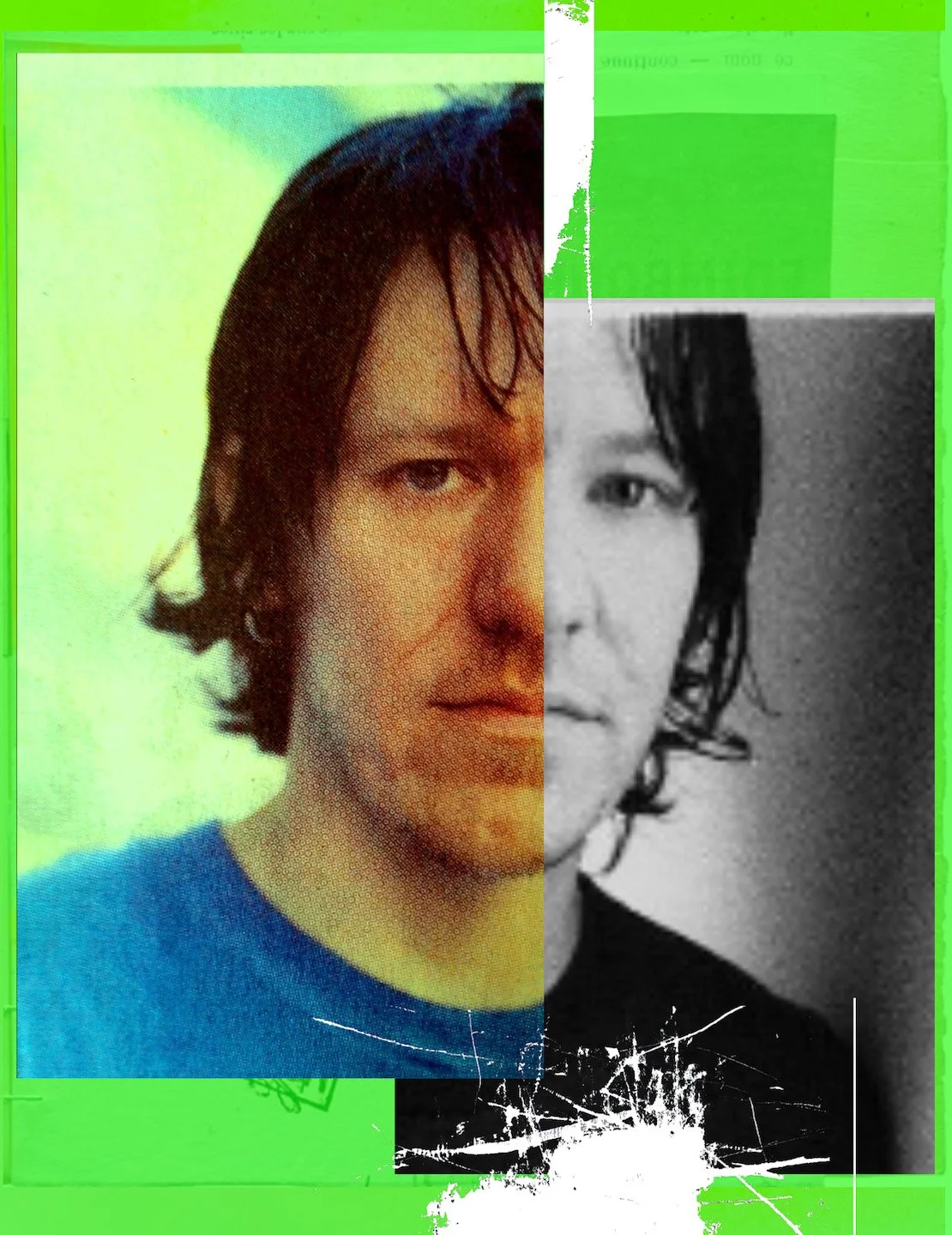
Collage by Austin Hughes
Many remember Elliott Smith as the solitary, anguished singer-songwriter whose intimate music and early death in 2003 form a tragic story. Writer Jamie Fisher offers a more complicated portrait in Nobody Broke Your Heart: An Intimate Biography of Elliott Smith, drawing on archival materials and extensive interviews with his friends, family, partners, and collaborators. Fisher, a freelance writer and staff researcher for The New York Times Magazine, began the book after realizing that existing accounts had not captured the funny, intellectually restless, deeply empathetic person she discovered in his lyrics and music.
In the conversation that follows, Fisher discusses the divided selves dramatized in Smith’s songs, his engagement with psychoanalysis, and the roles that creativity, addiction, and a longing for connection played in his life. An accompanying reflection by psychoanalyst Garrick Duckler, Smith’s childhood friend and early bandmate, offers a more personal angle on the songwriter and his life (see Conversations with Elliott below).
How is Elliott Smith remembered?
There was always a lot of interest in pigeonholing him into this very dark and sad place. In England, he got questions like, “How does it feel to be the sad sack troubadour of America?” Elliott himself got sucked into it over time. If you’re constantly seeing this vision of yourself reinforced and insisted on, it’s like looking in a funhouse mirror.
I think that there’s always been this division between the broader public idea of him and what his fans have always known. If you look on Reddit forums, you can see pictures of him in silly wigs or dressing up in drag to go with friends to an event, or just generally being very goofy and thoughtful and sweet. And one of my goals with the book is bringing it together in one place, because I think that with a lot of the books that were out you didn’t see the sweetness and kindness and silliness as much, or honestly, the intelligence. He was brilliant.
Elliott Smith’s manner of death has inevitably become a part of his story. As his biographer, how did you keep his death from becoming the lens through which you viewed everything that came before it?
As I was finishing my book, I read this wonderful book about Sylvia Plath called Loving Sylvia Plath: A Reclamation. And one of the things that the author points out, is that Plath’s life has always been read backwards from the point of her death.
I initially thought about not writing about his death at all. I had a much more limited idea of the book that was more focused on exploring themes in his lyrics. And then as I kept working on the book, I realized a number of these people aren’t going to talk to anyone again. And so I realized I had this obligation to cover the full story, which is very difficult.
It’s a very small portion of the overall book. Most of the book is about his life. It isn’t looking as if it all is leading inexorably to this one fixed point that’s very tragic at the end. It’s a privilege of history to be able to look back as if everything leads inevitably to something. Nothing about it was inevitable.
You describe Elliott Smith as an intensely empathetic person.
Something that Garrick called to my attention is that sometimes he would understand things at a level that went below explicit speech. He was very intuitive and alive to other people’s emotions and thoughtful about the ways that they got through the world.
And he was an artist who painted with emotion. One of the ways that he did that was by sometimes splitting people up into different emotions within a song. Like, with “Bottle Up and Explode”: “You look at him like you’ve never known him / but I know for a fact that you have / The last time you cried, who’d you think was inside?” That’s not about two people. That’s a speaker addressing himself and recognizing that there’s a part of himself that he buries and pretends he doesn’t know, and that it will keep coming out until he acknowledges it.
That’s very psychoanalytic.
Absolutely.
You describe Elliott as a serious reader. He read Kierkegaard, Dostoevsky, Nietzsche. What was he looking for in books?
One of his friends, Steve Cole, they had this little book club together for a while. They worked together at a bakery, and after work they would go downtown and sit in the fountain and put their legs in the water and just read. He remembered how many of the books that Elliott picked for them to read seemed to really disturb him, like, really freak him out, but he wanted to read them.
With Dostoevsky, there was a certain reflection of his internal life. It was just comforting to see that reflected. This is someone who feels like me.
He also read Freud, and his father Gary Smith was a psychiatrist who worked psychoanalytically. Did psychoanalysis become part of his vocabulary for understanding himself?
I think that that reading about the ways in which the self could be split into these warring impulses shaped how he came up with this emotional vocabulary in his songs. Like, there’s a recurring kind of character or force in his songs called the Boss, and you know, is that the superego?
Actually, I asked Garrick about this once, and he said, “No, that’s a negative parental introjection.” And I just kind of threw up my hands.
Some of our readers will appreciate that. In other words, the internalized critical voice of the parent.
It’s a deep cut.
Look at a song like, “Misery Let Me Down”: “The keeper falls asleep in the hall / I become what he won’t allow.” The idea is this kind of oversight internally that sometimes shuts off. And then something inside him is allowed to run rampant when it’s off. I really think it’s impossible to think about him developing that vocabulary without having exposure to psychoanalysis.
The one example that Garrick remembered was he was reading The Brothers Karamazov. He said something like, “These people have no ego. They’re just superego and id.” Garrick told me that he thought that was a remarkably insightful thing to say about the book, but also something remarkable for Elliott to say about himself. Because he did kind of go between impulse, and then censuring himself for those impulses.
His friend Sean Croghan remembered when Elliott got into a fight with a promoter in Canada who had been rude and combative with his band. And he kind of shoved the guy against the wall, and he was like, “These are my friends, and this is my tour.” And then afterwards, on the tour bus, he was going back and forth between “That fucking old man!” and “Oh my god, that poor old man!”
He also compared songs to dreams.
It was partly evasion, like people would say, “What is Son of Sam” about, and he’d be like, “I don’t know. I had a dream.”
A lot of his songwriting he did when he had one part of his brain shut off or distracted so that he felt like he could reach deeper emotional truths or turn off a self-critical part of himself. Like, “Between the Bars” was written while watching Xena, Warrior Princess with the sound off. Or he would write in bars, where you could just have this distraction in the background that could prevent you from being too critical and killing an idea before you let it grow.
There can also be kind of a dream logic to his songs, like it all connects but it’s not necessarily straightforward.
Garrick had told me about how they would have these conversations, and sometimes the words were not actually what was being exchanged. Like, the words would belie whatever was going on underneath, and they were paying attention to these emotional and psychological undercurrents that were happening underneath the explicit level of the conversation. And his songs are a lot like that.

Published by Dutton (Penguin Random House). Release date August 25, 2026.
You mention that he briefly went to therapy in his 20s. But generally, he was averse to seeking help. Did songwriting or performing play that role for him?
Yeah, there’s this quote from the early 90s he gave to a newspaper while he was still part of Heatmiser. He says something like, “I write about panic attacks, things I can’t get out of my system any other way.”
Your book traces Elliott Smith’s relationships with alcohol, drugs, and to an extent, gambling. What role did these behaviors have in his life?
To a large extent, shutting things off. He had this sensitivity toward the world that was really wonderful and enabled his most beautiful art and these really wonderful friendships. But it could also be overwhelming. And the kind of interior dialogue that was going on inside of him—between superego and id, you might say—could also be overwhelming. A number of his songs sing very sweetly about oblivion.
Too much was getting in. I think that we all have internal defenses, and there are points in his life when those defenses were really low. He felt like the only way he could survive and stay was to mute everything that was going on.
One of the most difficult parts of the book concerns Elliott Smith’s accounts of childhood abuse. How do you approach memories that are both psychologically important and historically difficult to verify?
There are things that we can’t know. I wanted to be so careful because there’s an obligation to the dead, but there’s also an obligation to the living. And then there’s the consideration of who deserves to know this much. If you push for completion and exhaustiveness, do you end up leaning into sensationalism? It was very difficult sometimes to weigh, and I would be agonized about it. Because it can be misleading either way, and it was very difficult to balance that out.
It wasn’t until college that he started to identify himself as someone who had gone through abuse. And after that point, he starts telling people pretty readily, often strangers. There are things that Elliott told people that I couldn’t confirm and that he himself was not sure about. Ultimately, what really tormented Elliott was not knowing for sure what had happened and what had not happened, and that was true until the end of his life. Almost all of his songs that deal with it are not about abuse as a concrete reality. It’s about being tormented by not knowing.
One of the catalysts for me working on the book is a previous biography that refers to the conversations that Elliott was having with people about abuse as “boozy fabrications.” I was bothered by the assumption that they were deliberately fabricated, even in a scenario where nothing happened. There are all kinds of internal realities that we have. And I think that he did believe it.
A core tension in your book is longing for connection but also being afraid of it.
Yes, absolutely. The title Nobody Broke Your Heart I picked because the song “Alameda” captured this essential tension that he was dealing with all his life between the hunger for connection and the fear of it. The conclusion of the song is, “Nobody broke your heart / You broke your own / because you can’t finish what you start / If you’re alone / it must be you that wants to be apart.”
If you’re feeling lonely, it’s because you keep pushing people back. It’s brutal. It’s a brutal ending to that song, and it really sticks.
Rose Melberg from the Softies, who toured with him in ’96, felt like part of that was kind of captured in his relationship with the stage. It was very difficult for him to perform. It was anxiety-inducing, and it was part of the reason why he liked playing with a full band. He didn’t like having all of the attention on him. He preferred it when people were talking in the audience or playing darts.
But she said that she felt like it was something that he had to do because it was so important to him despite that, this push for connection. Despite the fear of it, and despite the pain of it, too.
You were thinking about Elliott Smith all the time for years. What is that like?
Well, it was really interesting. I’d just be thinking about him all the time and asking myself these like unresolvable questions that I guess I’m still asking.
I’d just be walking down the street and I’d remember something someone told me and just start laughing. Someone he knew in New York remembered walking home late at night with him, and a garbage truck rolled by, and Elliott just kind of like tilted his head and was like, “That’s my ride.”
I just remember these little funny things and start laughing as if I was remembering these experiences I’d had with a friend. And then sometimes I would just think about, you know, more difficult memories and kind of be sent to that place too.
I got started on this when the pandemic was really in full force. So it was nice having the company.
Did he become more understandable to you, or more mysterious?
I had this interesting feeling, like a parabola, where sometimes, the more I knew, it felt like I was getting closer to knowing him. But sometimes the more I knew it felt like I was pulling further away from knowing him, and it could be really disorienting.
I feel like I know him better now, but he would always surprise me. There would be moments when someone remembered a conversation with him, and it would totally throw my idea of him up into the air. One of the reasons I ended up talking to so many people is that everyone had a different Elliott. He was kaleidoscopic. You can look at any one piece of him, and it’s accurate, but it’s not true.
It seems like a paradox that people enjoy listening to sad music. I think you make some sense of it. You say in the book that Elliott’s music shines recognition on difficulty.
Sometimes you just need someone to acknowledge it’s hard. You don’t want a song that’s like, it’s going to be okay all the time. Sometimes you just want someone to have a frank conversation with you, and perhaps in the form of a song. And it might not get better. But you’re not alone. Because someone else at some other point in history thought that too.
And I think there’s a lot of power and comfort in that. Not easy comfort. But just the kind of comfort that comes from feeling understood.
Is there one thing that you would hope readers would carry with them after finishing the book?
How broad people can be, how much they can contain. How difficult it is to tame that into one narrative and sometimes how it can be misleading.
Sometimes the truth is multiple stories. I tried to represent that in the book. If I heard contradictory stories, sometimes I’d just tell you both.
Chekhov has this quote: “A psychologist should not pretend to understand what he does not understand. Moreover, a psychologist should not convey the impression that he understands what no one understands. We shall not play the charlatan, and we will declare frankly that nothing is clear in this world.”
So maybe that ties back to psychoanalysis for you, too.
This interview has been edited and condensed
Conversations with Elliott
By Garrick Duckler 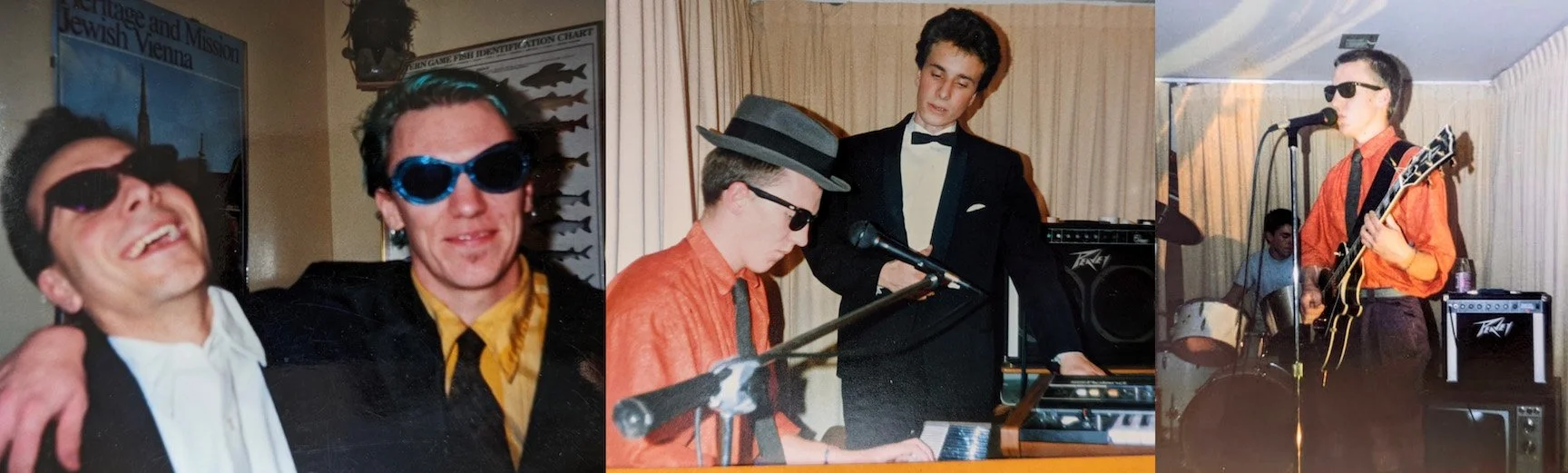
Hanging out at Garrick’s (parents’) house. Left: Garrick and Elliott in their early 20s. Center and right: Their high school band Stranger than Fiction plays Garrick’s (17th?) birthday party, with drummer Adam Koval. Photos courtesy Garrick Duckler.
It was after college but before I left for grad school. We were in our early twenties, and we were coming back from a show or a movie. He seemed unhappy and tired of being unhappy. I remember saying something like “You feel like a room in a house in which a dog had jumped on and knocked over something precious on a desk but the house had been hit by an earthquake earlier and the house itself was built out of iron and paper. And outside the house a storm is brewing.” In other words, it was hard to tell which of the various things that were going on simultaneously with him were really what was bothering him at any given moment. He liked hearing this because it helped him make a distinction between what was an episodic disturbance, a structure of personality, or a tragic event from long ago and something that was off in the distance but nonetheless threatening. The message was he was a complex person even if what he might have been feeling was experienced as “all at once.”
If I could offer him dimensionality, he offered me concision, something condensed, a pointer. For example, we were sitting in a booth one night at Pine Street Theater. We were talking about things we loved to talk about when out of the blue, he turned around and poked his finger into the stiff black vinyl of the seat. The indentation slowly resumed its original form. He said, smiling, “This is what your dad is like with your mom.” I laughed. I knew exactly what he meant but I remember thinking, how on earth did he see this (he and my dad barely said two words to each other) and how could he capture their dynamic so succinctly, include a sympathetic criticism of both parents as well as emphasize the novelty for him of being around a couple that was functional but had their problems?
Elliott always made you think about things without ever drawing attention to this unusual ability to distill complex situations into poetic form. His style reminded me of what Gary, Elliott’s father, had once told me about Harry Guntrip, who would often make references in his writing to other authors’ ideas that no one had ever heard of before until it was later discovered that he had simply made up these references because (one imagines) it helped him feel protected from the vulnerability of his own creativity.
I think this was true with our songwriting as well. He could use my lyrics as a cover for his own experimentation (he wrote a song entirely on a balalaika, for instance) that he didn’t afford himself when he was “out there on his own.” One thing I learned from working with him was an attitude toward creative work that (if all goes well) is akin to being in relationship with a person. This song or that piece of writing (or, for me, a short film) is like someone you bring around to meet your friends. You bring them to a party and see if people are repulsed or confused or charmed or let down or engaged. You lose control of something if it is inspired enough and then you’re a kind of chaperone. This was why I started the Inner Frame, a short film festival showcasing analytic films, which rather than illustrating theoretical ideas, capture experiences that resonate with what happens in analytic work and ultimately have a life of their own.
Looking back, I think it’s easy to think that psychoanalytic ideas likes those of Ron Britton or Herbert Rosenfeld would have helped me understand Elliott or his lyrics, but I think of it more as the reverse: I came to appreciate psychoanalytic ideas more fully and with greater depth as a result of knowing Elliott and his work. So when Jamie says in her book that I see a certain image in his lyrics (the cop following him around) not as a representative of the superego and more aligned with what Ferenczi would call “identification with the aggressor,” what I am saying is less about the meaning of the lyric and more about how I am helped as an analyst by Elliott’s poetic images that bring psychoanalytic insights to life.
Published July 2026