Welcome to the United States
A homecoming amid closing borders
By Chandra Rai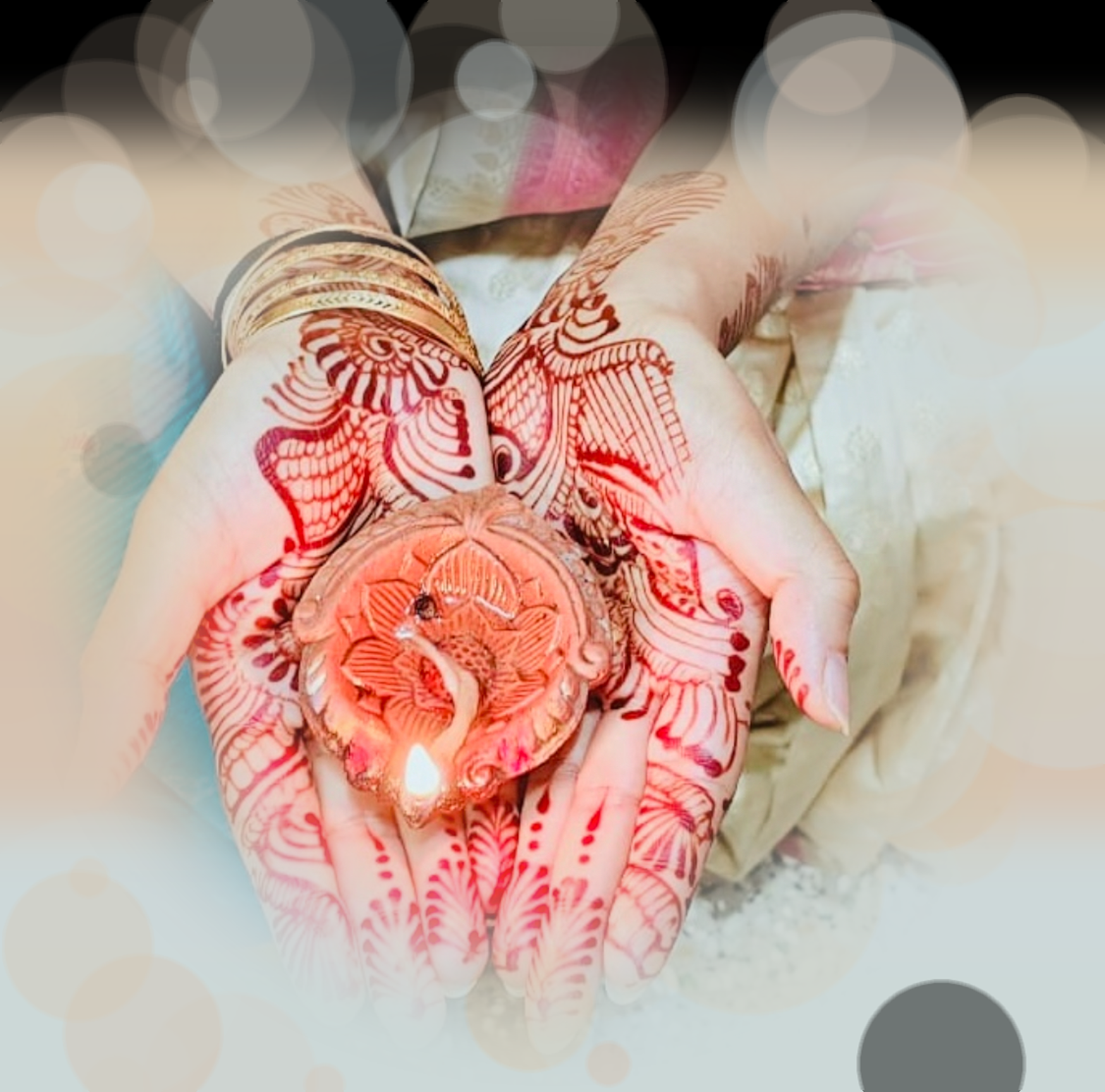
Photography by Vinay Kumar. Photo courtesy Chandra Rai.
It was a bittersweet moment boarding the flight from Bengaluru to San Francisco via Dubai. Was I flying home or leaving my home behind? The trip was memorable and full of experiences, as my nephew put it. My first Diwali back in India after years away was steeped in traditional food, silk saris, the house brimming with family, and patakhe (firecrackers) echoing childhood. Woven into the trip was a journey to two ancient cities—Varanasi and Bodh Gaya—where the Ganges flows and the Buddha found enlightenment, all safely tucked inside my heart, memories to savor for years to come. I’m grateful for all the new connections and old relationships reforged during my month-long stay in India.
So I left with the promise of returning soon—to my mother and to the land where I was born. As the years have gone by for me as an immigrant in the US, India has become more than just my family who lives there. The country itself, the nostalgia, the identity of being Indian—all have taken on a life of their own. Some of it is an immigrant’s romanticization, and the rest is the split-off fantasies, disappointments, isolation, and loneliness that one feels in a foreign country.
I ate, slept, read, wrote plenty, dreamed, savored memories of the trip, listened to music, ignored the annoying fellow passengers, and built a cocoon for myself during the 15-plus-hour leg from Dubai to San Francisco. I needed to consolidate, to make space for all the feelings swirling inside me, to let them settle and make room for creativity.
The dim lights and the constant hum, suspended in air resisting gravity, floating through clouds, outside all borders, claimed by no nation, paradoxically alone in the presence of others, transitioning between who I was at departure and who I’ll become at arrival: the airplane becomes the analytic couch.
Here, my unconscious comes out to play as my reveries roam: patients, humanity, poetry, grief, dreams, longing, silence, love—creativity emerging from the wandering. This is the creative aliveness I cultivate—the capacity to listen deeply, to feel, to think what hasn’t yet been thought, in myself and in those I sit with—psychoanalysis becoming not merely a craft, but a way of being in the world.
The flight landed—a very smooth landing. As always, people jumped from their seats, grabbed their overhead suitcases, and impatiently waited for the doors to open, ready to rush into the lives waiting for them outside the airport. I thought of my dog, Lexi, and how she would impatiently wait as I got ready for our walks. She would pace around and make her frustration clear if there was even a millisecond’s delay in our routine.
I could feel similar frustration in the shuffling feet, grunts, murmurs, nervous glances, whispering to partners, and voiced concerns as the plane door remained locked—almost ten minutes after arriving at the gate. The pilot had already given the instruction: “Crew members can now unlock the doors.”
The families were anxious. One family kept checking their passports and scrambling to find their boarding passes. The wife thought the husband had them. He remembered handing them to her. The daughter felt embarrassed by her parents’ fuss. When people cannot contain their anxieties, they turn them into actions—in this case, searching for security and reassurance.
Finally, the door opened.
But the line of passengers did not pile out at the familiar speed. There would be no autopilot through this arrival.
***
As the line snaked its way out of the plane into the familiar San Francisco passport control corridors, there stood the reason for the delay: two armed border control officers, one man and one woman, checking each passenger’s passport as we exited the plane—something I’d never seen in decades of travel.
So, what was this about?
The collective anxiety around me began to intensify. A guy in front of me in a gray suit dropped his bag. His pants threatened to slip down as he lurched forward to grab it, shirt coming untucked. With visible anxiety, he scrambled through his laptop bag to find his passport. Another young passenger rummaged through his backpack, taking a knee for support. Everyone stood watching this play out with some discomfort, while the officers kept poker faces.
As I watched the scene unfold—the two Border Patrol officers towering stoically like border walls, a man in a gray suit with pants falling, a young man on one knee, anxiety thick in the air—I saw the tableau of America today.
In this tableau, we are all actors in an unfolding, unmasked America—some cast in the costume of power, others in the posture of submission, still others cloaked in indifference, and some standing witness with averted eyes. Beneath it all lies the loss of the identity America once claimed: a system of checks and balances, where power was constrained by law, not law bent to serve power.
When my turn came, I handed my passport to the woman officer. She looked at my document and compared the picture to my face.
“Welcome to the United States,” she said, but her body language conveyed anything but welcome. It was intimidating, hostile, domineering—seemingly with an intent to humiliate.
The show of force was not lost on me. I was more annoyed than afraid, but that’s the privilege I have—a passport that opens doors, the choice to leave, a dream of practicing psychoanalysis in India. I’m sure there were plenty of people behind me who felt fear, maybe even terror, at how close you can come to losing the place you’ve made your home.
Some of us just have better papers.
For now.
“Amid closing borders and crumbling freedoms, homecoming is not to rooms, nations, or flags, but to an inner home cultivated slowly and deliberately through psychoanalysis.”
***
I got through immigration in the airport—that officer was friendlier and more welcoming. He didn’t seem to care about the Indian sweets I was carrying in my luggage. He even named a few and talked about Diwali celebrations. He appeared to be an immigrant himself.
As I stood outside arrivals waiting for my friend to pick me up, I reluctantly opened The New York Times, which I had been avoiding for a whole month. I’d trusted that if the world blew up, I would hear about it on the streets of India—I didn’t need a newspaper for that.
But back on San Francisco soil, my natural instinct to read news in any spare moment kicked in. An article popped up: “So Long, East Wing.” It showed images of the demolished East Wing making way for a new ballroom. My stomach lurched. I closed the app, closed my eyes, and let the sounds of cars and people drown out my thoughts.
Finally, I was on the freeway, admiring the FSD (Full Self-Driving) in my friend’s new Tesla and wondering if I should upgrade my car. The car knew exactly where to go, requiring nothing from me. It took all of 30 minutes for Silicon Valley tech utopianism to reclaim me. In that moment, the reality of all my experiences in India and at immigration vanished. Maybe my mind took refuge in the fantasy of first-world luxury to soothe the pain I was desperately avoiding—the question I didn’t want to face.
Where is home today?
***
I briefly touched on the visit to India with my friend Maya (alias), a fellow clinician and immigrant like me—a sister from another mother. Driving on the freeway from the airport has always been a transition space where I feel the shift from India to the United States. In the past, the transition mirrored the freeway—high-speed, rushed, and one-dimensional. But today I needed more space, more room to breathe, for all the feelings and experiences to settle. The flight had just stirred them up in a different way. Entry to this country had welcomed me to a new reality: Nothing is permanent, nothing can be taken for granted, the physical space that defines home may no longer hold true. Maybe, just maybe, I need to tune into the home inside me, the one I carry in my body and mind.
Trusting the emotional space between us, I shared my distress with Maya about reading the news and the unpredictability of everyday changes.
“Well, maybe the ballroom is needed,” she responded from the driver’s seat. “The White House has been putting up tents to host events. It’s been problematic—people can’t walk in heels on the grass, it’s uncomfortable, unstable.”
I felt my heart rate spike. She continued to explain a worldview I couldn’t comprehend. The space to grieve the America where democracy wasn’t auctioned to the highest bidder began to close off as the Tesla drove itself to my home address.
The car drove on, silent and certain. Me—very uncertain. I looked at my friend drive away and saw the safety, or the illusion of safety, that one craves.
I went inside and I slept. I slept for hours. A whole day rolled past me.
I needed that sleep to let my mind rest, to let my body recover from all the transitions, the experiences, and all the feelings I could finally feel. There was a time when I could shut them all off.
But not today.
***
Home begins in water, in the womb. Then skin—the mother’s arms, warmth against chaos. Rooms follow, then street names, then the languages we speak without thinking. Then the nation arrives, draping us in its flag, teaching us its borders as our own. Each home contains the last, or tries to, like nesting identities of belonging.
Immigration fractures this nesting, creating two homes: The body remembers one, the passport claims another. Remembering in one language, living in another. Carrying two calendars, two skies, two silences. Two nations, India and America.
India is the ruh (soul), America is the jazba (passion)—one offers roots, the other freedom. Tradition where there is innovation, collective warmth where there is individual fire. America is the open road to India’s winding lanes, the question “why not?” to balance “this is how.” Yet now, in this age of fading freedoms, each is fractured by its isms—once whispered, now declared. And I stand between departure and arrival, holding both homes braided inside me: the one I left, and the one that left me.
Amid closing borders and crumbling freedoms, homecoming is not to rooms, nations, or flags, but to an inner home cultivated slowly and deliberately through psychoanalysis—a space to hold the paradox of the external world, to embrace reality, and to claim what cannot be taken: a place at the border where inner life meets shared life.
Home is in my heart, where I hold tremendous love for my people, and in their hearts, where they hold me with equal love. In the optimism and dreams of my 13-year-old nephew, who turns to the book The Monk Who Sold His Ferrari, already asking what it means to live well in the world. In the grit and strength of my 28-eight-year-old niece, as she prepares to leave bold footprints in this world. In my mother’s love. In the budding friendships. In the sage-green succulent and the welcome-home note my Arizona friend left on the kitchen counter. In the empty bed of my black lab—she is gone, but her scent lingers. On the analytic couch where conscious and unconscious converse.
Home is the question itself, endlessly unfolding within me. I am building it—not with bricks and mortar, but with memories I choose to carry: jasmine-scented evenings in India and sterile airplane corridors, moments of love and loss, belonging and displacement. I am building it with experiences I refuse to let slip away, the ordinary and the extraordinary, the ones that continue to shape who I am becoming, that mark me like fading henna on my hands.
Chandra Rai is a psychotherapist and psychoanalyst affiliated with the San Francisco Center for Psychoanalysis. She serves as an adjunct clinical instructor at Stanford Medicine’s Department of Psychiatry and Behavioral Sciences. She has a private practice in San Jose.
Published December 2025