A Small Space
What takes, and what returns
By Kelly Nguyen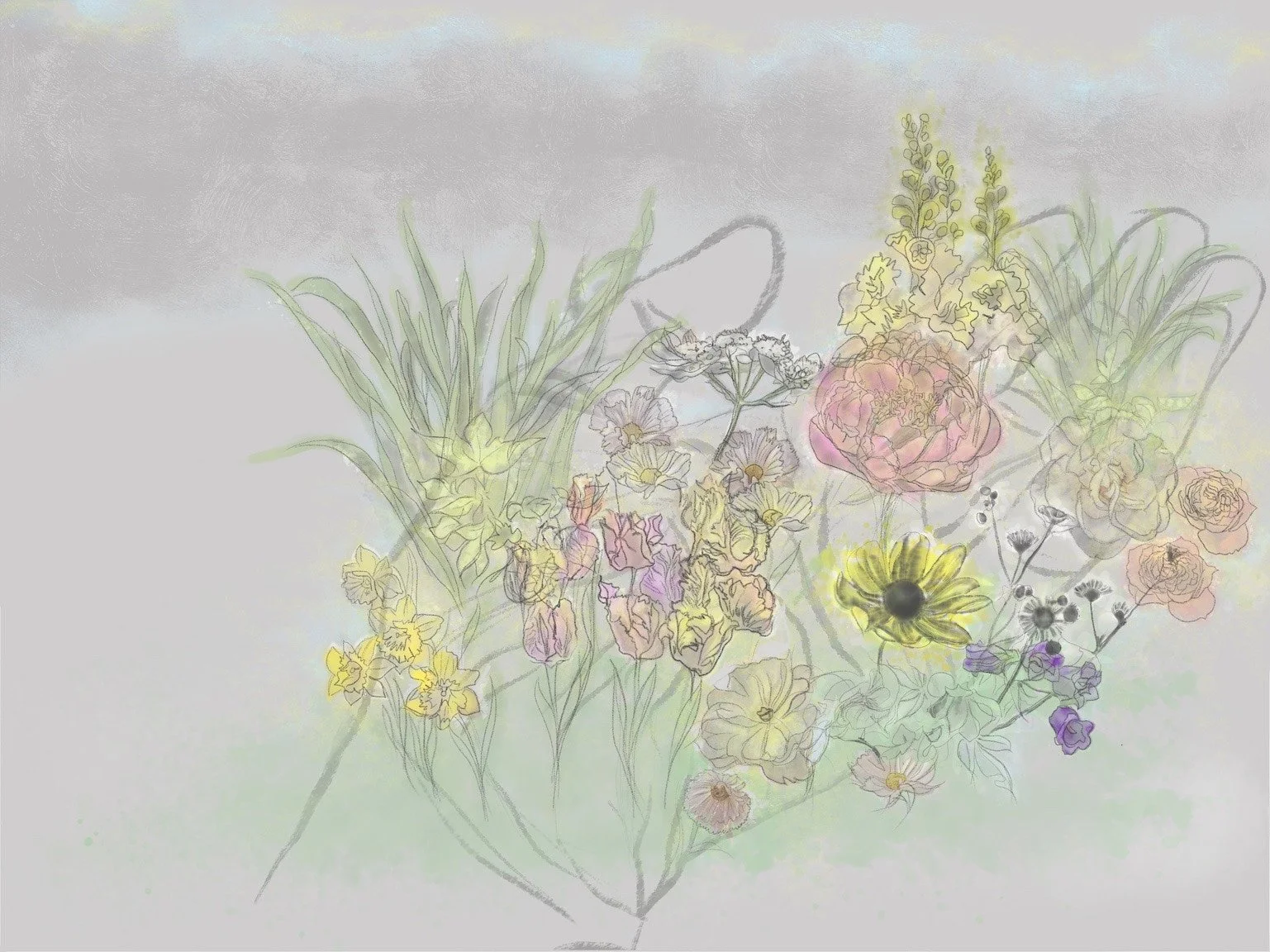
Illustration by Tati Nguyen
The landscape committee of my HOA said nothing would grow there. Dogs had seen to that.
It’s a small patch of sandy dirt—no nutrients to be seen—maybe seven by nine feet, tucked under a large, dark-colored plum tree in a small complex in Marin, California. For years, it was left bare. Not neglected exactly, but agreed upon. This was not a place to try.
I asked my neighbors if they’d mind if I planted something anyway.
At first, it was a bit of everything. Yellow daffodils, a few random annuals, whatever caught my eye. I didn’t know how to mix color yet. I didn’t understand the care that was required—sun, shade, soil, pinching, water —or the diseases and infestations, some manageable, some not. It was more hopeful than cohesive. Some things worked, some didn’t. I would move things around, try again and again, one season after the next, noticing what held and what didn’t.
Over time, something began to settle. Evergreen grasses, clustered toward the center, gave the space a kind of structure—something steady to return to. Around them, I added perennials: white snowdrops that announce the beginning of the flowering season, wedding bell hellebores, and white daffodils with softly ruffled peach centers. They came back each year, almost unnoticeable at first, and reliably. Ground cover filled in the gaps—little flashes of purple campanula.
And then the annuals, changing with the seasons: butterfly ranunculus, peony and parrot tulips, cupcake cosmos, double frappé apricot snapdragons, airy umbrella-like white orlaya—more playful, less committed—allowed to come and go without consequence, along with the ladybugs that seem to love them.
In the spring, it comes together in a way that still surprises me. Peach, blush, purple, white—layered in a way that finally makes sense. Neighbors and strangers pause when they walk by. It feels held and enjoyed—a place for conversation, quietly bringing people together. One neighbor recently shared a photo of her mother admiring the garden. Her mother is gone now. But the memory of her and the flowers remains.
Upstairs, on my balcony, the scale is even smaller, but the feeling is different. More intimate.
The wisteria drapes like a curtain, softening the edges of everything. Tall grasses form a screen, swaying even when I don’t notice the wind. There are climbing roses—Hanxian, a gift from my cousin—in a soft peach, with a sweet, almost fruity scent, their layers of petals folding like ruffles in a cup. Blush geraniums sit like clusters of small puffs of cotton, dotting the spaces between the rails, holding their color longer than I expect them to. A round yellow lantern from Hoi An hangs from above.
A handmade stone bird bath nestled within. Small red, yellow, and brown-feathered visitors come to drink, to pause, to eat, to sing—and occasionally leave their mark.
There is so much we cannot control. What takes, what doesn’t. What lasts, what disappears. But within a small space, with some attention, something takes hold, and returns.
In the early morning, after turning on the balcony lights, I nestle back into bed with the coffee my husband makes, my dog next to me, the garden just within reach.
Kelly Nguyen is a licensed psychotherapist in private practice in San Francisco, working with individuals and couples. She is a first-year candidate at the San Francisco Center for Psychoanalysis. Her writing explores lived experience and the subtle ways meaning emerges over time.
Published May 2026