A Surface Scratched
Improvisation on a dead-end street
By Mendel Horowitz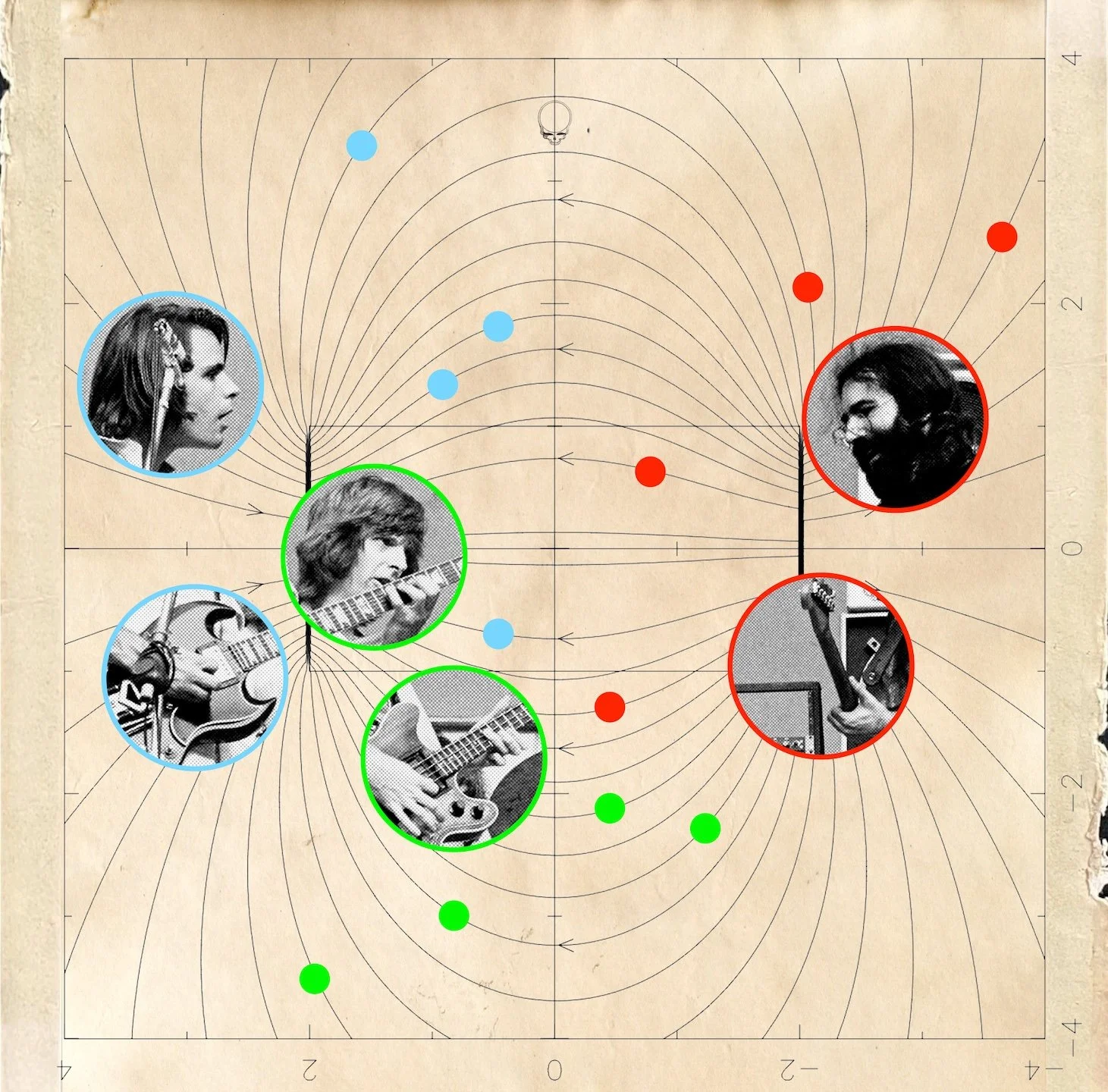
Collages by Austin Hughes
“Maybe you’ll find direction. Around some corner where it’s been waiting to meet you.”—“Box of Rain,” the Grateful Dead, 1970
Like all good trips, this one began with music.
On the way to clinical supervision in my white Camry, listening to “Dark Star” from the Grateful Dead’s Live/Dead release, I heard melodies and harmonies unfolding, band members following and leading each other, venturing forward and holding back. I noticed how my supervisor and I, and my patients, fall into patterns of communication by withholding and yielding. Like Bob and Jerry, we take turns improvising on themes, balancing boldness and restraint across steady rhythms.
In addition to reviewing case material, we had been considering how speaking in therapy, performing on stage, and writing for an audience share a common vulnerability. I had mentioned the dead-end street where I grew up, which he thought significant, and the notion lingered. With my patients, I had been encouraging free association, the willingness to risk what emerges. That sunny Thursday, winding through those familiar hills with the band in my ears, I let my own thoughts drift, doing in reverie what I invite patients to venture aloud, following the road and the music where they led.
The Dead have been with me a long time.
Once, inside the veneered sideboard in the den of my childhood home on that dead-end street, I discovered my father’s worn LP among the albums my mother kept. That day, the jacket art and band name did not frighten me away. I was intrigued, then surprised by its secrets, so unlike what I expected. I watched the vinyl spin, heard the crackles and scratches, the unpredictable cascade of notes. In those moments, I sensed how tension and freedom can coexist within improvisation shaped by uncertainty and chance.
The street itself was unyielding in a way I could not yet understand. Cars did not pass. Conversation did not flow. Our house held stories that stopped short. My mother filled the quiet with wordy folk tunes, while my father offered less wordy improvisations. Somewhere between them, I discovered the Dead.
Maybe the street had more to reveal.
In therapy and on the stage, revelation has its cost. Patients do not hesitate to associate freely because they lack material but because speaking freely carries consequences, imagined or real. Freedom is permitted, but never free. Every time we speak, we monitor what we say. We choose words, omit others, adjust syntax, and anticipate effects. From when we were first hushed, we learned to be cautious about what we tell.
Like improvised music, free association is a willingness to return after each costly attempt, or after the opening notes fall flat. When a therapist or audience does not respond as expected or hoped for, a possibility arises to discover what can still be said.
The temptation to stop is its own communication. What interrupts free association—the sudden silence, the changed subject, the implication that there is nothing more to say—is not a failure of the method but a feature of it. To put down the guitar mid-solo is never a neutral act.
Each hesitancy defends against a threat not yet named. Each inhibition is an opportunity to play another phrase. As Freud noted in “The Dynamics of Transference,” “Every act of the person under treatment must reckon with the resistance, and represents a compromise between the forces that are striving towards recovery and the opposing ones.”

Analysis and the Grateful Dead are not easily approached. Both are repetitive and resistant to explanation, requiring a tolerance for not knowing what comes next. Both trips can be reparative, but they ask you to stay beyond your expected destination and are said to be long and strange.
The wager is that something true and surprising might emerge that could not have been predicted, that what can still be said is worth the cost of saying it. To speak in analysis, perform on stage, or write for an audience, is to carry an exhibitionistic impulse, a masochistic pleasure, and a thrill in expressing what can be expressed.
And concealment within the performance is part of the act. What is not communicated or voiced is as present as what is. Every silence and omission includes possibilities, doubts, and regrets. The patient who changes the subject, the guitarist who skips a note, and the writer who leaves something out: each knows something is missing, though no one else can be sure.
The risk, that first time, was not knowing what I would encounter when slipping that LP from its jacket. The art was intimidating, the band name strange. I might have resisted, might have put it back. Instead I knelt before the turntable and waited to be changed by what I heard. That readiness to lower the needle and let the vinyl spin resembles what the analytic hour requires, the open stage demands, and the blank page awaits.
That LP remains in my parents’ basement with a thousand others, but when I imagine the needle dropping, the same strange trip begins. Maybe direction is found around some corner where it's been waiting to meet you. Or maybe direction emerges not from certainty but from the willingness to risk getting lost, to begin without knowing the end.
And so I drove onward that Thursday, content to keep on listening.
Beneath the Aleppo pine trees, I parked and shut off the engine. In a few minutes I would walk into that dimly lit office and return to the ideas we had been considering about my patients and their resistances, and about the dead-end street, which my supervisor thought mattered.
That morning I brought new material for analysis, a reverie that held my mother’s tunes and my father’s improvisations, the needle dropping, and the unpredictable cascade of notes. I was reminded of the crackles and scratches, the basement, and the band name. I wondered about the inevitability of a street that announced itself as dead.
I walked inside, leaving my notes behind. I did not yet know what life my supervisor sensed in that dead-end street, but I was listening for what he offered. Grateful for the trip and truckin’ like the do-dah man.
Mendel Horowitz, MS CGP, is a psychotherapist in Jerusalem who maintains a private practice and serves on the editorial staff and Public Outreach Committee of the AGPA. He writes from the space between memory and experience, seeking what lingers beneath the immediate encounter.
Published May 2026