Introducing TAP 60.1
By Lucas McGranahan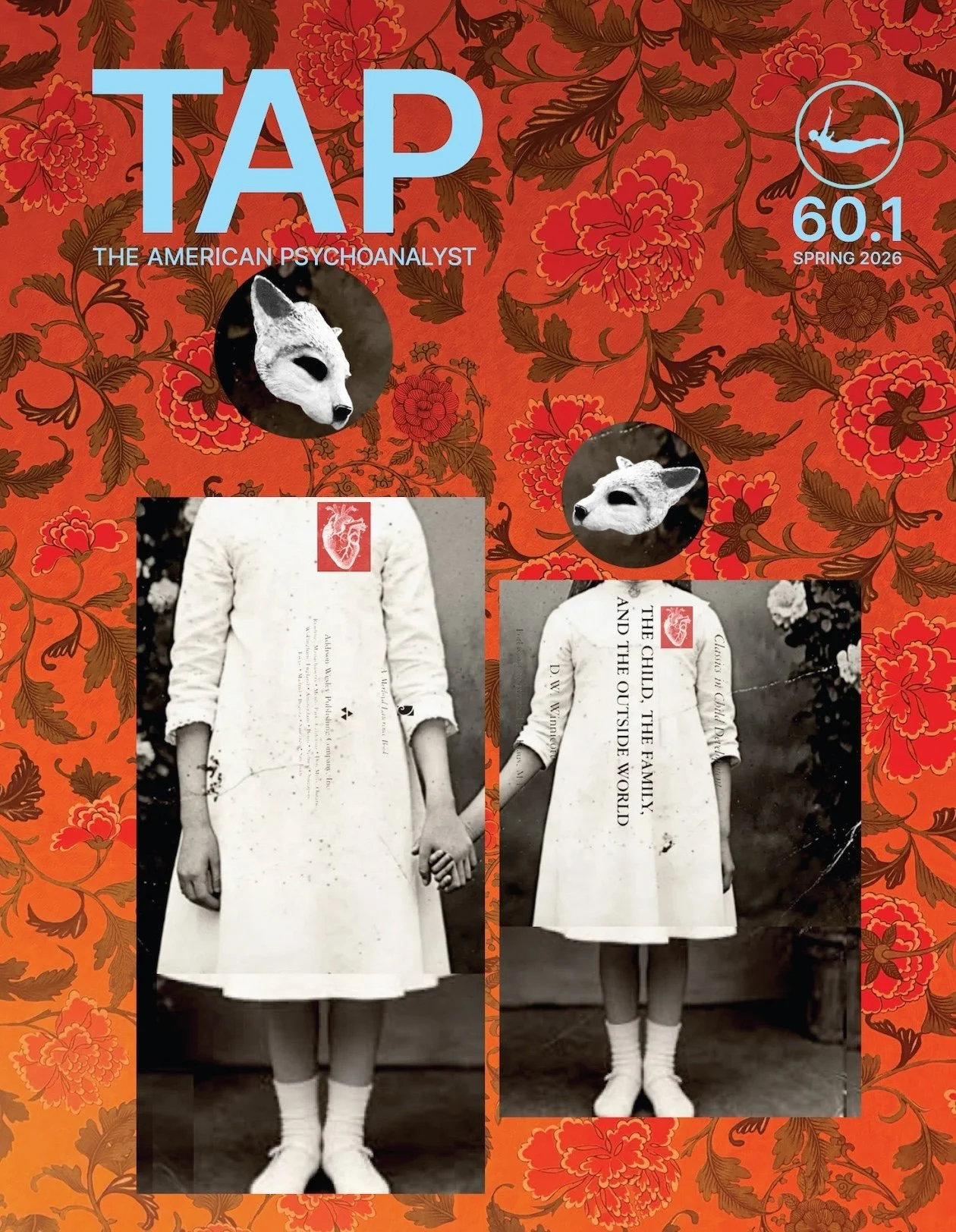
Illustration by Austin Hughes
From chatbot therapy to the “manosphere,” from fairy tales to analytic training, TAP 60.1 explores dependence, recognition, and the difficulty of remaining human in contemporary life.
The new print issue is available now in our online store. APsA members will receive a complimentary copy in the mail, and the PDF version is available for free to everyone.
Try out the issue by reading the editor’s letter below.
Infinite Debt
By Lucas McGranahanWe can’t afford to give mothers the credit they deserve. In the introduction to his book The Child, the Family, and the Outside World, Donald Winnicott notes the immeasurable contribution made by all ordinary mothers to their children’s development:
If this contribution is accepted, it follows that everyone who is sane, everyone who feels himself to be a person in the world, and for whom the world means something, every happy person, is in infinite debt to a woman. At a time in earliest infancy when there was no perception of dependence, we were absolutely dependent.
This is a lot to accept. Indeed, we don’t accept it. Here is the problem: If we fully recognized our infantile dependence, we would be just one step from recognizing our lifelong dependence—the fact that we need others, that we are constituted by our relationships, that we can only ever be relatively autonomous, healthy, and strong. Dependence is not a temporary condition.
Giving mothers full credit is especially frightening to men, whose misogyny, according to Winnicott, is rooted in fear of the dependence they experienced as infants. Many men, including those in public life, grow to disdain and disown femininity. The infantile roots of misogyny and toxic masculinity are explored at length by Richard Tuch in this issue of TAP. The topic is both timeless and timely, given how the “manosphere” of Andrew Tate and his ilk continues peddling a defensive model of manhood.
If our earliest sense of dependence lingers on, it is bound to appear in some form in the consulting room. Santiago Delboy writes about the patient’s wish to know the therapist—not the biographical details, but the intimate reality of another mind. The question “What are you thinking?” can feel intrusive or beside the point. It may also be one of the clearest expressions of our need to be recognized. Knowing one’s therapist shows up in a different way in this issue’s advice column, where Stephanie Newman writes to a patient who is grappling with discovering her therapist’s dating life online—an opportunity to think about transference rather than avoid it.
Can today’s mental health care meet the need for recognition? Elizabeth Cotton describes the rise of “UberTherapy,” a model that promises convenience while lowering the ambition of therapy. And Linda Michaels shows how practice management companies bend and strain the clinical frame, inserting unwelcome third parties into the therapeutic relationship.
Chatbot therapy is a culmination of these dynamics. Karyne Messina reflects on encounters with AI that feel fluent yet strangely hollow—empathy without risk, understanding without consequence. Messina is also one of the members of APsA’s Presidential Commission on Artificial Intelligence (CAI) working to produce a full-length documentary meant to bring a psychoanalytic perspective to questions of human well-being in the age of AI.
Relational tensions are explored through arts and culture as well. Patricia Gherovici turns to fashion and gender to show how the body is not simply given but made—staged, revised, and lived in relation to others. And Adam Gidwitz, writing about fairy tales, arguing that these strange, often brutal stories are better suited to addressing psychic tensions than the frictionless entertainments that now light up the tablets of toddlers.

Photo by Logan Morris
Chandra Rai’s essay takes up personal and political questions of belonging, traced through her return to the United States from India. Moving between external borders and an internal sense of home, Rai suggests that psychoanalysis offers a way of holding these tensions.
Finally, this issue looks at how psychoanalysis is taught and transmitted. Austin Ratner’s conversation with Harvard’s Elizabeth Lunbeck shows how Freud can be made newly legible to students. Xiaomeng Qiao reflects on the demand that analytic candidates declare a theoretical allegiance. What appears to be a question about ideas turns out to be a question about belonging, anxiety, and the difficulty of holding multiple perspectives at once. Cara Maniaci draws on favorite texts to trace her uneven path through analytic training, capturing both its transformative power and its structural constraints. And Brian Ngo-Smith and Teresa Méndez ask, more bluntly, whether a field that cannot reckon with generational anxiety is in danger of hoarding its future rather than sharing it.
TAP not only publishes psychoanalytic work, but advocates for it. In March the TAP team set up shop at the AWP Conference in Baltimore, selling issues and striking up conversations with editors, writers, and small presses from across the country. We can tell you that the interest in psychoanalysis is out there—we just need to keep the conversation going.
You’ll also notice that this is our only print issue of the year. The shift to annual print issues reflects a change in emphasis rather than a retreat. Print allows us to curate a set of essays with care; our digital platforms allow us to stay in continuous contact with readers, including many who are not (yet?) members of APsA. We are publishing more on Substack and Instagram, experimenting with new formats, and reaching a wider audience. For instance, TAP Art Director Austin Hughes created a hilarious short video featuring a therapy chatbot called Gabby, who “responds instantly because she knows which words people like to see—and what order to put them in.” See if you can spot her in this issue.
I should have said: I’m reading Winnicott’s book because my wife is seven months pregnant. She and I will take Winnicott over the latest parenting blog. We doubt the advice has gotten much better in the decades since he gave the BBC radio addresses that became this book—except, perhaps, in that we expect more of fathers, and can now imagine a child well cared for by two of them.
Winnicott is associated with mothers more than fathers. But for me, he is clarifying a key task: to dwell in dependence rather than disown it. The alternative is puffery, not courage.
Published June 2026