Inheritance of Silence
A journey from analphabetism to psychoanalysis
By Konstantinos Taliouridis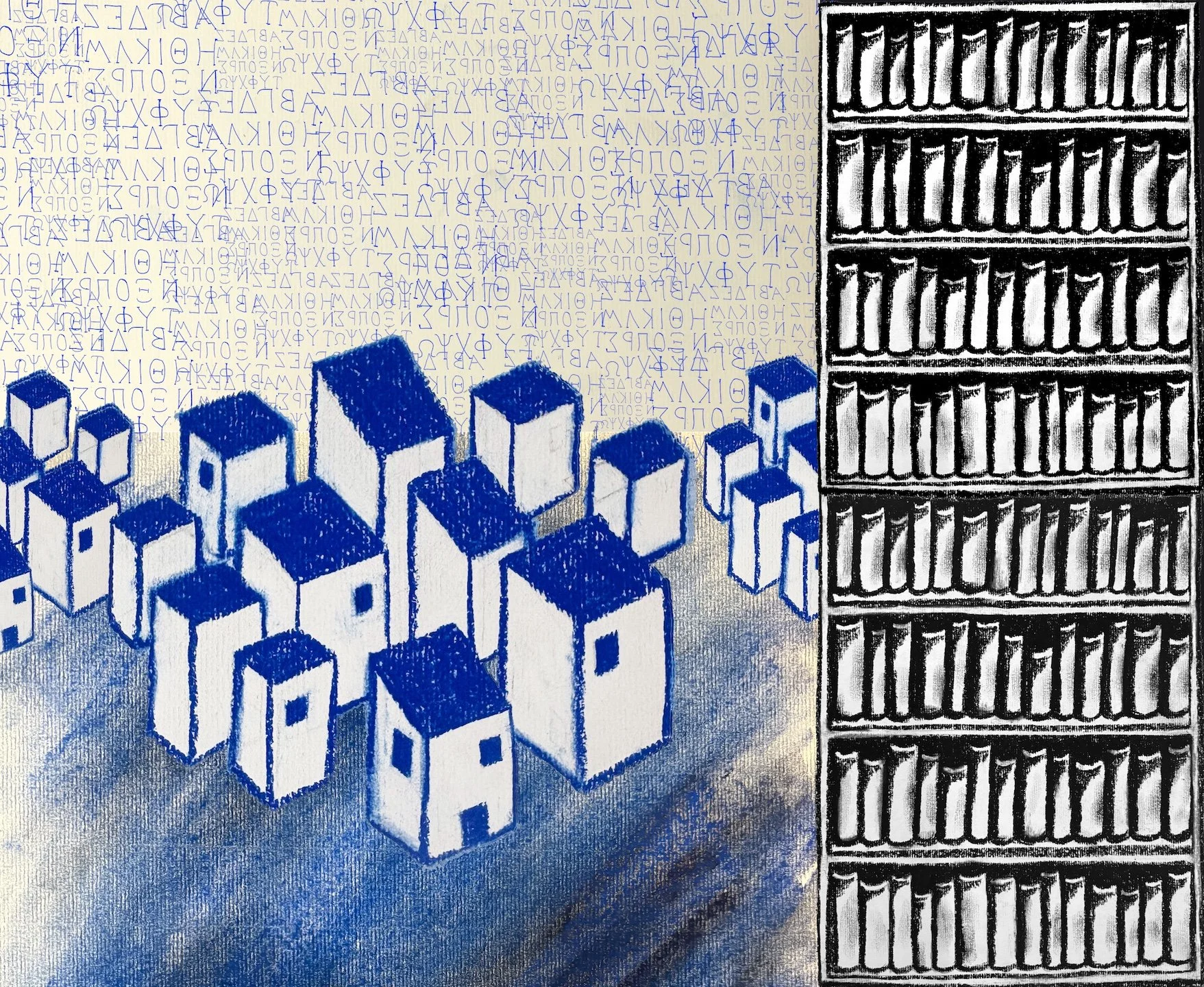
Illustration by Lark Nguyen-Hughes
The distance between my parents’ world and my own is not measured in miles or years, but in the weight of unspoken things. When I sit in the quiet of my consulting room in the USA, the shelves of books standing as silent witnesses, I often trace the improbable trajectory that led me from a small village defined by what it lacked to a place I never imagined I could reach. It is a path from a home without letters to rooms where language is everything—a journey that was profoundly shaped by the silence it sought to overcome.
My parents were analphabetic—a word that, in Greek, carries a resonance beyond mere “illiteracy.” It speaks to a particular state of being, a relationship to knowledge, authority, and the official world. My father’s hands, calloused and capable, could build a house from stone but could not form the letters of his own name. My mother’s eyes, which could perceive the faintest tremor of a child’s distress, saw only indecipherable marks on a page.
Growing up in this environment, I became the family’s designated translator, the bridge to a world that communicated in a code they could not crack. Official letters, bills, and documents arrived as messages from an alien other, imbued with a power and threat that I, as a child, was tasked with deciphering. I remember being eight years old, standing in the kitchen, reading aloud a letter from the tax office while my father’s face darkened with worry he couldn’t articulate. The words on the page were mine to speak, but the consequences were his to bear. This role was a heavy burden; it forced me into a precocious adulthood and made me acutely aware of the shame and vulnerability that haunted my parents. I learned early that language was power, and its absence meant disenfranchisement.
Yet, this was also a world of incredible emotional richness. When I came home from school carrying anxieties I couldn’t name, my mother would sit with me in silence, her presence alone somehow making the unbearable bearable. She would hold my fear without words, and hand it back to me transformed—lighter, manageable. My father, too, had his own language: the patient way he showed me how to fix things, how to work with my hands, how to be present in the world without needing to explain yourself. It was a world of emotional safety that stood in stark contrast to its intellectual and symbolic poverty.
If my parents were dispossessed of the written word, I would reclaim it for all of us. This became my unconscious, driving mission. Every book I mastered, every exam I passed, was a symbolic act of restoration, an attempt to make whole what I felt was broken in my family’s world. But it was also an act of separation. Each step forward in my education was a step away from them, into a world they could never enter.
Books became my most cherished companions, existing in the space between the intimate, preliterate world of my home and the alien, demanding world of the academy. They allowed me to navigate the immense guilt and exhilarating freedom of my journey. But this relentless pursuit of knowledge was also a shield. Intellectualization became my primary armor against the conflict I felt about my origins. It was a way to manage the painful splitting required to exist in two worlds at once: the loving, warm home I was loyal to, and the cold, validating academy I was desperate to join.
I remember the first time a professor asked me about my family background. I froze. I had become fluent in academic discourse, could quote theory and construct arguments, but I had no language for the truth of where I came from. So I said something vague and changed the subject. The shame was visceral—not only shame of my parents, but shame that I felt ashamed, that I couldn’t bridge these worlds, even in conversation.
My encounter with Freud’s The Interpretation of Dreams in a dusty bookstore was the moment the two halves of my life finally began to speak to one another. Here was a discipline that took the unspoken seriously. It gave language to the intuitive wisdom of my parents’ world—the idea that the body speaks, that dreams have meaning, that silence is eloquent. Psychoanalysis offered a grammar for the soul, a way to bridge the chasm between emotional knowing and intellectual understanding. For the first time, I began to see that my mother’s wordless attunement and my academic training weren’t opposites—they were complementary ways of knowing.
My analytic training, however, began with the gnawing anxiety of an impostor. Who was I, the son of analphabetic parents, to enter this temple of words and presume to understand the human mind? My own analysis became my lifeline. On the couch, I began the painful work of integration. I mourned the parents who could never share my intellectual passions. I mourned, too, the parts of myself I had left behind in my rush to escape—the boy who knew how to be still, how to listen without always needing to interpret.
I came to see that my journey was not simply a story of escape, but a more complex narrative of loyalty, betrayal, loss, and recovery. The analytic process mirrored the task of my childhood: translating raw, unspoken experience into a narrative that could be understood. But now, I was learning to translate in both directions—not just from feeling into words, but from words back into feeling.
As I progressed, I discovered that my background was not a handicap but a unique lens. It gave me a particular sensitivity to what remains unspoken in the consulting room—not because it’s repressed, but because it never had words to begin with. I found myself especially attuned to patients who felt displaced, who straddled worlds, who carried private shames about where they came from or who they were supposed to be.
These insights changed how I understood the work itself. In supervision groups and candidate meetings, I found myself asking different questions than my colleagues: Who feels they can speak here? Whose experience are we centering, and whose are we overlooking? What assumptions are we making about education, class, access—assumptions so embedded we don’t even see them?
I remember one particularly heated discussion in a candidates’ meeting about the cost of training. A colleague argued that “anyone truly committed” could find a way to afford it. I thought of my parents, of their profound commitment to things they valued, and how that commitment had nothing to do with their ability to navigate financial systems or advocate for themselves in institutional spaces. I spoke up, perhaps more forcefully than I intended, about the invisible barriers we erect when we assume everyone starts from the same place.
That moment marked a shift for me. I realized I had a responsibility not just to succeed within the system, but to question it, to make space for others who might feel, as I once did, that they didn’t belong. This work—serving in candidate organizations, advocating for more inclusive training models, trying to build bridges between different psychoanalytic communities—became as central to my identity as the clinical work.
In these roles, I have tried to hold onto the values my parents instilled in me: humility, respect for different forms of knowing, and an unwavering attention to the person behind the theory. My journey from a small Greek village to the rooms where psychoanalytic institutions make their decisions is a testament to the transformative power of education, but it is also a story about what we inherit. My parents gave me an inheritance of silence, but also an inheritance of resilience, emotional depth, and human dignity.
Every book I mastered, every exam I passed, was a symbolic act of restoration, an attempt to make whole what I felt was broken in my family’s world. But it was also an act of separation.
Psychoanalysis gave me the tools to understand that inheritance. It taught me that my life’s work was not to escape my origins, but to integrate them. As I continue to see patients, supervise clinicians, and participate in these organizations, I carry my parents with me. Their illiteracy is no longer a source of shame but a foundational part of my analytic identity—a constant reminder of where I come from and why this work matters so profoundly.
I think often of a patient I saw early in my practice, a young man whose parents were undocumented immigrants. He came to therapy drowning in anxiety, unable to complete his graduate degree, convinced he was a fraud. In our work together, I recognized myself—the guilt of surpassing your parents, the terror of being discovered as someone who doesn’t belong, the exhausting labor of translation. But I also recognized something my parents had taught me without words: that you can hold two truths at once. You can honor where you come from and still move forward. You can translate between worlds without betraying either one.
Ultimately, this journey has convinced me that the future of psychoanalysis depends on its ability to bridge worlds. We must strive to be a field that is as fluent in the language of the heart as it is in the language of the mind. We must create space for the voices that have been historically silenced, ensuring that our theories and our institutions reflect the vast, complex tapestry of human experience. The distance between my parents’ world and my own is not as great as it once seemed. Both are dedicated to the most human of tasks: making sense of our lives, finding meaning in our struggles, and connecting, authentically and deeply, with one another.
This is my inheritance. This is my work. This is how I translate between worlds—not by choosing one over the other, but by insisting, against all the forces that would split us apart, that we can be whole.
Dr. Konstantinos Taliouridis is a licensed clinical psychologist and advanced candidate at the Chicago Psychoanalytic Institute specializing in child and adult analysis. With over 30 years of experience, he focuses on immigration, refugees, trauma, and community initiatives with disadvantaged populations.
Published May 2026