Why “Backrooms” Feels So Uncanny
Sigmund Freud and David Lynch open portals to an enigmatic new film
By Austin Ratner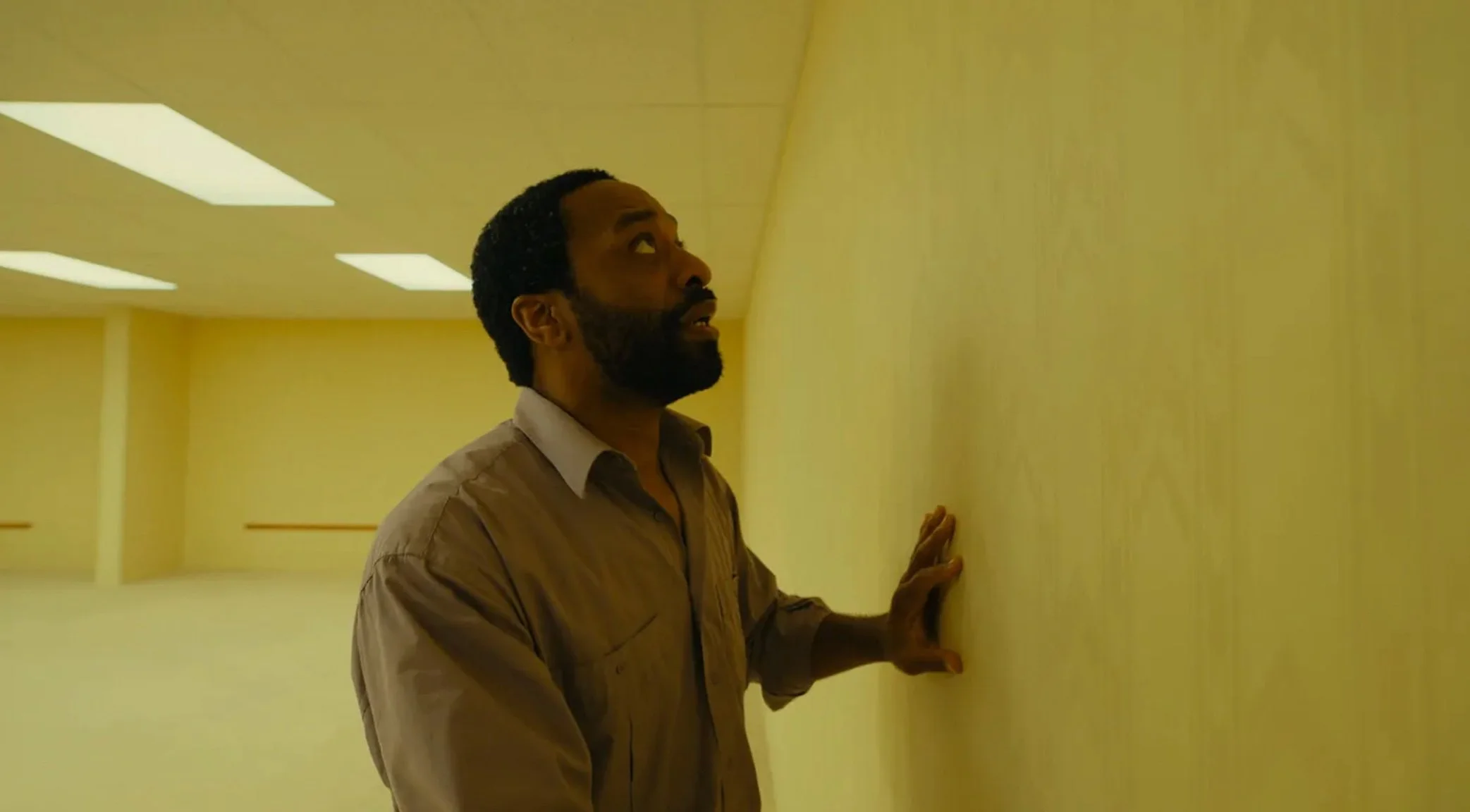
Clark crosses the threshold into the backrooms. © A24.
In our house, it’s not uncommon to hear the wails of an abducted woman echoing from out of a dirty dry well in the basement. Sometimes when I’m headed to the bathroom to wash up before bed, I hear demonic chants in Latin. Other times, I open the door to the den and see a psycho killer gazing back at me from within the eyeless depths of a white rubber mask.
You see, I married a horror junkie. She’ll put on Silence of the Lambs,The Omen, or Halloween to relax the way other people put on background jazz. I’ve heard Hannibal Lecter and Clarice Starling’s dialogue so many times I could probably play either one of them in a remake starting tomorrow. And I’ve noticed something surprising about these films: They’ve started to acquire a comforting feel to me too. They’ve become homey and familiar.
Horror movies of course traffic in the exact opposite, the unsettling and the uncanny, a topic Freud wrote about in his 1919 essay “The Uncanny.” The Freudian outlook, indeed, helps explain horror movies like Backrooms, which came out May 29 this year and within a week became movie studio A24’s highest-grossing film of all time. It’s a remarkable film, not only because it was directed by 20-year-old phenom Kane Parsons, who amassed a huge following on YouTube with short films that manipulate found footage of liminal spaces. It may well be the uncanniest cinema since David Lynch.
Lynch is a reasonable place to start in deciphering the uncanny effects of Backrooms. (Parsons told Collider that his dad was such a huge David Lynch fan that after his dad’s divorce, when Parsons was seven, he decorated his bachelor pad like the infamous Red Room from Twin Peaks. Parsons kindly refers to this as “eccentric.”) Parsons, like Lynch, can arouse deeply uncanny feelings in the viewer without much happening onscreen. Chris Rodley described the Lynchian-Freudian uncanny in his introduction to a series of interviews with Lynch published in 1997:
The uncanny’s attributes, in what Freud termed “the field of what is frightening,” are those of dread rather than actual terror, of the haunting rather than the apparition. It transforms the “homely” into the “unhomely” [the German word for uncanny is unheimlich—literally, unhomely], producing a disturbing unfamiliarity in the evidently familiar. In Freud’s words: “The uncanny is uncanny because it is secretly all too familiar, which is why it is repressed.” This is the essence of Lynch’s cinema.
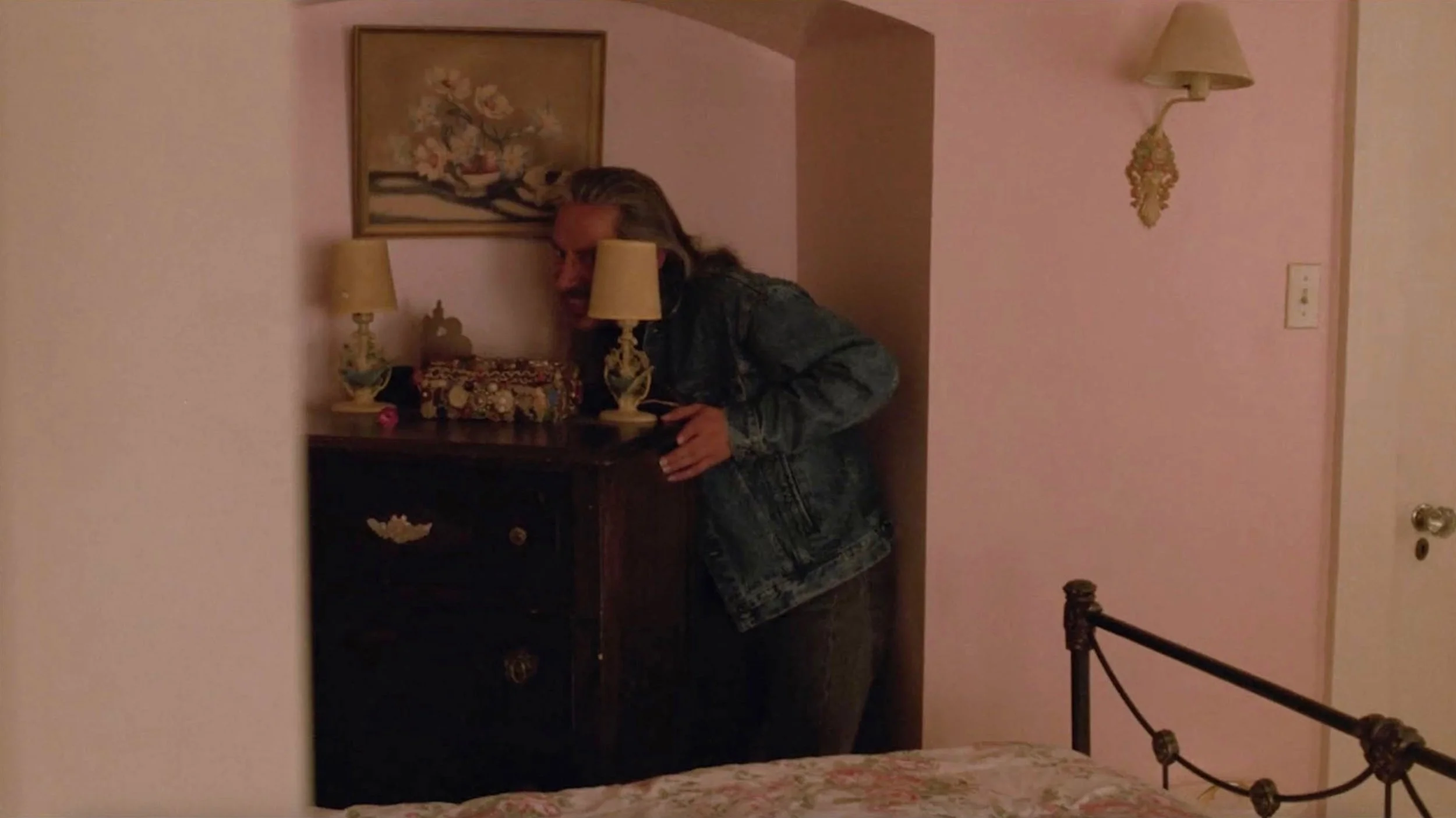
© CBS Entertainment
The figure of Killer BOB from Lynch’s Twin Peaks exemplifies this uncanny effect. In the TV pilot, he appears at the foot of teenage Laura Palmer’s bed, peering through the ironwork footboard. Frank Silva, who played Killer BOB, was Lynch’s set-dresser who accidentally got stuck in the bedroom set while dressing it for a scene. Lynch later realized Silva was also accidentally reflected in a mirror in another shot of Laura’s mother. These coincidences inspired Lynch to give Silva a key role in the Twin Peaks story. In the movie version, Killer BOB appears half-crouching and grinning behind Laura Palmer’s bedroom dresser, which has a tiny lamp on it. The lamp, the dresser, and the alcove that houses it are way too small to hide him, so he’s plainly visible, almost like he’s mocking the idea of hiding. The scenes suggest a terrifying psychic fact: that what has been pushed out of awareness may still be there, barely hidden, staring directly at us. An image of a grown man pretending to hide in a teenage girl’s bedroom is like a thought that’s burst into the open against the force of repression, an unfamiliar, alien, implicitly sexual and dangerous element in a familiar, homey setting. And it’s creepy as hell.
Freud thought uncanny dread arises when certain experiences invite regression to the superstitions and magical thinking of early childhood, a time when the distinction between self and world was blurrier. For small children, the familiar world of home can be laced with terror—terror of their own bad wishes coming true, of punishments, curses, and disasters being inflicted upon them by the bogeymen and witches of their imagination. As we grow older, we may get tempted back into old ways of thinking under certain circumstances. When it’s night and the mind is tired and getting ready to dream, for example, or when we’re reminded of an old childhood fear, or see a creepy movie or image on the internet—whenever the perceived boundaries between real and imagined fray—we may seem to catch the eye of a bogeyman lurking in the darkness of the closet.
Photos of liminal spaces posted and shared in internet forums like Reddit may call up an uncanny feeling precisely because they dissolve boundary lines between familiar and unfamiliar. They show unbounded, empty interiors like hallways with no people in them. Think the Overlook Hotel in The Shining after it’s closed for the winter and empty of all guests but the caretaker’s family. Such images convey the familiarity of home made porous to the unfamiliar, opened up to intrusion by ghosts. For Parsons, those ghosts seem to come from childhood, which is not only a time of belief in bogeymen, but a part of the irretrievable past. What makes such spaces uncanny is not unboundedness and emptiness alone but the sense that they were once inhabited by a life that’s now gone.
This means a living room doesn’t qualify as a liminal space, Parsons explains in a YouTube interview, “unless it’s the living room on the last day you were in your childhood house before you’re moving out to a new….” He trails off, neglecting to say the word house, as if the liminality of that imagined or remembered living room has broken open the whole concept of home, which is exactly what children of divorce experience. In another interview on “Q with Tom Power,” Parsons describes the liminal space in Backrooms this way: “It’s like it’s wearing the skin of the past, like a simple past that was real and was touchable.”
Clark, the main character of Backrooms, played by Chiwetel Ejiofor, is a divorced architect who owns a discount furniture store and has a drinking problem. The store has become his broken home. He sleeps there, in a literal liminal space full of bedroom and living room ensembles without any walls—the familiar opened out to the unfamiliar. To make matters worse, faulty wiring makes the store’s lights glitch and turn on in the middle of the night, illuminating the cavernous space in an even more un-homey, uncanny way. When Clark goes down to the basement in a rage to flip the circuit breakers and turn all the lights back off, he notices a strip of light shining from under part of the basement wall, as if there were a door there. It’s not quite a door but a portal to an endless labyrinth of liminal backrooms reminiscent of the broken home of the furniture store, but still more uncanny.
Freud wrote in his 1919 essay: “The uncanny [unheimlich] is something which is secretly familiar [heimlich-heimisch], which has undergone repression and then returned from it.”
The backrooms are exactly like that. They recapitulate the jumbled furniture ensembles of the store, and other aspects of Clark’s life and self, in distorted form, monstrous parts he both refuses to acknowledge and refuses to give up. Writers Parsons and Will Soodik make it plain that the backrooms have an intimate relationship with Clark’s unconscious mind. They even give Clark a Freudian psychotherapist (Dr. Mary Kline, played by Renate Reinsve) who in one psychotherapy session draws a connection between Clark’s own mind and the mis-wired furniture store, the anteroom to the backrooms: “I hurt people,” Clark tells Dr. Kline. “I don’t mean to. Maybe it’s just the way I’m wired.” She in turn tries to bring his repressed demons out in therapy, and ends up entering the backrooms herself to rescue Clark from their clutches.
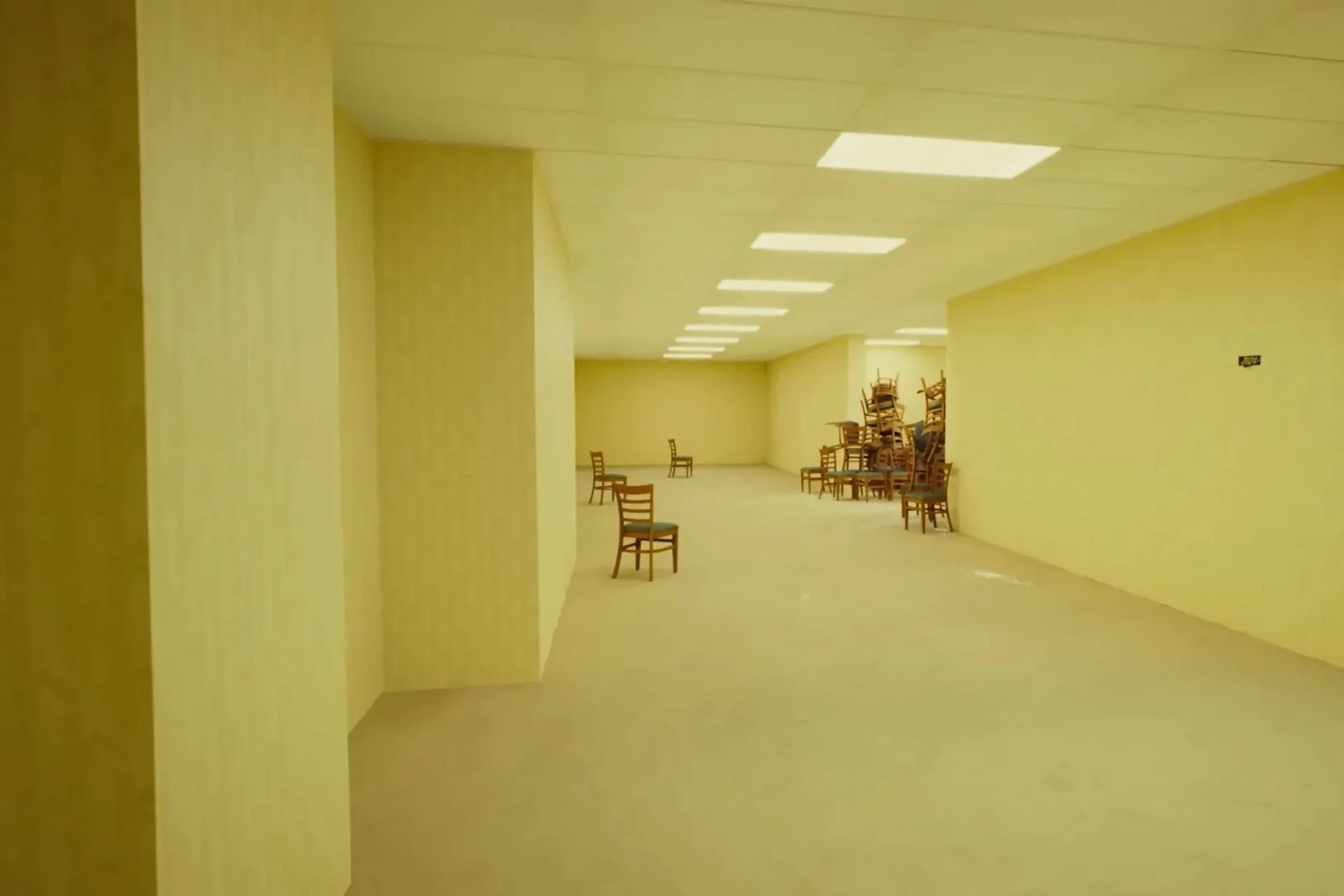
Objects lose their ordinary function and take on psychic meaning in the backrooms. © A24.
Fictional works and psychotherapy have different sets of tools for breaking down the barriers against the repressed. One tool that’s employed by both Lynch and Parsons is a kind of game played against “the fourth wall.” Philosophe Denis Diderot introduced the concept in the 18th century to refer to the wall dividing the imaginary space of a play from its audience, a wall invisible to the audience but opaque to the actors when they become characters on stage. Writers sometimes break the fourth wall by having a character speak directly to the audience, often for comic effect. But such violations can also be scary. In Stephen Mallatratt’s theatrical adaptation of Susan Hill’s neo-Gothic horror story The Woman in Black, for example, a ghost appears among the audience, walking up the aisle toward the stage. At that moment, the ghost feels chillingly real.
By drawing attention to barriers such as the fourth wall separating audience from fictional world—or nesting worlds within a fiction itself, like a play within a play—writers open doors for ghosts to cross from one space to another. Such moments can reactivate the magical notion from childhood that thoughts, fantasies, and fictional creations can cross over into reality. They may even seem to suspend the very delineation of subjective and objective worlds that is first achieved in infancy.
While Backrooms doesn’t feature a play within a play, and doesn’t break the fourth wall directly, even for the duration of a soliloquy, it does juxtapose an artificial world with a real one, and the interplay between these levels of reality has an uncanny effect. The boundary between these levels is a permeable but opaque door through which Clark enters and exits the backrooms. Clark is an architect and an amateur actor too—he shoots his own commercials where he plays a character called Pirate Clark, a character who shows up in the backrooms, returning from the repressed in distorted form. Clark builds spaces and characters for a living, only to find himself swallowed by a distorted world that seems built from the materials of his own mind.
But the uncanniest aspect of Backrooms may derive not from its endless, psychically charged spaces but from a certain absence lurking behind them. The backrooms resemble an elaborate stage set emptied of actors, with no director in sight. While Clark has contributed to the shape and content of the backrooms, we’re meant to understand he is not their creator. Somebody else made the backrooms and we don’t know who. They convey, in other words, a sense of a missing creator. As in a liminal-space image of an empty hallway, we see a place that was clearly created for human beings, but the creator isn’t there. No one is. This space is like the unconscious itself: Thoughts, fantasies, and fears seem to arise from somewhere, yet no stable author ever fully claims them. For some, the backrooms may even evoke a fear of the vast, unauthored abyss of the cosmos itself, which Blaise Pascal described as an “infinite immensity of spaces of which I am ignorant and which know me not.”
Absence lies at the heart of Backrooms and is the secret to its power. For absence is sewn deeply into the very fabric of human experience. It can be haunting, representing loss—loss of a loved one, real or imagined; loss of childhood with the passage of time; loss of gods no longer believed in; loss of parts of the self to the erasure of repression. It can represent horrific secrets and fantasies, the stuff of nightmares, the stuff of David Lynch, who Chris Rodley says “keeps looking under the rock to expose red ants, darkness and decay.”
But absence can also be a portal to understanding and meaning. What is missing from a space or a life can sometimes press upon the mind more powerfully than what is physically present. In this way, as James Joyce wrote in a letter to his schizophrenic daughter Lucia, who was confined in an asylum and missed her father, “Absence is the highest form of presence.” Such absence drives creation, as artists seek to recover their personal losses among the products of their own imaginations. That motivation may well have driven Kane Parsons to construct the deliciously uncanny labyrinth that is Backrooms.
Austin Ratner is contributing editor to TAP and author of The Jump Artist.
Published June 2026