By Richard Tuch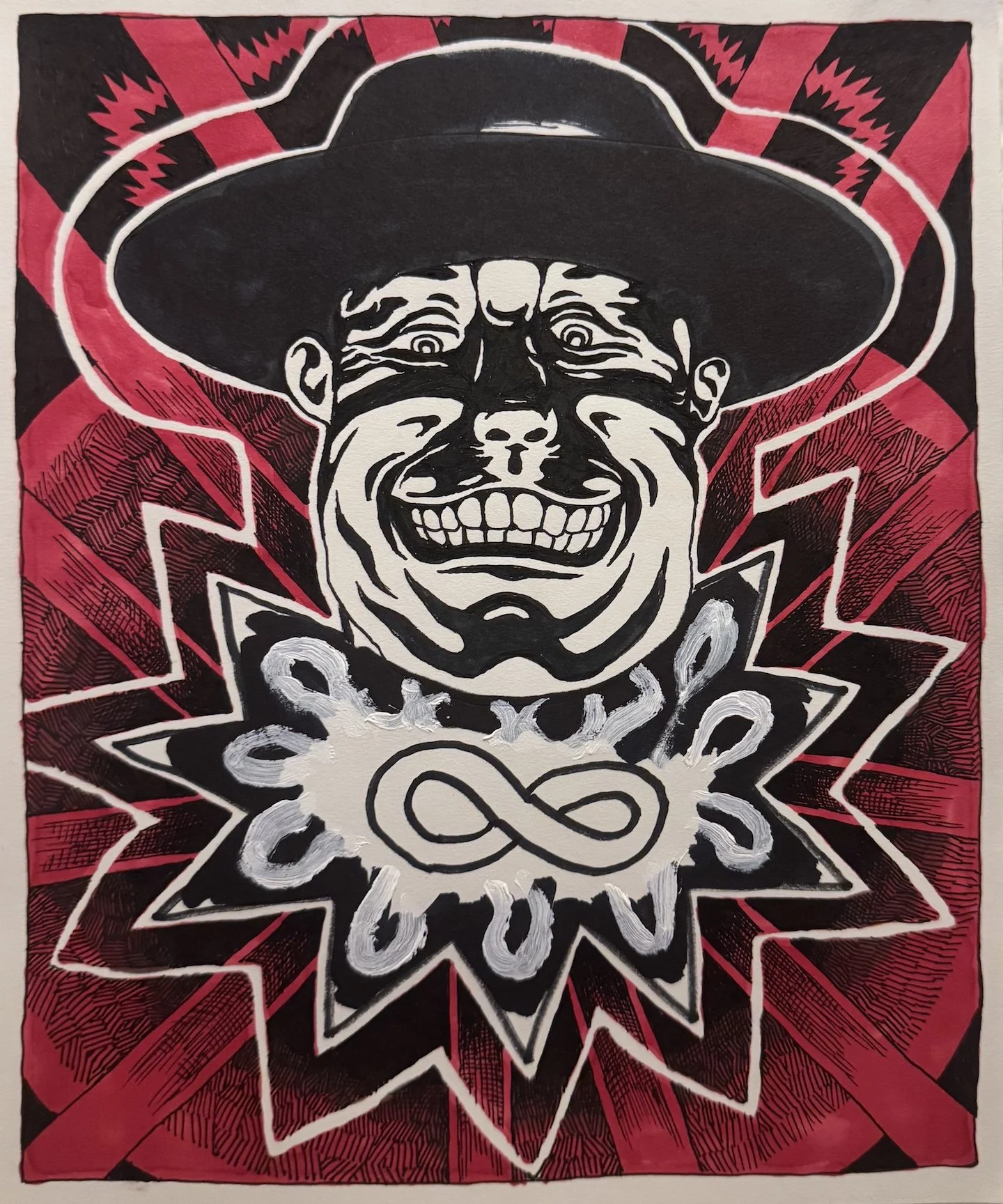
Drawing by Virgil Ratner
A contemporary male predicament, emerging in the wake of feminist-driven social change, deserves our attention. Traditional gender roles and male privileges have given way as society has sought to correct longstanding injustice. Many men have adapted well. Others angrily complain that the pendulum has swung too far—that they have been kicked to the curb in the rush to right one wrong, only to create another. Social change never benefits everyone equally.
A backlash against cultural progress is taking shape worldwide. Misogyny is surging, accompanied by reactionary ideology and rightward political shifts evident in the election of strongman leaders who capitalize on male grievance. In Germany, young men are twice as likely as their female peers to vote for the far-right Alternative für Deutschland. In South Korea, three out of four men in their twenties support conservative candidates trafficking in antifeminist rhetoric; 60 percent strongly oppose feminism. In England, over 90 percent of young men report familiarity with manosphere influencer Andrew Tate, and a quarter agree with his doctrine of male control over women.
These are not isolated data points but symptoms of shared malaise. In an increasingly competitive global economy, men sense scarcity everywhere—jobs, status, sexual attention. As the breadwinning roots of masculinity erode, male pride suffers a blow that cannot be ignored. With so much having changed, many men struggle to say what it means to be a man today. Anxiety seeks explanation. Misogyny provides it. Feminism becomes an easy scapegoat as an old patriarchal narrative is repackaged for the algorithmic age: Women took what was ours. Such narratives fuel what increasingly resembles a looming culture war.
Signs of misogyny appear everywhere: in the bitter rhetoric of aggrieved men populating the manosphere, in popular culture dramatizations like the Netflix series Adolescence (which portrays a boy radicalized by online misogyny who murders a female classmate), and in contemporary political life populated by chest-beating men certain of their standing, men who would rather double down than admit error. Toxic masculinity and misogyny travel together.
What follows situates these developments psychoanalytically, moving from sociocultural observation to conceptual clarification, developmental theory, and finally to clinical and disciplinary implications.
Toxic Masculinity: A Politicized Term in Search of Theory
The phenomenon we call toxic masculinity long predates contemporary political trends, though recent cultural shifts have added fuel to the fire. The term emerged within the Men’s Movement of the 1980s and 1990s to illustrate how men should not behave. Feminist writers subsequently adopted it to describe domineering, misogynistic, and homophobic behavior. Psychiatrist Terry Kupers observed that early conservative critiques framed it as a label for marginalized, low-income men—street criminals or incarcerated felons whose hypercompetitive, dominance-driven behavior reflected social pathology. That framing shifted dramatically once applied to powerful men like Donald Trump, Harvey Weinstein, Roger Ailes, and Jeffrey Epstein. Many conservatives then regarded the concept as evidence of an antimale feminist bias pathologizing normative masculinity itself.
Despite the term’s ubiquity in public discourse, psychoanalysis has been slow to address it. A search of Psychoanalytic Electronic Publishing reveals slightly over 50 papers referencing toxic masculinity, most published within the last five years—and most mention it only in passing. Few psychoanalytic works confront the topic directly.
Notable exceptions exist. Michael Diamond’s Masculinity and Its Discontents (2021) offers sustained examination of male developmental vulnerability. Karl Figlio’s seminal paper “Phallic and Seminal Masculinity” (2010) and his book Rethinking the Psychoanalysis of Masculinity (2023) explicitly engage the conceptual confusion surrounding masculinity and attempt to move the field beyond moralized or behavioristic descriptions.
Still, a glaring problem remains: Authors who invoke toxic masculinity rarely define it. The term is treated as self-evident, referring vaguely to a recognizable but unspecified cluster of attitudes and behaviors. This conceptual looseness weakens both clinical understanding and theoretical precision.
While autonomy and self-reliance are adaptive capacities, their exaggerated expression betrays underlying fragility rather than genuine potency.
Toward a Psychoanalytic Definition
Defining the term rigorously is essential if we are to speak meaningfully of a psychological type rather than a moral caricature. In writing my recent book Perversity, Pornography, and the Psychology of the Male Species (2025), I conduct a comprehensive literature review and distill a provisional clinical typology. Men typically described as toxically masculine tend to
Resort to violence and aggression
Strive for power and status within a winner-take-all mindset
Dominate and control others
Display misogyny in attitude, language, or action
Exaggerate toughness and bravado
Project smugness, arrogance, and superiority
Adopt a know-it-all posture
Act entitled, taking without asking
Lack humility or capacity to admit error
Deny weakness or vulnerability
Suppress tender emotions
Reject help in the name of self-sufficiency
While one might be tempted to describe toxic masculinity as a condition from which men suffer, the suffering is borne primarily by those subjected to these men’s relational styles. Such men rarely experience themselves as troubled; their lack of subjective distress is itself diagnostically significant.
Clinical Resistance and Phallic Narcissism
The psychoanalytic treatment of such men is notoriously difficult. Published case reports describe analysts who attempted—and failed—to treat patients whose personalities would today be described as toxically masculine. These patients are often better understood as phallic narcissists, a perverse character type whose hostility emerges in the transference as contemptuous rivalry, entitlement, and insatiable demand for admiration. Herbert Rosenfeld observed that such patients are chronically resistant to analysis, their defensive organization rendering interpretive work largely ineffectual.
Consider the following case from my own practice, which demonstrates how difficult and unpleasant these patients are to treat. Timothy A., a married man in his early forties, presented with idiopathic genital pain that developed shortly after yet another in a long series of casual extramarital sexual encounters. An incidental finding that emerged only after treatment was well underway was his longstanding tendency to exhibit his penis to women—which Timothy made sure to let me know was “humongous.”
The patient was, not surprisingly, highly narcissistic: Everything from his choice of cars to the location of his home and office was designed to impress. In his estimation, everything of his put everything of mine to shame. He dedicated himself to treating me in a way designed to make me feel worthless, which likely related to his having been mercilessly teased by other kids about certain of his body features, leaving him feeling ashamed and deformed. His transference to me was perverse in every sense of the term.
In The Fundamentals of Psychoanalytic Technique (1991), Horacio Etchegoyen describes the polemical quality of perverse transferences. In line with Etchegoyen’s analysis, my patient reeked of superiority and expressed unrelenting contempt for me. My office building, my interventions, my intellect—all were “second rate.” His devaluing diatribes focused chiefly on the worthlessness of everything I was and everything I had to offer. He complained incessantly that he was not receiving the kind of eye-opening interpretations that would prove he was getting his money’s worth, and he endlessly challenged and goaded me to finally give him something worthwhile in the way of pithy interpretations.
For months on end, Timothy opened each session expressing dismay that he was continuing to see me. He figured he’d be best off cutting his losses and accepting, once and for all, that I wasn’t the right analyst for him. He considered his inability to leave me yet another in a long list of symptoms I had yet to help him resolve—ignoring the fact that his presenting genital pain had all but vanished. He reasoned I was too financially dependent on him to let him go, and that if treatment were to end, I would be the one losing out, not him. Timothy could have picked up and left treatment months before, but he seemed to be deriving far too much sadistic pleasure watching me squirm in reaction to his unrelenting contempt as he achieved his ultimate aim: to defeat and triumph over me.
I understood Timothy’s transference reactions as a way of ensuring that, this time around, if anyone was going to be treated scornfully, it would be me, not him. Any countertransference urge I felt to retaliate I held in check, realizing it would only provide further proof of what he deemed my glaring inadequacy. Eventually, it became difficult to say anything, since the patient would tear it to shreds, declaring it complete and utter “rubbish.”
I felt cornered, in a no-win situation with a man whose thinking conformed to a zero-sum game theory of human relations: There are only two roles—winners and losers—and the patient knew what he had to do to stay on the right side of the ledger. Being on the receiving end of such contempt provided me with a firsthand taste of what his childhood had been like for him (what Kleinian theory describes as the communicative aspect of projective identification, in which one makes the other feel what one cannot bear or symbolize). Interpretations I made along these lines went nowhere, providing further proof that I was indeed a worthless and contemptible “piece of shit,” which the patient was dedicated to reminding me of each and every session.
Stan Coen’s observations fit in here:
[a patient’s] perverse defenses evoke perverse countertransferences—the opprobrium accorded perversion—in which we relish being sadistically judgmental, dominating, and attacking. The sadistic pleasure analysts take in such perverse countertransference attitudes is more difficult for us to bear than is our countertransference response of feeling excluded, alone, and insignificant when faced with narcissistic defenses …We need to acknowledge the perverse and antagonistic affective force-field we analysts are drawn into by perverse patients who refuse to be reasonable.
Our field’s difficulty treating these cases might tempt dismissal of the topic altogether. Yet psychoanalytic progress has often emerged from studying extreme cases. Freud’s general psychology was built on investigating pathology. Toxic masculinity, viewed as an extreme endpoint along a continuum of masculine development, offers similar theoretical value.
Toxically masculine men differ from other men only in degree. All men have it in them to act in a somewhat toxic manner, particularly when their male pride is threatened. A man can act toxically when he feels threatened, humiliated, frightened, or needy, or when he experiences a loss of power or control. Such tendencies manifest when pride is punctured or vulnerability exposed. Toxicity exists on a spectrum—from momentary lapses into domination and arrogance to chronic patterns of exploitation and condescension. The more a man takes without asking, imposes his will while ignoring others’ wishes, or exploits vulnerability to get his way, the more toxic we consider him to be.
Developmental Origins: The Contours of Male Psychology
Male psychology is organized around a central developmental predicament: Masculinity is not a given but a precarious achievement that must be continuously established, defended, and reaffirmed. Unlike femininity, which permits broader expressive latitude, “hegemonic masculinity”—Raewyn Connell’s term—functions as a restrictive regulatory ideal prescribing narrow behavioral parameters that define what counts as being “manly.” Male subjectivity therefore tends to organize around narcissistic vulnerability, with masculine self-experience closely tethered to pride that is acutely susceptible to challenge, deflation, and emasculating shame.
To understand toxic masculinity, one must revisit the developmental foundations of masculine identity. Diamond reviews literature demonstrating that infant boys “have a more limited capacity for self-regulation, are more impacted by infant-mother attachment failures in containment and regulatory functioning and require earlier maternal (and/or paternal) co-regulation than do girls.”
Men implicitly remember a time when they relied mightily on their mothers for emotional regulation. You wouldn’t think this would be the case given what boys become—individuals appearing highly independent and self-sufficient, and proud of it—but research establishes the fact nonetheless. This implicit memory operates subliminally throughout a man’s life, whether he knows it or not.
When caregiving is inconsistent, unavailable, or experienced as shaming, boys are more likely to experience dependency as dangerous. Dependency needs are then disavowed, often replaced by compensatory hyperautonomy. As a result, male psychology frequently prioritizes defenses against narcissistic injury over the pursuit of relational intimacy or libidinal satisfaction. A man’s struggle with underlying dependency leads to defense-driven portrayals of self-sufficiency.
The stereotypic model of extreme male autonomy is a ruse. In the context of adult relationships, men comprise the majority of avoidantly attached individuals, not because men are inherently autonomous, but because they defensively disavow their dependency. Culturally valorized ideals of extreme male autonomy thus function less as markers of strength than as defensive masquerades. While autonomy and self-reliance are adaptive capacities, their exaggerated expression betrays underlying fragility rather than genuine potency.
Robert Stoller emphasized the boy’s monumental task of repudiating femininity to consolidate masculinity. His oft-cited dictum—“The first order of business in being a man is: don’t be a woman”—captures the defensive intensity of this process. As Diamond observes, masculinity grounded in femininity’s disavowal remains inherently unstable.
In the early 1980s, Robert Stoller and Gilbert Herdt outlined the prevailing rules about how men must behave to be considered manly: “Be tough, loud, belligerent; abuse and fetishize women; find friendship only with men but also hate homosexuals; talk dirty; disparage women’s occupations.” Though the term didn’t exist back then, Stoller was outlining behaviors and attitudes we now recognize as toxic masculinity. While he appears to regard this ethos as core to masculinity, later writers have critiqued this view, noting that many boys temporarily distance themselves from maternal identification before reintegrating it without compromising masculinity.
I propose that toxic masculinity reflects fixation at—or regression to—the phallic-narcissistic developmental stage. During this stage, boys experience exuberant bodily pride and exhibitionism, but this inflation is shadowed by castration anxiety—an unremembered but enduring fear of loss and humiliation. Male pride, built upon this fragile foundation, is easily punctured. Hypermasculine posturing functions as manic defense against feelings of weakness, dependency, and need.
Contemporary Responses and the Role of Psychoanalysis
It is difficult to estimate how many men today grapple with societal change in ways evoking nostalgia for rigid gender hierarchies. Lay authors like Scott Galloway have stepped into the breach, offering pragmatic guidance to men disoriented by cultural upheaval. Galloway’s emphasis on responsibility, generativity, and purpose echoes Figlio’s concept of seminal masculinity—masculinity defined not by dominance but by internal fertility and creative contribution.
Yet psychoanalysis must not cede this terrain. Lay authors may provide reassurance and containment, but psychoanalysis alone can illuminate the unconscious roots of male discontent and the defensive structures giving rise to toxic masculinity. Addressing this emerging crisis is not optional. It is a clinical and theoretical obligation. The field is well equipped for the task—if it chooses to engage.
Richard Tuch, MD, is a training and supervising analyst at The New Center for Psychoanalysis (LA) and the Psychoanalytic Center of California. He serves on the editorial boards of JAPA and The Psychoanalytic Quarterly, and he chairs the Idea Incubation Workshop at the annual meeting of the American Psychoanalytic Association.
Potentially personally identifying information presented that relates directly or indirectly to an individual, or individuals, has been changed to disguise and safeguard the confidentiality, privacy, and data protection rights of those concerned.
Published February 2026