The Body You Wear
Gender and embodiment in fashion
By Patricia Gherovici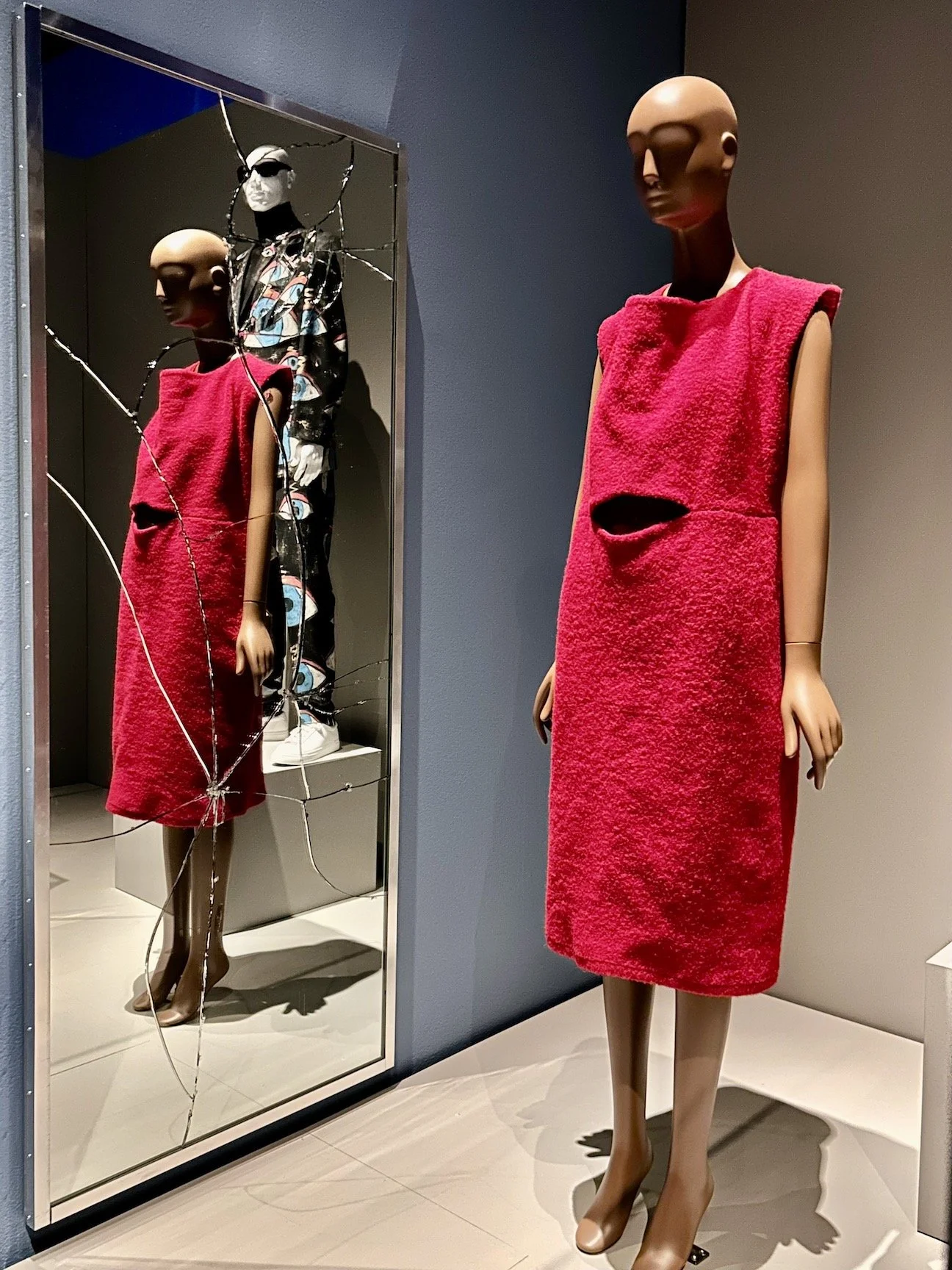
Dress, Dreams, and Desire: Fashion and Psychoanalysis runs through January 4, 2026, at the Museum at FIT in New York City. Photo by Tati Nguyen.
Why do we wear what we wear?
I’ve written a little about fashion, though I would never claim expertise. Still, like everyone else, I’m shaped by it—by which I mean intellectual fashion. I remember the early nineteen-nineties, when gender was having something of a moment. At a conference at Rutgers, Judith Butler spoke, and the audience seemed to have arrived in coordinated drag, as if theory itself required a costume.
A sharpened urgency now animates conversations about gender, fueled in part by the increasingly assertive role governments have taken in matters that reach into the most intimate corners of people’s lives. In the United States, this shift has become especially stark: protections against discrimination—once thought settled and secure—are now subject to renewed scrutiny and, at times, unmistakably brazen erosion.
I was recently spurred to think through critical questions of gender and performance by an exquisite exhibition. In Dress, Dreams, and Desire: Fashion and Psychoanalysis, the first exhibition dedicated to exploring the cultural history of fashion through a psychoanalytic lens, on view until January 4, 2026, at the Fashion Institute of Technology in New York, Chief Curator and Museum Director Valerie Steele, known as the Freud of fashion, deciphers the unconscious patterns that shape our choices of dress. The show is a beautifully crafted, three-dimensional rendering of the knot between body and soul, psyche and cloth. With dazzling insight and historical depth, the exhibition shows how fashion stages our desires, fears, and dreams—how we become the bodies we wear.
What I learned from Steele’s show is not only how to bring psychoanalysis back into fashion. She knows her Freud, her Lacan, her Anzieu—and makes them her own. I was also led to reflect on how, of the designs on view, many are examples of what I would call the art of wearing a body—an act of creation, even of rebirth. Such an art makes life, once again, livable, wearable.
In this essay, I will situate Steele’s exhibition within a broader context. Namely, last summer, I saw two exhibitions that opened a fascinating conversation about gender and embodiment that I wish to set in dialogue with Dress, Dreams, and Desire: Fashion and Psychoanalysis. The first was the Tate Modern’s retrospective devoted to the performance artist and designer Leigh Bowery, who once declared, “If you label me, you negate me.”
Labels In and Out of Fashion
While some would insist that labels are essential for any understanding of fashion, Bowery’s defiance of categorization offers unexpected parallels with psychoanalysis itself. Any good analyst knows that to diagnose too soon is to foreclose discovery. One must resist the impulse to classify and instead let the patient’s speech unfold in all its idiosyncrasy. A diagnosis, after all, is only a working hypothesis. The goal is not the erasure of difference but creating the conditions that allow singularity to emerge.
Bowery’s exuberant challenge to aesthetic and anatomical limits was performed as an elaborately constructed flesh—painted, padded, pierced, and distorted—that ended up turning the body inside out. The Russian theorist Mikhail Bakhtin has described the grotesque as the unsettling reversal of borders, particularly bodily ones. The etymology of “border” itself is revealing. In English, it originally referred not to national boundaries but to a decorative frame—a 14th-century heraldic term for the colored strip framing a shield, its edge, its seam. The term later extended to the ornamental rims of plates and garments.
What if the body itself were such a border—a boundary, a seam, an ornamental edge along the perimeter of being? Bowery’s radical self-fashioning—his extravagant costumes and metamorphic performances—made precisely that claim. His influence still reverberates through the fashion world. In a 2015 show, Rick Owens sent models down the runway carrying other models strapped to their bodies in harnesses, which Owens himself admitted was, in his words, “totally ripped off” from Bowery.
You can trace Bowery’s influence everywhere: in John Galliano’s designs, in Alexander McQueen’s 2009 show, with models painted in his signature exaggerated lips, in Maison Margiela’s use of flowers, latex, and dripping paint, even in his made-up face popping up photo-printed in a Supreme shirt. Bowery’s ghost still stalks the catwalk—his spirit of excess, defiance, and grotesque glamour remains very much alive.
The body is not simply being—it is having. And that “having” is never secure.
Out-of-Body Experience
If Bowery’s art staged the body as a site of transformation, Owens’s 2025 exhibition, Temple of Love, at the Palais Galliera, in Paris, turns to the body as monumental shrine. Owens—often described as the “Lord of darkness“ in contemporary fashion—creates sculptural silhouettes that suggest both armor and vulnerability, forms that, in good hysterical strategy, protect and expose in the same gesture. The exhibition unfolds staging extremes.
On one side, glorious couture-like dresses and sweeping capes, displayed like modern pyramids. On the other, a smaller dark room opens to a mischievous and transgressive dimension: a hyperreal statue of Owens himself urinating, surrounded by video clips of kink performances.
Owens’s work stages fashion as a frame for the fantasies that clothing both conceals and reveals—the wish to transcend the body and the impossibility of ever escaping it. After all, the body is the one realm from which we cannot escape. We are each confined within our mortal container, an embodiment that carries death within it.
If Bowery’s art insisted on the flesh as spectacle, too alive, too much, Owens’s vision turns toward the body’s afterlife. Or perhaps, as Walter Benjamin suggested, toward fashion’s peculiar rebellion against death. For Benjamin, fashion is a “necessary denial of the natural course of things”—its final destination always destruction. “Fashion,” he wrote, “was never anything other than the provocation of death.”
Such a “titillation of death,” to paraphrase Benjamin, haunts Owens’s work. His monumental designs call up sarcophagi and shrouds—garments for the last rites rather than the runway: the erotics of decay. In Owens, the body becomes a memento mori. Where Bowery exploded the boundaries of the body, Owens embalms it, giving form to the fantasy of control in the face of mortality. One of his earliest designs, from 1994, was deceptively simple: a nylon T-shirt with a row of beads sewn into the sleeves. The beads, pressing against the fabric, created strange little ridges when worn, suggesting scarification or extra bones beginning to sprout along each arm.
Together, these two exhibitions stage the body between extremes: the grotesque and the cadaverous, excess and restraint, the too-living and the already-dead. And, as we observe in the magnificent designs gathered in Dress, Dreams, and Desire, psychoanalysis, like fashion, moves in that same precarious space—where to conduct a treatment successfully one must look death in the face, wrestle with mortality, and still have the courage to choose life.
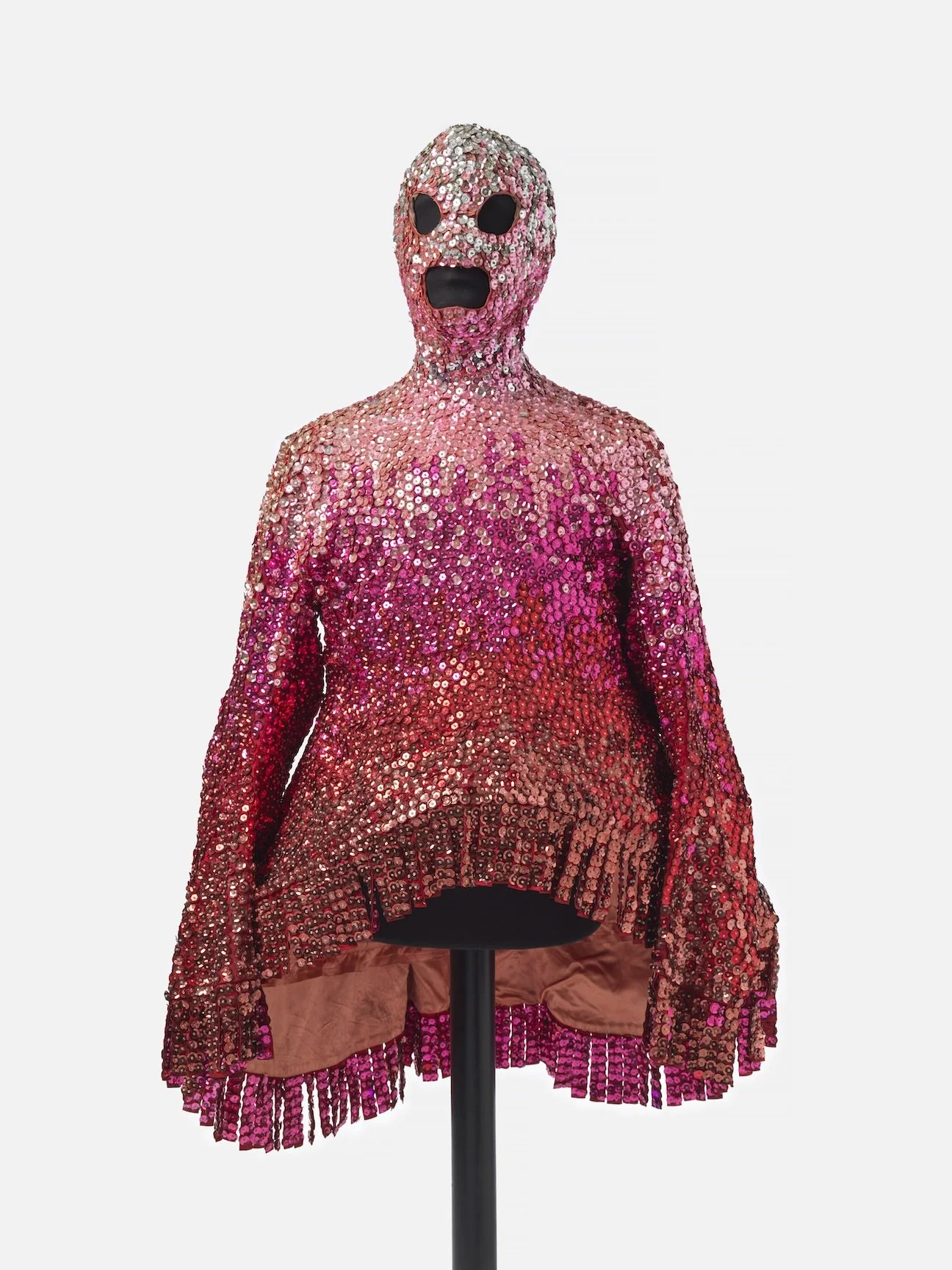
A piece from Leigh Bowery’s retrospective at the Tate Modern. © Tate Photography, courtesy the estate of Leigh Bowery.
Cheating Death
If things go out of fashion, yet fashion itself never does, then fashion becomes the one trend immune to its own logic—always vanishing, always returning, and always, somehow, in style. How exactly does fashion conjure the new—and, in doing so, cheat death? For Benjamin, it is not an act of divine creation but a worldly metamorphosis, a kind of profane alchemy through which the discarded and the outmoded are transfigured into the signs of the now. This same aspiration for renewal animates the course of a psychoanalytic cure: the forgotten past is transformed into the possibility of a new future.
We see this idea of change as a kind of rebirth most vividly in Bowery. Trained in fashion design in his native Australia, he began on the margins—not as a gallery artist but as a club figure. (He died prematurely, of AIDS complications, at 33.) Yet Bowery was a meticulous craftsman, an expert pattern-cutter. After moving to London, he sold designs to boutiques and, in 1982, unveiled his first “total looks” during London Fashion Week. His costumes evolved into performances involving body fluids and the staging of pregnancy, giving birth to his wife and collaborator, Nicola Bateman, onstage. There were defiant acts, such as the notorious performance at an AIDS benefit, when he administered himself an enema and sprayed the audience with the water. After the ensuing uproar, he wrote in his diary with bleak candor: “Hungover, depressed, full of regrets. No money.”
Owens exercises a more restrained but still transgressive creative freedom, drawing on a wide constellation of references—from brutalist architecture to modern art to early Hollywood cinema—and has become one of the most fearless and visionary designers of our time. His 1998 first full collection, titled “Monsters,” announced his arrival. He mixed wild monkey fur with acetate, rayon, and silk. With that gesture, Owens staked his ground in fashion’s mythology of the monstrous: the beautiful misfit, the elegant aberration. (See Listening to Monsters below.)
Lucha Libre
In my clinical practice, I take notice of analysands who describe a peculiar experience of embodiment—a sense that the body can slip away from the self, like a wrapping that doesn’t quite fit. Their testimonies remind me that having a body is never simple. Even our language gives us away. We say, “I have a body,” as though it were something we owned, an accessory. There’s already a distance in that phrase—an uneasy possession that echoes, almost comically, “I have nothing to wear.” The body is not simply being—it is having. And that “having” is never secure.
Let me arrive at my conclusion with a brief clinical vignette—the one that inspired the title of this essay.
James is a Mexican American 16-year-old who identifies as transmasculine and was referred to me for depression. Born and raised in the United States, he speaks Spanish at home, but English is his preferred language—the one in which our sessions unfold. He likes math and science, though his grades tell a different story. Concentration eludes him; studying feels impossible. Most afternoons, he disappears into his bedroom, watching “whatever” online or slipping into the fugue of video games. His affect is flat, his energy depleted.
Except when he talks about wrestling.
Then something flickers back to life. His voice sharpens, his posture straightens. Wrestling, James tells me, is nothing like the rest of his day. It demands precision, discipline; it’s a place where mistakes turn into lessons, where you rely on yourself but the team still holds you up. And James is good—exceptionally so. During the season, he practices five or six days a week, folding extra training into whatever time he can steal for himself.
Wrestling also carries the thrum of inheritance. His family comes from a tradition shaped by lucha libre, Mexico’s flamboyant blend of sport and spectacle—more than wrestling, really, a form of theatrical combat that has been part of the national imagination since the early twentieth century.
Before his transition, James competed in a women’s wrestling league, known for his skill, precision, and sheer determination. Now he wants to join a men’s team—not the division that corresponds to the gender assigned at birth.
But here’s the dilemma: Among the women, he was one of the best; among the men, his performance is only average. And so he hesitates—uncertain, suspended between categories that promise clarity but deliver confusion.
This decision, which should have been liberating, has instead unsettled him. It has forced him to ask, not rhetorically but with quiet anguish, “Am I a man—or a masculine woman?”
He doesn’t know yet. He’s still wrestling—with his opponents, with the law, and with himself. Psychoanalysis has become the space where these questions can reverberate, where their echoes begin to take shape.
And here’s what I’ve learned from him, and from so many others: Having a body is never simple. It’s not a given—it’s a struggle. It’s a kind of wrestling match between being and having, between the flesh we inhabit and the self that seeks to claim it. You can’t learn to wrestle by thinking about it. You have to do it—again and again—until it becomes instinct, until it becomes reflex.
And if, as Judith Butler reminds us, gender itself is a doing, then we, too, become our gendered selves through repetition—again and again and again—until it feels natural, until it becomes reflex.
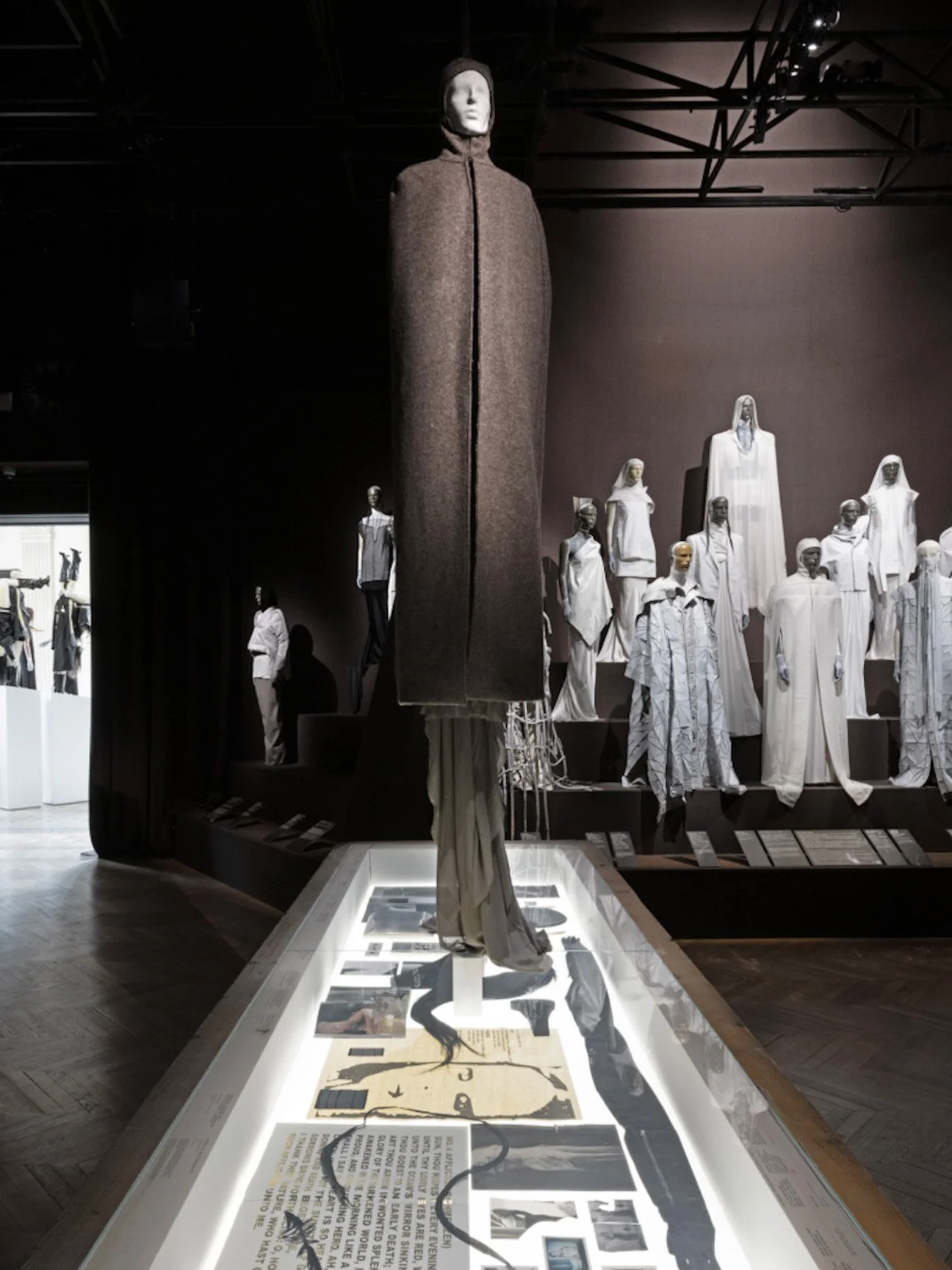
Rick Owens’s “Temple of Love” exhibition. © Palais Galliera Paris Musées, photo by Gautier Deblonde.
Ego Scriptor
While commenting on the work of the British psychologist J. C. Flügel—so brilliantly revisited by Valerie Steele in her latest book—Jacques Lacan discusses fashion. For Lacan, each of us both desires and fears that forbidden kernel of experience around which our psychic life turns. To keep it at bay, we build defenses—a whole symbolic wardrobe made up of language, customs, institutions. Civilization itself is a kind of fabric, Lacan says. We cut holes in it for our heads and arms to pass through—and that’s how the subject takes form. “The person,” he writes, “begins to organize himself as clothed.”
Our identities are stitched into that cloth. They shift with the seasons, with the fashions. Identity isn’t pure freedom—it’s creative play within this symbolic machinery, woven from threads that come before and beyond us. Anticipating Roland Barthes, Lacan muses on Adam and Eve and their sudden awareness of nakedness. “Textile,” he remarks, “is first of all a text.”
From my experience with trans analysands, I’ve come to see that hormonal or surgical transformation alone does not complete a transition. As I proposed back in 2010, the practices of trans people point us toward what I call a body written. In many cases, corporeal reconstruction must be followed by an act of authorship. An ego scriptor—a writing self—needs to intervene, to reclaim the body and craft a livable life. Embodiment is like a sport in which one is never quite sure to be in the right category—or even in the right league.
It is also a craft. Not a form of high art but a kind of know-how—a practiced wisdom, a choreography of new moves, resourcefulness, improvisation. A whole art.
Psychologically speaking, the body is an image: the self made visible, projected onto a surface. That image inevitably falters, comes undone. Yet it can be reconstituted through writing. Think of the many memoirs of gender transition that do precisely this—each one an effort to give the author a new face, a new coherence. Through writing, the subject as author fashions a home within the transformed body.
Listening to Monsters
The word “monster” comes from the Latin monstrum—meaning “a warning,” or “a divine omen.” It derives from monere, to warn, to instruct. In the ancient world, the appearance of a monster didn’t simply evoke terror—it signaled revelation. It was a message from the gods that something extraordinary had broken through the ordinary, that the boundaries of the possible had shifted, and that we should, quite literally, take notice.
The figure of the monster is reclaimed by the historian Susan Stryker, who, in a 1994 essay, turned to “Frankenstein” to describe the trans experience in a performance piece. Stryker writes that during the initial 1993 performance she stood at the podium wearing genderfuck drag—combat boots, threadbare Levi 501s over a black lace bodysuit, a shredded Transgender Nation T-shirt with the neck and sleeves cut out, a pink triangle, quartz-crystal pendant, grunge-metal jewelry, and a six-inch-long marlin hook dangling around her neck on a length of heavy stainless-steel chain. She decorated the set by draping her black leather biker jacket over her chair at the panelists’ table. The jacket had handcuffs on the left shoulder, rainbow freedom rings on the right-side lacings, and Queer Nation–style stickers reading “sex change,” “dyke,” and “fuck your transphobia” plastered on the back.
Fashion carries profound importance for members of the transgender community, extending far beyond mere material items. It represents the pivotal first step in harmonizing external presentation with identity. Primarily, fashion serves as a language to experiment, to search, and eventually to convey identity. RuPaul generalizes this experience when saying, “We are all born naked, the rest is drag.” While fashion emerges as a unifying force for anyone, cis or trans, particularly for those trans individuals who have grappled with aligning their sense of self with their bodies, fashion symbolizes a fresh start—a canvas to experiment with diverse looks and expressions until finding one that resonates.
Looking at the recent debates, I ask myself, “Why is the trans experience creating such strong backlash?” Is it because trans embodiment makes explicit a fact that Freud observed early on—that what constitutes masculinity or femininity is an unknown element which it is beyond the power of anatomy to grasp? We are fundamentally bisexual; our sexual identity may seem settled but in fact it is precarious, constantly fluctuating, as suggested by the Lacanian idea of mobile sexuation patterns. Jacqueline Rose observes that if the trans experience has brought anything irrevocably to the surface, it is that the question of what constitutes sexual difference—like the inner work of discovering one’s sexuality—is never finished, it remains perpetually ongoing. Yet, Rose notes, when trans persons are deprived of the right to define their gender, or are denied access to gender-affirming health care, or when gender-confirmation surgeries are prohibited, gender is treated as a fixed, absolute, stable category to which some people have access and others not.
Emphasizing identity, the trans experience is often attacked while neglecting the dimension of desire, which makes life livable. Andrea Long Chu considers transition not in terms of identity but of desire. She writes, “How can you want to be something you already are? Desire implies deficiency; want implies want. … [W]hat makes women like me transsexual is not identity but desire. …” Chu steers clear of the well-worn discourse of authenticity, imagining desire, in its nonarrival, as the engine that sets everything in motion. Desire, in her view, is the centrifugal force that spins gender outward.
As antitransgender laws are being introduced around the United States in record-breaking numbers, let’s keep in mind that the bodily transformation, the choice of a different gender from the gender assigned at birth, can become an act of creation, a re-naissance, a rebirth that makes life livable.
In Mary Shelley’s 1818 novel, Dr. Victor Frankenstein creates a monster out of body parts from freshly dead human bodies. Like the monster, Stryker says, she is often seen as less than fully human because of how her body came to be. And, like the monster, her exclusion from the human community generates a deep rage that Stryker transforms into self-affirmation and political agency: “In birthing my rage, my rage has rebirthed me.”
The philosopher Paul B. Preciado, who became well known by refashioning his body as a “testo junkie,” also takes up the figure of the monster—by way of Kafka. In 2019, he stood before an audience of 3,500 Lacanian psychoanalysts in Paris. The monster, speaking back. Demanding to be heard.
This essay is adapted from remarks given at the Museum at FIT’s Fashion and Psychoanalysis Symposium on November 14, 2025.
Patricia Gherovici is a psychoanalyst and author. A Sigourney Award recipient and three-time Gradiva Award winner, she is the author of The Puerto Rican Syndrome, Please Select Your Gender, Transgender Psychoanalysis, and coeditor of Psychoanalysis in the Barrios.
Potentially personally identifying information presented that relates directly or indirectly to an individual, or individuals, has been changed to disguise and safeguard the confidentiality, privacy, and data protection rights of those concerned.
Published December 2025